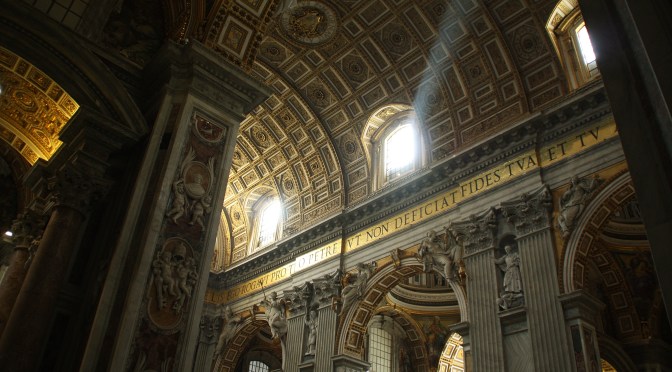
A Vatican conference rejects the Catholic church’s long-held teachings on just war theory, saying they have been used to justify violent conflicts and the global church must reconsider Jesus’ teachings on Gospel nonviolence.

A Vatican conference rejects the Catholic church’s long-held teachings on just war theory, saying they have been used to justify violent conflicts and the global church must reconsider Jesus’ teachings on Gospel nonviolence.
by Paul Alexander
Part 3 of 3
Only one person raced as Egyptian (White) exits Whiteness alive—Moses. Can people raced as White locate themselves in Moses’ narrative and escape? Moses was not raced as ‘White’ from his mother’s womb. He was raced by Whiteness as Other.
Continue reading Escaping Whiteness: Racing, Raising, and Razing Moses as White
An Interview with Dr. Drew G.I. Hart
by Micky ScottBey Jones
Dog-whistle politics. Protest in the streets. Changing religious norms. For many, there is trouble to be seen everywhere we look. In Trouble I’ve Seen: Changing the Way the Church Views Racism, author and theologian Dr. Drew Hart shares the racism he has observed in the American church and in the larger culture.
Continue reading Eyes to See: How We View Racism in the Church
by Paul Alexander
Part 2 of 8
It is well known that Israel’s exodus from Egypt is a central story for liberation movements, and it could be a way for people who have been raced by Whiteness as White to “inhabit the world beyond the theological problem of whiteness.”[1] I am inspired by African American biblical hermeneutics and the lyrics of slave spirituals that underline the resonances of exodus within enslaved Africans’ hearts and their hermeneutical freedom to identify the Egypt land with the US south.[2]
A Canadian city called Medicine Hat has now eliminated homelessness by giving the homeless homes. Utah is doing this as well – every homeless person gets a home and access to a social worker and a case worker who will help them getting a job, be intergrated in society and get mental health care if they need some. At first, the home is free, and if they get a job they’ll pay 30% of their income for the house.
Continue reading Ending Homelessness by Giving the Homeless Homes
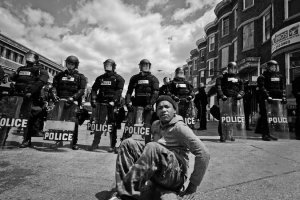
“Why do we discriminate? The big factor isn’t overt racism. Rather, it seems to be unconscious bias among whites who believe in equality but act in ways that perpetuate inequality.”

Part 1 of 8
by Paul Alexander
White American Christians need a liberation theology of their own to free them from the denial of their own past. White Amer-Europeans must courageously own their past—without guilt but with great intentionality—to change the present and the future.

“I could stand in the middle of Fifth Avenue and shoot somebody and I wouldn’t lose any voters.” -Donald Trump
by Paul Alexander
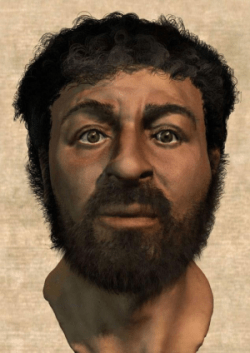
As you know, Jesus was not European or white. Jesus was Middle Eastern and Jewish, of African and Canaanite descent. Back in 2002 a forensic artist used Semite skulls found in Israel to reconstruct the face and head of what a first-century male from Palestine would most probably have looked like.



 PCPJ
PCPJ 