Tag Archives: pentecostalism

Francis, the Pope Who Combined Charismatic Spirituality with Peace and Justice

Pope Francis has departed this earthly life, leaving behind a legacy of uniting signs and wonders with peace and justice! He was both the most charismatic and activist pope the Catholic Church has had in hundreds of years.

In truth, this shouldn’t be an unusual combination – Jesus Himself united pacifism and economic equality with healing the sick and performing miracles. But in our time, there is often a dividing line between Christians passionate about peace and justice and those who emphasize the gifts of the Spirit. For Francis, however, all of this was one and the same.

Few have missed that Francis is a passionate advocate for peace and justice: he has criticized capitalism for neglecting the poor, he lives simply and promotes economic equality, he has prayed for peace in the Middle East both at the Western wall and at the West Bank wall. But what not as many know is that Francis also is a charismatic pope, who believes in Spiritual gifts and who blesses both the Catholic charismatic renewal and Pentecostals.

I have previously written about how Francis stated in an interview that the charismatic movement is necessary for the church. In 2014, pope Francis attended a Catholic charismatic renewal convention in Rome, where he said:

I expect from you that you share with all, in the Church, the grace of Baptism in the Holy Spirit.

I expect from you an evangelization with the Word of God which proclaims that Jesus is alive and loves all men.

I expect that you give witness of spiritual ecumenism with all those brothers and sisters of other Churches and Christian communities who believe in Jesus as Lord and Savior.

[…]

Be close to the poor, the needy, to touch in their flesh the flesh of Jesus. Be close, please!

Later the same year, Francis visited a Pentecostal church, being the first pope ever to do that. He asked for forgiveness for the hostility that some Catholics has shown to Pentecostals:

“Among those who persecuted and denounced Pentecostals, almost as if they were crazy people trying to ruin the race, there were also Catholics. I am the pastor of Catholics, and I ask your forgiveness for those Catholic brothers and sisters who didn’t know and were tempted by the devil.”

 “Someone will be surprised: ‘The pope went to visit the evangelicals?’ But he went to see his brothers.”

Similarly to the saint from which he took his name, Francis of Assisi, pope Francis loved the poor and experienced amazing miracles. Even if there are many things I don’t agree with when it comes to Catholic theology, I truly rejoice when I see how pope Francis walks in the same tradition, following Jesus both when it comes to Spiritual baptism and social justice.

Micael Grenholm is a Swedish church historian, author and an editor for PCPJ.

ska%cc%88rmavbild-2017-01-06-kl-21-17-02

Pentecostals & Charismatics for Peace & Justice is a multicultural, gender inclusive, and ecumenical organization that promotes peace, justice, and reconciliation work among Pentecostal and Charismatic Christians around the world. If you like what we do, please become a member!

Pentecostals Against Trumpism — Sign Our Statement!

Join your name to this statement below!

We who have signed this statement are Spirit-filled Pentecostal and Charismatic Christians who believe that the Bible is the Word of God and that Jesus is the Way, the Truth and the Life. Because of this, we refuse to vote for or support Donald Trump and his MAGA movement.

We do not feel that we need to compromise with or ignore our faith when we take a stance against Trumpism. On the contrary, it is precisely because of our commitment to the Lord Jesus Christ that we cannot in good conscience endorse Donald Trump and what he stands for.

The Demonization of Immigrants

At the center of our Pentecostal spirituality is the miracle of Pentecost, in which the Holy Spirit united people of various nations through the miracle of tongues. The modern Pentecostal movement has one of its origins at Azusa Street in Los Angeles in which a multi-racial group of Americans and immigrants were baptized in the Holy Spirit together.

Leviticus 19:33-34 clearly states that we should love immigrants as ourselves and treat them as natives. Treating immigrants with love and empathy is a core value of any Christian.

For these reasons, we are horrified when we see how:

Most of the migrants that Trump employ this hateful, vile rhetoric towards are Christians. And most of those he wants to deport to poor, war-torn countries are also Christians. As fellow Christians, we cannot stand behind this.

The Disrespect, Belittling and Criminal Abuse of Women

As Pentecostal and Charismatic Christians, we strive for holiness and to become more Christ-like in all that we do and say and want to support people of good character. Evangelical Christians used to be the ones that emphasized the importance of politicians’ personal morality the most – that has rapidly changed during the reign of Trump.

While we do not believe one has to be perfect to be a president, the Bible emphasizes the importance of good character in both political and spiritual leaders (Deuteronomy 17:17, 1 Timothy 3:2). In particular, greed and sexual immorality are sins that bring God’s wrath upon people as they are equal to idolatry (Colossians 3:5). Donald Trump abounds in these sins without being repentant which has even led to criminal convictions:

Notice that Trump has done all this while claiming to be a Christian and without ever apologizing for any of these acts towards women. He also said in 2015 that he has never asked God for forgiveness.

The Threat to Democracy

Pentecostal and Charismatic Christians have been pioneers for democracy around the world, since our conviction that the Holy Spirit can and wants to use anyone empowers them to make a difference for their lives and their communities. Jesus taught that we should do to others as we would have them do to us (Matthew 7:12) and that leaders should serve rather than rule as kings (Matthew 10:42-45). Thus, we believe that democracy is biblical while dictatorship leads to tyranny and oppression.

Donald Trump has become alarmingly authoritarian over time and researchers have found that Trumpism has made the Republican party more akin to authoritarian parties such as AKP in Turkey and Fidesz in Hungary. It has become increasingly clear that Trumpism is a threat to democracy:

Obviously, the fact that we view Trump as a threat to democracy does in no way legitimize or excuse the awful assassination attempts on Donald Trump’s life. As Christians, we reject all types of political violence. At the same time, we cannot stay silent about the threat to democracy that Trumpism forms in the light of all the evidence given above.

Conclusion

As Spirit-filled Christians, we affirm the inherent God-given value of all human beings and whole-heartedly oppose all hate and belittling towards migrants, women and minorities. Our primary loyalty is to Jesus Christ, not to a political party, and our faith remains in him. This is why we cannot embrace Trumpism and refuse to vote for Trump in this year’s presidential election.

Go back

Your message has been sent

Warning
Warning
Warning
Warning
Warning.

Charismania, COVID, and the 2020 Election

When Pentecostal/Charismatic Christianity emerged a century ago, many conservative Christians denounced the movement. Part of this was due to the egalitarian and counter-culture nature of the movement. Another part of it was that the incorporation of the gifts of the Spirit into worship seemed crazy – perhaps even demonic. At this point, Christians were mostly used to some variety of ordered worship, so when Charismatics came into church services and started speaking in tongues or dancing, it made a lot of people uncomfortable. They thought that Charismatic Christians were deceiving people and obstructing proper worship. A term was coined as an insult towards Charismatics – Charismania.

Charismania is commonly used as an insult to describe Charismatic Christians as unstable. People may perhaps see our prophetic visions, speaking in tongues, and claims of supernatural healings as delusional. It is a criticism of the Charismatic Movement that I know well.

While I do not think that Charismatic spirituality and worship are false, I must say that as a Charismatic looking into the wider world of Charismatic Christianity, we do have a serious problem. The movement has for a long time been infested with false doctrines such as end times theology, prosperity preaching, and cults of personality. The movement is also infested with false prophets, false healers, and con artists. And like the early church, the movement has been twisted in order to serve the empire. We have a very serious problem of not “testing the spirits” (1 John 4:1).

Continue reading Charismania, COVID, and the 2020 Election

Why Pentecostal Churches Managed to Fight COVID-19 Better than the United Nations

Why are many American Pentecostals disobedient regarding efforts to stop the spread of COVID-19? Are Pentecostals and Charismatics in other parts of the world behaving differently? How was the strong faith in healing that characterized early Pentecostals impacted by the pandemic known as the “Spanish Flu”?

A few weeks ago, PCPJ gathered a panel of scholars and Pentecostal leaders to discuss these important questions. The panel consisted of:

Jörg Haustein, doctor of World Christianities, University of Cambridge.
Erica Ramirez, president of PCPJ, director of applied research, Auburn Seminary.
Daniel Isgrigg, director for the Holy Spirit Research Center, Oral Roberts University.
Niclas Lindgren, director, PMU Interlife.
Andrea Johnson, Assistant Professor of History, California State University DH.
Micael Grenholm, pastor, editor at PCPJ.

Everybody brought interesting food for thought to the table. Isgrigg compared Pentecostal reactions to the Spanish Flu with what we see today. Ramirez spoke about what aspects of the Pentecostal faith makes it vulnerable to conspiracy theories. Haustein pointed to the nuance between different Pentecostal and Charismatic groups even in the same country. Johnson gave a historical backdrop to how American Pentecostals view politics.

Continue reading Why Pentecostal Churches Managed to Fight COVID-19 Better than the United Nations

Biblical Prosperity: Why the Prosperity Gospel Is Wrong

My grandmother and aunt were both charismatics, and they worked at the local Christian television station. There were many times when I was growing up that I would watch that television station simply out of curiosity. This was before I became a committed Christian, and some of the theology that I saw on this station seemed very strange to me. It was through this television station that I was first introduced to the Prosperity Gospel.

I came across many shows featuring Mike Murdock, Rod Parsley, Jesse Duplantis, and Joel Osteen. I distinctly remember being turned away by their preaching. I was a big fan of Jesus at the time, but I wasn’t comfortable with Christianity. And they were a big reason why. I remember seeing their fame and fortune, and I had a very difficult time reconciling that with the poverty and humility I read about in the Gospels.

Unfortunately, for the last one hundred years or so, the American Church has become captivated by the Prosperity Gospel. This has especially been the case within Pentecostal and Charismatic churches. Continue reading Biblical Prosperity: Why the Prosperity Gospel Is Wrong

Black Lives Must Matter: A Historical Pentecostal Response

by U-Wen Low, originally published here, reposted with permission.

Many Pentecostal Christians have been divided in how to respond to recent events. The rallying cry for most (as it has been for years) is “Black Lives Matter,” a statement which shocks us with its brazenness; it highlights the fact that African-American lives in particular are at disproportionately high risk in the United States, and has forced many of us to consider our own nations’ treatment of African-American and First Nations people.

Given the complexity of the issues, it can be extraordinarily difficult to formulate a coherent, careful response – so many of us have stayed silent.

However, it is imperative for the people of God to respond, and indeed many church organisations have already added their voices to the conversation. How, then, should Pentecostals seek to respond to these issues in a Godly way, led by the Holy Spirit?

Let us do so by reminding ourselves of the history of our movement. Like many such reflections, we begin in Acts, where the Holy Spirit falls with tongues of fire upon men and women, Jew and Gentile, causing no small amount of controversy.

The early church is prompted by the Spirit to challenge both injustice and domination; throughout the narrative of Acts, we see the early Christians (an underprivileged minority group) given agency through the Spirit, fighting persecution through acts of love and kindness – and solidarity with the poor and oppressed, to the point of martyrdom.

Of course, let us not forget that Jesus himself died alongside criminals, viewed as a criminal and disproportionately punished, murdered by an oppressive system. Continue reading Black Lives Must Matter: A Historical Pentecostal Response

The Forgotten Origin of Pentecostalism Among Women in India

I used to think that Pentecostalism started with the Azusa Street revival in Los Angeles 1906, preceded by events at Charles Fox Parham’s Bethel Bible College in Kansas 1901. From the US, Pentecostalism then spread rapidly across the world, impacting Africa, Europe, Asia and Latin America so that it became the global phenomenon we know of today.

I know realize that I was severely wrong.

To be fair, the Azusa revival had a tremendous impact and is surely among the roots of Pentecostalism. But it’s not the only one. In fact, it is not the earliest. Frank Bartleman, one of American Pentecostalism’s most important pioneers (and a pacifist), acknowledged that “The present world-wide revival was rocked in the cradle of little Wales. It was ‘brought up in India, following; becoming full-grown in Los Angeles later.” While the Welsh revival was quite different than what Pentecostalism became known for, the Indian revival wasn’t.

Contrary to Bartleman, I would describe what they experienced as just as full-grown as Azusa. It also managed to remain much more egalitarian and racially inclusive, something American Pentecostalism ultimately failed at as the revival grew older.

ramabai
Pandita Ramabai teaching girls about the Gospel and their rights.

A key leader in the Indian revival was Pandita Ramabai, a theologian and women’s rights activist who translated the Bible into Marathi and started a community center for women and girls, Mukti Mission in Pune, while campaigning politically for women’s education and an end to British colonial rule. She was baptized in the Spirit in 1894, and the women at Mukti started to speak in tongues, prophesy and heal the sick long before William Seymour and his fellow believers even had access to the chapel on Azusa Street.

Pentecostal scholar Allan Anderson points out in the first chapter of his book To the Ends of the Earth that the Mukti revival had a huge impact in the region. Minnie Abrams, an Episcopalian missionary who joined Mukti and worked with Ramabai for many years, wrote a booklet called The Baptism of the Holy Ghost & Fire in 1906 which is likely the first published Pentecostal theology of Spirit baptism. 30,000 copies of it circulated during the early 1900s and influenced May Louise Hoover, who led the Pentecostal revival in Chile together with her husband Willis.

Another acquaintance of Ramabai, Shorat Chuckerbutty, was the one who prayed for Alice Luce when she received her Spirit baptism. Luce, who was a missionary in India at the time, went on to spread Pentecostalism in the southern US and in Mexico, pioneering the concept of indigenous churches that became very influential in Pentecostal missions.

Anderson also points out that the Christian Pettah revival led by John Christian Arulappan experienced “outpourings of the Spirit” with prophecy, healing and speaking in tongues as early as the 1860s in southern India. Ironically, the Brethren church which Arulappan belonged to later became hostile towards Pentecostalism, but phenomenologically they had experienced the same thing before Pentecostalism existed, according to Anderson.

Anderson goes on to point out that similar pentecostal-type movements sprung up in England, Estonia, Korea, China and Liberia with hardly any input from Azusa. Christians in Russia and Armenia experienced Spirit baptism and tongue-speaking as early as 1855, and were dubbed “Pentecostal Christians” by their countrymen fifty years before Azusa was a thing!

Long story short: Pentecostalism does not have one root, it has many. Just like the gift of tongues, the Pentecostal revival is truly an international miracle. And from the very beginning, God used women just as much – and sometimes even more – than men.

Micael Grenholm is a Swedish pastor, author and editor for PCPJ.

ska%cc%88rmavbild-2017-01-06-kl-21-17-02Pentecostals & Charismatics for Peace & Justice is a multicultural, gender inclusive, and ecumenical organization that promotes peace, justice, and reconciliation work among Pentecostal and Charismatic Christians around the world. If you like what we do, please become a member!

Luther’s Failure and the Success of Pentecostalism 

German reformer Martin Luther is often heralded as the founder of Protestantism and one of the most influential Christians ever. Historian Bernd Moeller has even described him as the most influential European who ever lived, with millions of followers and a massive readership, his reformation project has had an overwhelming success – even though it ultimately failed to reform the Roman-Catholic church.[1]

However, this notion has recently been challenged by other historians. Hartmut Lehmann writes in his contribution to Radicalism and Dissent in the World of Protestant Reform, an anthology on the so-called radical reformation:

True, Protestantism has become a major world religion, with congregations on all continents. In the course of the twentieth century, however, not all branches of the Protestant family grew at the same rate. In Europe and North America, Lutheran churches, that is the churches directly descending from the German reformer, stagnated. Some are in decline, like many other mainstream churches. In contrast, the various branches of Baptist churches blossomed and attracted many new members, and so did numerous Pentecostal churches.

In Africa and some parts of Asia, in particular, congregations that can best be described as charismatic, fundamentalist, or evangelical (I am aware that all of these terms are disputed), are strong and vibrant. While Europe’s traditional Protestant churches are afflicted by progressive secularization, the much younger Protestant churches in the southern hemisphere experience vitality, and their leaders speak of unheard blessings.

In looking at what the British-American historian Philip Jenkins, in his book The Next Christendom, has called ‘The Coming of Global Christianity’, one may ask what has become of Luther’s heritage and what of his theological legacy. Luther never accepted the baptism of adults and was among the fiercest opponents of the early Baptist movement. Furthermore, Luther strongly rejected any kind of charismatic or emotional religious performance. For him, those who believed that they should follow sensational inspirations, were nothing but enthusiasts who could not be trusted.

However, not in the early years of the Protestant Reformation, but over the centuries, these unreliable enthusiasts have succeeded in unforeseen ways. By the twentieth century, ‘Martin Luther’s unruly offspring’ could proudly claim ‘mass’ success, or ‘Massenerfolg’, to use Bernd Möller’s phrase.[2]

Continue reading Luther’s Failure and the Success of Pentecostalism 

The International Miracle of Pentecost

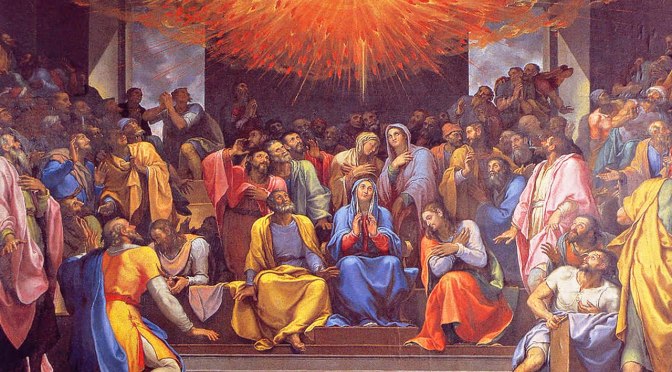
Happy Pentecost! This weekend, millions of Christians all across the globe are celebrating the baptism of the Holy Spirit and the birth of the apostolic church. Pentecost has always been very important for me, since the apostolic Pentecost as it is described in Acts 2 combines everything I like: charismatic fire, economic redistribution, universal evangelism as well as simplicity, worship and joy.

It all started when the wonderful Holy Spirit descended with fire and the international gift of tongues:

When the day of Pentecost came, they were all together in one place. Suddenly a sound like the blowing of a violent wind came from heaven and filled the whole house where they were sitting. They saw what seemed to be tongues of fire that separated and came to rest on each of them. All of them were filled with the Holy Spirit and began to speak in other tongues as the Spirit enabled them.

Now there were staying in Jerusalem God-fearing Jews from every nation under heaven. When they heard this sound, a crowd came together in bewilderment, because each one heard their own language being spoken. Utterly amazed, they asked: “Aren’t all these who are speaking Galileans? Then how is it that each of us hears them in our native language? (Acts 2:1-8, NIV)

In my experience, this is quite a common miracle. When the early Pentecostals met at the Azusa Street revival in Los Angeles to enjoy the restoration of Spirit baptism, many claimed that people actually started to speak real languages. In the October issue 1906 of The Apostolic Faith, the official publication of the Azusa Street church, the following article is included:

Sister Hutchins has been preaching the Gospel in the power of the Holy Spirit. She has received the baptism with the Holy Ghost and the gift of the Uganda language, the language of the people to whom she is sent. A brother who has been in that country understands and has interpreted the language she speaks. Her husband is with her and her niece, who also has been given the African language.

Continue reading The International Miracle of Pentecost

Few but Pentecostals Realized that World War One was Pointless

This year marks the 100th anniversary of the end of the ”War to End All Wars”: World War One. It directly killed nine million combatants and seven million civilians. Furthermore, it contributed to the spread and severity of epidemics that killed an additional 100 million people.

And here’s the really embarrassing part: with few exceptions, WW1 was a war in which Christians killed other Christians. Catholics fought other Catholics; Protestants fought other Protestants. People who claimed to follow Jesus slaughtered their supposed brothers in the trenches because their leaders – many of which claimed to have been appointed by God – ordered them to.

Madness. Utter, disgraceful madness.

As time went on and more people died without breaking the stalemate of the conflict, many started to protest. In fact, one of the reasons the war ended in 1918 was that soldiers and civilians alike criticized their own governments for continuing the pointless fighting. But many were late in the game. Christian pacifists criticized WW1 long before it was cool: and many of them were Pentecostals.

Skärmavbild 2018-11-19 kl. 14.58.42

The Weekly Evangel, the official evangelistic magazine of the Assemblies of God, stated in 1917:

From the very beginning, the movement has been characterized by Quaker principles. The laws of the Kingdom, laid down by our elder brother, Jesus Christ, in His Sermon on the Mount, have been unqualifiedly adopted, consequently the movement has found itself opposed to the spilling of the blood of any man, or of offering resistance to any aggression. Every branch of the movement, whether in the United States, Canada, Great Britain, or Germany has held themselves to this principle.

When the war first broke out in August of 1914, our Pentecostal brethren in Germany found themselves in a peculiar position. Some of those who were called to the colors responded, but many were court marshaled and shot because they heartily subscribed to the principles of non-resistance. Great Britain has been more humane. Some of our British brethren have been given non-combatant service, and none have been shot down because of their faith.

In the same year, Arthur Sidney Booth-Clibborn who was a Pentecostal leader and grandson of the founders of the Salvation Army, wrote:

Find me in the New Testament where Christ ever sent His followers on such a mission? On the contrary He sent them out to save men—not to butcher them like cattle. . . . No! as far as the Christian is concerned, the “eye for an eye” system has given place to the “Turn to him the other cheek also” of Matt. 5:39-44.

And A. J. Tomlinson, first general overseer of the Church of God of Prophecy, wrote in early 1918:

I could not take a gun and fire it at my fellow men even at the command of a military officer. I could submit to the penalty inflicted upon me for refusing, but I cannot kill. I doubt if I could take the obligation to become a soldier in the first place.

Pacifism is often labeled naive or short-sighted, but in this case the pacifist Pentecostals were able to see the truth through all the patriotic war-mongering around them, thanks to them sticking to Jesus’ commitments in the Sermon on the Mount.

World War One was an idiotic catastrophe of Christians killing Christians. Our Spirit-filled ancestors refused to play that game.

Read more about early Pentecostal pacifism here.

Micael Grenholm is editor-in-chief for PCPJ.

Enter your email address to subscribe to this blog and receive notifications of new posts by email.

ska%cc%88rmavbild-2017-01-06-kl-21-17-02Pentecostals & Charismatics for Peace & Justice is a multicultural, gender inclusive, and ecumenical organization that promotes peace, justice, and reconciliation work among Pentecostal and Charismatic Christians around the world. If you like what we do, please become a member!