Few but Pentecostals Realized that World War One was Pointless

This year marks the 100th anniversary of the end of the ”War to End All Wars”: World War One. It directly killed nine million combatants and seven million civilians. Furthermore, it contributed to the spread and severity of epidemics that killed an additional 100 million people.

And here’s the really embarrassing part: with few exceptions, WW1 was a war in which Christians killed other Christians. Catholics fought other Catholics; Protestants fought other Protestants. People who claimed to follow Jesus slaughtered their supposed brothers in the trenches because their leaders – many of which claimed to have been appointed by God – ordered them to.

Madness. Utter, disgraceful madness.

As time went on and more people died without breaking the stalemate of the conflict, many started to protest. In fact, one of the reasons the war ended in 1918 was that soldiers and civilians alike criticized their own governments for continuing the pointless fighting. But many were late in the game. Christian pacifists criticized WW1 long before it was cool: and many of them were Pentecostals.

Skärmavbild 2018-11-19 kl. 14.58.42

The Weekly Evangel, the official evangelistic magazine of the Assemblies of God, stated in 1917:

From the very beginning, the movement has been characterized by Quaker principles. The laws of the Kingdom, laid down by our elder brother, Jesus Christ, in His Sermon on the Mount, have been unqualifiedly adopted, consequently the movement has found itself opposed to the spilling of the blood of any man, or of offering resistance to any aggression. Every branch of the movement, whether in the United States, Canada, Great Britain, or Germany has held themselves to this principle.

When the war first broke out in August of 1914, our Pentecostal brethren in Germany found themselves in a peculiar position. Some of those who were called to the colors responded, but many were court marshaled and shot because they heartily subscribed to the principles of non-resistance. Great Britain has been more humane. Some of our British brethren have been given non-combatant service, and none have been shot down because of their faith.

In the same year, Arthur Sidney Booth-Clibborn who was a Pentecostal leader and grandson of the founders of the Salvation Army, wrote:

Find me in the New Testament where Christ ever sent His followers on such a mission? On the contrary He sent them out to save men—not to butcher them like cattle. . . . No! as far as the Christian is concerned, the “eye for an eye” system has given place to the “Turn to him the other cheek also” of Matt. 5:39-44.

And A. J. Tomlinson, first general overseer of the Church of God of Prophecy, wrote in early 1918:

I could not take a gun and fire it at my fellow men even at the command of a military officer. I could submit to the penalty inflicted upon me for refusing, but I cannot kill. I doubt if I could take the obligation to become a soldier in the first place.

Pacifism is often labeled naive or short-sighted, but in this case the pacifist Pentecostals were able to see the truth through all the patriotic war-mongering around them, thanks to them sticking to Jesus’ commitments in the Sermon on the Mount.

World War One was an idiotic catastrophe of Christians killing Christians. Our Spirit-filled ancestors refused to play that game.

Read more about early Pentecostal pacifism here.

Micael Grenholm is editor-in-chief for PCPJ.

Enter your email address to subscribe to this blog and receive notifications of new posts by email.

ska%cc%88rmavbild-2017-01-06-kl-21-17-02Pentecostals & Charismatics for Peace & Justice is a multicultural, gender inclusive, and ecumenical organization that promotes peace, justice, and reconciliation work among Pentecostal and Charismatic Christians around the world. If you like what we do, please become a member!

Why Should Pentecostals Care about Climate Change?

by Joel Daniels. Originally posted at Engaged Pentecostalism.

It was widely reported last week that the UN Intergovernmental Panel on Climate Change presented new research that says we humans have just over decade to change the way we consume energy or the detrimental effects will be irreversible. In an era where apocalyptic-style news is commonplace, this story has not received the space that it is due.

Indeed, we must ask ourselves some questions. First, why do so many people of faith, particularly Pentecostals, continue to refute the reality of climate change? Second, do we have a moral obligation to fix the ecological problem that we created? And third, what can we, as individuals, even do?

1 Climate Change

According to surveys, disbelief in climate change rose 7% between 2013 and 2014, and for those that can at least acknowledge that temperatures and sea levels are rising, white Evangelicals are the least likely among their Christian sisters and brothers to claim that it has anything to do with human activity.

What is perhaps most disheartening is that the more people go to church the less likely they are to take responsibility for this planetary crisis. How can that be? Continue reading Why Should Pentecostals Care about Climate Change?

Finding A Christian Response to Migrants

I’ve listened to the political dialogue around how our nation should respond to migrants, asylees and refugees and have noticed the assumptions that we begin with and how those assumptions form our responses. I want to talk about that in this blog post because who we think migrants are shapes how we respond to them. In addition, how we think about migrants shapes the policy discussions that we have. And then I want us to reflect on whether or not our assumptions reflect our faith and how we might consider seeking a truly Christian response to this crisis.

Our beginning assumptions shape how we see:

If we begin with the assumption that migrants or refugees are a threat to our way of life–our culture, if they are a threat to our jobs, if they are a threat to our faith or if they are a threat to our well-being, if they are a threat to our social strength, then we must create policy and enact various security measures to protect ourselves.  If we think of migrants as invaders, then we would need to use military force to protect ourselves from an invasion.  That is the logical flow from our assumptions to our actions.

If our beginning point regarding migrants and refugees is that all of those heading to our borders are criminals coming to harm us, then we must of course stop them from coming into our country at all costs.  Naturally we would not want more violent people or drug dealers. Continue reading Finding A Christian Response to Migrants

The Trump Tragedy: What Some Evangelicals of Color See that Most White Evangelicals Don’t

by Elizabeth D. Rios.

Almost every Evangelical knows what the 81% means when talking about politics. Nothing more actually needs to be said in many cases because most on both sides of this political discourse know. If you are reading this and you don’t know, where have you been? That percentage represents the 81% of white evangelicals who voted for Trump in the 2016 election. Others state that 35%-45% of all evangelicals voted for Trump. And still others debate if it was 81% at all. At the end of the day, it does not really matter the exact number because what we are seeing in America is that too many Evangelicals voted for Trump knowing all he represented BEFORE going to the polls.

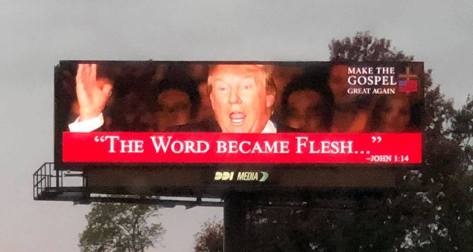
What white evangelicals saw (and continue to see) in Trump is a hero. Some even have referred to him recently as Jesus Christ himself with a billboard ad that stated “the Word became flesh” (verified here for those who can’t believe anything negative). THAT is scary!

blasphemy.jpg

They see him as the hero that will be the one to slow the growth of diversity (specifically brown taking over America although Brown as in Latinos is the majority in the U.S. already), slow the shrinking role of religion (because in no way does legislating public and private behavior even for non-Christians look like the Taliban) and here’s the biggie reversing Roe vs. Wade, which if can accomplish that, he will be delivering on an evangelical dream that five Republican presidents, including Ronald Regan could not deliver. All this is mesmerizing for white evangelicals so much so that they are willing to do (and have done) anything to get these deliverables, even if they have to sell their soul to do it. Which they have also done.

For many (not all) evangelicals of color, Trump is simply a tragedy in American politics. At first no one took this reality star seriously but then a shift occurred, a racist base was rallied and a biblically illiterate and/or privileged white evangelical community aligned with his agenda and well, the rest is history.

Continue reading The Trump Tragedy: What Some Evangelicals of Color See that Most White Evangelicals Don’t

All Christians Are Refugees

Most believers are aware of the Bible telling us that we are citizens in Heaven (Phil 3:20) as well as foreigners and strangers on the earth (Hebrews 11:13). But did you know that it also says that we are refugees?

“we who have fled to take hold of the hope set before us may be greatly encouraged.” – Hebr 6:18

The Greek word for “fled” is kataphygontes, which more explicitely means “having fled for refuge”. All Christians have fled from death, evil and sin and entered the safe refuge of the Lord.

This is also expressed earlier in the same letter:

“[Jesus] too shared in [our] humanity so that by his death he might break the power of him who holds the power of death—that is, the devil— and free those who all their lives were held in slavery by their fear of death.” (Hebr 2:14-15).

We are liberated from the deadly claws of satan and enjoy the security and asylum that Jesus’ Kingdom brings. Think about it: if you are saved, you have escaped the most horrible state imaginable and entered the most glorious state in existence. Isn’t that amazing?

When encountering refugees, we have to put ourselves in their shoes. What pains and struggles are they going through? What are they seeking salvation from? In what ways are our spiritual journey similar to their literal journey?

We must never forget that Jesus Christi Himself was a refugee as a baby (Mt 2:13-15). Let us also consider that we ourselves are refugees, and that this is part of our core identity as believers. This should not just produce more understanding for refugee’s situation, but compassion and love as well.

Micael Grenholm is editor-in-chief for PCPJ.

Enter your email address to subscribe to this blog and receive notifications of new posts by email.

ska%cc%88rmavbild-2017-01-06-kl-21-17-02Pentecostals & Charismatics for Peace & Justice is a multicultural, gender inclusive, and ecumenical organization that promotes peace, justice, and reconciliation work among Pentecostal and Charismatic Christians around the world. If you like what we do, please become a member!

A “Caravan” of God’s Beloved

It is so disheartening and sorrowful to see the hateful rhetoric directed towards refugee that the US president and his supporters are passionately spreading. Refugees are described as violent invaders, and the president wants to send soldiers to possibly shoot at them. There is so much hate and fear, caused by Christian refugees.

Jesus and his parents were refugees once. Hated by political leaders. Forcefully removed from their home.

JoseyMaria.jpg
José y Maria by Everett Patterson.

The Bible commands us: “Share with the Lord’s people who are in need. Practice hospitality.” (Romans 12:13). The “caravan” that the media talks about is a group of about 7,000 refugees who flee from violence and persecution. The UN reports:

Eduardo, a sixteen-year-old from Honduras, told UNHCR that the gang violence in his hometown of Colon had become so intense, he felt he had no other option but to leave the country.

Describing his reaction after gang members torched his family home, he said, “When I saw our house burning, I knew out number had been called, our luck had run out, it was time to flee.”

These are people loved by God. Jesus died for them so that they will have life. Hate, fear and closed borders will not express the love of Christ towards them. Only Biblical hospitality will.

Micael Grenholm is editor-in-chief for PCPJ.

Enter your email address to subscribe to this blog and receive notifications of new posts by email.

ska%cc%88rmavbild-2017-01-06-kl-21-17-02Pentecostals & Charismatics for Peace & Justice is a multicultural, gender inclusive, and ecumenical organization that promotes peace, justice, and reconciliation work among Pentecostal and Charismatic Christians around the world. If you like what we do, please become a member!

Jesus was Homeless: A Kingdom Approach to Anti-Homeless Legislation

Originally posted at the Vineyard Justice Network. Check out their website for loads of inspiration on how we can promote social justice as charismatic Christians!

What is a Kingdom approach to thinking about anti-homeless legislation? How should we navigate the ethics of state and/or city laws that make feeding the homeless or sleeping in your car illegal? Should the fact that we worship a homeless man on Sundays make any difference?

Evan B. Howard is a spiritual director, professor of Christian Spirituality, and former Vineyard church planter. He shares his helpful Kingdom perspective on these questions, as well as why he’s advocating for Colorado to pass the Right to Rest bill on March 14.

HOMELESS RIGHTS: A CHRISTIAN CASE FOR THE SUPPORT OF COLORADO’S RIGHT TO REST

BY EVAN B. HOWARD

Every night, people–many people in Colorado–try to sleep outside. Homelessness is a simple fact, not only nationally, but also locally. Let’s take Denver, for example. No matter how you do the math–counting homeless persons and shelter beds available–there are at least a thousand people every night who must sleep outside in Denver.1

imageMost of us do not really notice many of our simple acts of physical survival. We pull up the covers when it gets cold. We get up and relieve ourselves in our bathrooms, rooms which we also use for hygiene purposes. We prepare our meals in kitchens and eat them in dining rooms. We store our possessions in houses or apartments. But what if we do not have access to these rooms, these “private” places? If private places are unavailable, we are obliged to perform these basic acts of survival in “public” places. We sleep on streets or under bridges or in a vehicle, near to light if possible to ensure safety. If commercial establishments allow only customers access to restrooms, we are obliged to relieve ourselves in alleys. We store (hide) our possessions in a small thicket of bushes in a city park. We gratefully receive food given to us wherever it may be offered. We do what we must to survive.

Continue reading Jesus was Homeless: A Kingdom Approach to Anti-Homeless Legislation

Why Are We To Choose Between Healing the Sick and Caring for the Environment?

39957113_10156987272091535_5137720770889252864_o.jpgby Vincent Mossberg.

We Christians believe that God is the creator of the world. In Genesis 1:28, God gives mankind the original plan for our existence – to be fruitful and multiply – but also to have dominion and stewardship over the animals and the earth that God has given to us. God is generous in character and by nature good, and He made us free and responsible. So what? How should we humans then steward the earth?

An analogy that for me has become a symbol for the lack of stewardship is the deprivation of the blue whale population. The blue whale is the largest creature that we have seen and identified on the earth, even larger than the largest known dinosaur. Yet they are so shy that whenever they see humans, they dive into the depths of the sea. Also, we don’t know where they give birth or really much about them.

In the beginning of the twentieth century there were 400,000 blue whales in the ocean, but today there are only 10,000 left because of whale hunting. Yes, species have always gone extinct, but today the extinction rate is a thousand times faster than before the time of man. Within the freedom that we have been given, these things are possible, but they are not responsible. Might these be examples of mankind straying away from our original purpose? Continue reading Why Are We To Choose Between Healing the Sick and Caring for the Environment?

Should Women Be Pastors? A Brief Biblical Defense

While great strides have been made towards gender equality in church leadership, a staggering segment of churches still subscribe to a narrow view that permits females only certain opportunities to exercise the call of God on their life.  Women may exercise authority over children and other females in the Western church context.  Women are also commissioned as missionaries and sent to the furthest reaches of the world that the borders of God’s kingdom may expand.  In this role they certainly teach, have authority, and pastor congregations of believers.  Yet, women are excluded from teaching/pastoring roles where males are present in the same churches that commissioned them to the mission field.  As a scholar of theology, I find this position inconsistent with scripture and harmful to the global church.

Not only is this position inconsistently applied within churches that do not affirm female leadership, it is damaging to women theologically, vocationally, and personally.  When taken to its logical conclusion this position is also harmful to congregations in other countries that have been planted by female missionaries. Essentially, this position views male members of these churches who have been led to Christ and growth in spiritual maturity by a woman as less valuable than Western males, or less worthy of “proper” teaching, since they would not be permitted to receive instruction from a woman should they live in the United States.

Continue reading Should Women Be Pastors? A Brief Biblical Defense

Four Ways an Apostolic Lifestyle will Solve the Climate Crisis

You thought that we had enough wars, hunger, and diseases. You thought that the current refugee crisis was big. You thought that natural disasters were too severe already.

Well, you were wrong.

The recent IPCC report cannot be taken lightly. It is based on 6,000 scientific studies and has received input from 40,000 peer-reviews. This is the scientific consensus. It’s time we stop getting distracted by climate change deniers and face the facts.

And the facts are that we are heading right into enormous environmental disasters that will kill and hurt hundreds of millions of people.

There is still time to change course, but it has to be done immediately. The modern, Western lifestyle is doomed. Either we choose to abandon it, or we will be forced to do so when the climate crisis hits. Many are confused as they are not sure how they ought to live in order to reduce their ecological impact on others.

What if I told you that we as Christians have had the solution to this problem for 2,000 years? What if I told you that if we simply lived like the early Christians, there would be no climate change? Continue reading Four Ways an Apostolic Lifestyle will Solve the Climate Crisis

Pentecostals & Charismatics for Peace & Justice