Category Archives: Politics

Why Supporting an Accused Pedophile is Disastrous for White Evangelicals

15288626_10153979189852633_6841051641861289023_o-1.jpgby Aaron Taylor.

Sometime in the latter part of the first century, during the peak of the Roman Empire’s power and decadence, Jesus appeared to his beloved disciple John while he was imprisoned on the island of Patmos. John’s vision led to the writing of what we now know as the Book of Revelation. Between 666, seven-headed dragons, and the whore of Babylon, Revelation’s imagery is cryptic and notoriously hard to interpret, but there’s one passage that stands out as particularly relevant for Americans living in 2017.

Jesus tells the Church at Ephesus they’ve lost sight of their first love, and that if they don’t repent, He’ll quickly remove their candlestick (Rev 2:1). As a person raised in the Protestant faith, I don’t believe that anyone—not even the Pope—has the infallible ability to speak for Jesus today, but that doesn’t mean that we can’t make an educated guess as to what He might be thinking. So I’ll give it a try: I think Jesus is removing the candlestick of white evangelical Christianity. Continue reading Why Supporting an Accused Pedophile is Disastrous for White Evangelicals

Learning About Peace and Justice from Christian Conservatives

There is a tendency to take Gospel values and try to lump them into a particular modern political category. It is something I am often guilty of myself. Not too long ago, I was a very politically sectarian individual, and if you did not agree with my specific political ideology, then you must be personally for oppression and/or sin. Lately, I have been reconsidering this stance heavily. I see the Spirit of God telling me that in Christ there is no longer progressive or conservative, left or right.

In Christ, we have a common King and a common Kingdom, and we must unite together behind the Gospel. One can be a loving, Christ-like conservative, and one can be a hateful, unchristian progressive, and vice versa. The Kingdom of God transcends man-made boundaries, as the Apostle Paul said:

For just as the body is one and yet has many members, and all the members of the body—though many—are one body, so too is Christ. For in one Spirit we were all baptized into one body. Whether Jews or Greeks or slaves or free, we were all made to drink of the one Spirit. For in fact the body is not a single member, but many (1 Cor. 12:12-14).

For in Christ Jesus you are all sons of God through faith. For all of you who were baptized into Christ have clothed yourselves with Christ. There is neither Jew nor Greek, there is neither slave nor free, there is neither male nor female—for all of you are one in Christ Jesus (Galatians 3:26-28).

Here there is neither Greek nor Jew, circumcised or uncircumcised, barbarian, Scythian, slave or free, but Christ is all and in all (Colossians 3:11).

Continue reading Learning About Peace and Justice from Christian Conservatives

It’s Time to Tell Trump What We Think

It’s time for Pentecostal and charismatic leaders that are critical to Trump’s bizarre presidency to speak up.

We call upon all sorts of leaders – pastors, scholars, CEOs, politicians, NGO representatives and others – that are part of the Pentecostal-charismatic movement to sign our open letter to president Donald Trump. The letter will be sent to the White House on the anniversary of his inauguration, January 20th.

This is not a partisan letter. Regardless of our political affiliation and opinions, we feel that Trump has taken politics to such extremes that Christians on both the right and the left of the political spectrum together should say “No!”.

The areas we at Pentecostals & Charismatics for Peace & Justice have identified as important to speak up about are:

  1. The demonization of immigrants and minorities;
  2. the reckless nuclear war rhetoric;
  3. the loosening of environmental protection;
  4. the belittling and abuse of women;
  5. the disrespect of indigenous people;
  6. the inequalities between rich and poor; and
  7. the dishonesty and lying.

To read the letter and sign it, go here.

Together, we and the Holy Spirit can change the world.

ska%cc%88rmavbild-2017-01-06-kl-21-17-02Pentecostals & Charismatics for Peace & Justice is a multicultural, gender inclusive, and ecumenical organization that promotes peace, justice, and reconciliation work among Pentecostal and Charismatic Christians around the world. If you like what we do, please join our Facebook forum, and sign up for our newsletter!
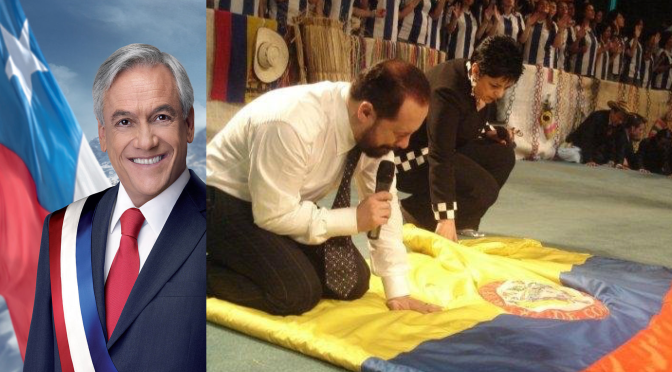
How Right-Wing Politicians Captured the Hearts of Pentecostals in Latin America

The last two years have been very important to Latin America concerning the relationship between religion and politics. In fact, there have been three significative cases in which evangelical-pentecostals have shown their will to participate in public debates.

First, there is the case of the 2016 impeachment against progressive president Dilma Rousseff in Brazil, led by the Pentecostal Assemblies of God congressman Eduardo Cunha, who besides belong to the so-called evangelical caucus, strongly conservative.

Second, there is the 2016 case of Peace Agreement in Colombia that intended to be a way to finish the war with FARC (Fuerzas Armadas Revolucionarias de Colombia), in which the Christian and particularly evangelical-pentecostal vote was an important factor for the victory of “no” option. The agreement considered the possibility for FARC to integrate into the political system, but this was not the most problematic issue for evangelicals. The agreement also considered issues like gender inclusion and LGBT demands. Continue reading How Right-Wing Politicians Captured the Hearts of Pentecostals in Latin America

Waking Up from My Fantasy About Israel

by Heather Goodman, originally posted on her blog.

As a Jew, I love Israel. There’s no way around that. In fourth grade I remember being assigned to write a report on any country in the world, and it was a complete no-brainer as to which country my report would be about. With great pride I decorated the blue-and-white report cover with the Israeli flag. Although seemingly irrelevant, I sprinkled some family recipes for things like matzo ball soup into the report, although now I see that the ethnic pride in recipes and that nationalistic pride in my peoples’ country really are not that far apart.

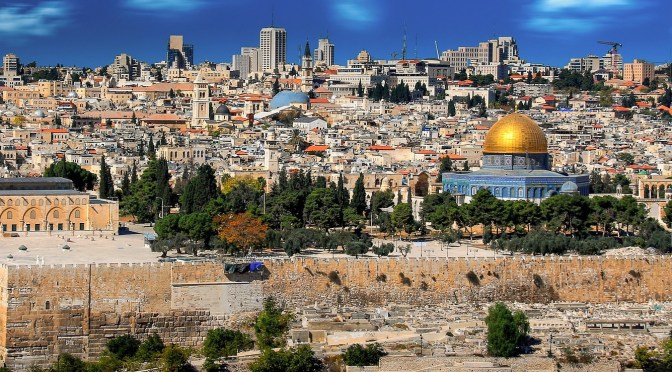
Years later, I’d get to take my first trip to Israel, and tour dozens of ancient Biblical archaeological sites. And where our Israeli tour guide could not take our group, but instead handed us off to a Palestinian tour guide, we also got to tour the ancient sites of the West Bank. As I came to realize how many places in my peoples’ history and my Bible were not under Jewish ownership but instead Palestinian, I started to realize that this did not sit well with my fantasies of what the “Jewish homeland” should be. My inner child wanted a complete restoration of what once was – I was living a fantasy of having walked back through the pages of the Bible, into the land of my Fathers and Mothers and into the “Kingdom of Israel” — with King David or Solomon, take your pick, ruling from Jerusalem, the Shekinah glory of God sitting on the Temple Mount in the Jewish temple, and every ancient parcel of land firmly a land for me, for us, the Jews. Continue reading Waking Up from My Fantasy About Israel

What Do We Mean By “Evangelical”?

In recent news, the term “Evangelical” has been used a lot. It was used during last year’s American elections due to Donald Trump and the Republican Party, and recently, the term has come up in response to scandals involving politician Ray Moore.

Whenever I see the term “Evangelical” used today, it always refers to a very specific group of people. It is always used in the context of politically/socially conservative American Protestants, especially from the southern United States. However, this use of the term is both historically and theologically inaccurate, and I believe that this needs to be addressed. This is especially true because of this organization — Pentecostals & Charismatics for Peace & Justice. The Pentecostal/Charismatic movement is in fact a part of the wider Evangelical tradition, so I think that we need to discuss what that term means in its wider context.  Continue reading What Do We Mean By “Evangelical”?

Pentecostals vs the Empire

by Luis Aranguiz Kahn.

It is a known story that some group of radical Jews wanted to go against the Roman Empire fighting for the independence of the land of Israel. In such a context, the figure of Jesus was at least contradictory. He claimed to be a king though without a land to rule, he said his realm was not of this world and he proclaimed freedom for the slaves, but not Israeli independence. It was understandable to see some Jews rejecting him, because why should we follow a liberator that can’t give political freedom?

This story has a different meaning depending on the place where it is remembered. For instance, it is not the same to speak about it being a Christian of a first world country like England -that was a big Christian empire until just some years ago- or United States -that still looks to be like a kind of empire for many parts of the world-, than to reflect on it from a third world country like a Latin-American one. Continue reading Pentecostals vs the Empire

Community of Goods: Economics According to the New Testament

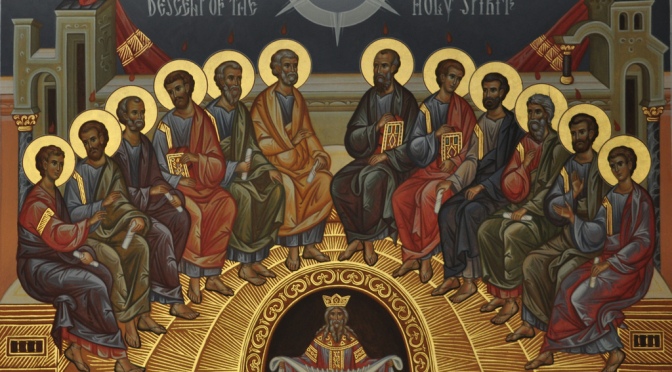
The original movement behind modern Charismatic Christianity is Pentecostalism. The name “Pentecostal”, as we all likely know, comes directly from the second chapter of the Acts of the Apostles. In that chapter, on the day of Pentecost (referring to the fiftieth day after Passover), the early church received an amazing gift (charism): the Holy Spirit descended upon them. The Bible says:

When the day of Pentecost had come, they were all together in one place. And suddenly from heaven there came a sound like the rush of a violent wind, and it filled the entire house where they were sitting. Divided tongues, as of fire, appeared among them, and a tongue rested on each of them. All of them were filled with the Holy Spirit and began to speak in other languages, as the Spirit gave them ability (Acts 2:1-4).

The story of Pentecost is powerful. It testifies to us the importance of the Spirit in the church. However, we in the Pentecostal/Charismatic movement have a tendency to stop reading the chapter not long after this. We heavily emphasize spiritual gifts and revival, but we ignore the following verses in this chapter, in which the early church’s social dynamic is described to us. Continue reading Community of Goods: Economics According to the New Testament

Millions of Evangelicals Did Not Vote for Trump – and I’m One of Them

by Craig Keener. Originally published on his blog on Huffington Post, reposted with permission.

I have been saving for the right time my likely one good shot at the subject of non-Trump evangelicals, and it looks like now is a good moment. The publication of Stephen Mansfield’s Choosing Donald Trump, an attempt to explain why religious conservatives flocked to Donald Trump, seems like the right moment (see Mansfield). Like Mansfield, I am a non-Trump evangelical.

I thus get a little sensitive when people complain that “evangelicals,” as if a monolithic group, stand behind Trump. I seek to respect the office of president and love my neighbor, including presidents I disagree with. But I did not vote for Trump, yet theologically I am plainly evangelical.

Within evangelicalism, I undoubtedly live too sheltered a life. Polls show that of self-declared evangelicals who voted, 80 percent voted for Donald Trump, and it appears that most of them still support him.

Continue reading Millions of Evangelicals Did Not Vote for Trump – and I’m One of Them

A People Without a Temple: Pentecostals, Nonviolence and the Chilean-Mapuche Conflict

by Elvis Castro Lagos.

On June 9, 2016, while a small Evangelical congregation in a rural area, about 2 miles from Temuco, La Araucanía, in Chile, was celebrating an evening service, a group of at least 5 people broke in, and shooting in the air with heavy guns drove the parishioners violently out of the building, proceeding to put it to fire. A note left in the site stated: “Christianity, accomplice of repression to Mapuche people”. It was the third evangelical temple burnt, but this case was special since the congregation (most of them Mapuche people) was in the building in the moment of the attack. The suspected perpetrators were imprisoned and are still being prosecuted. Up to this day, near 30 Catholic and Evangelical church buildings have been burnt in different rural sites in La Araucanía.

Continue reading A People Without a Temple: Pentecostals, Nonviolence and the Chilean-Mapuche Conflict