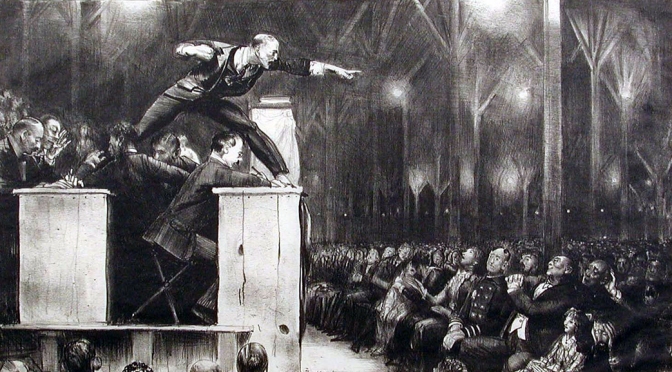
Revival as Social Transformation

Charismatics like myself love to talk about revival. Revival is usually defined as an “awakening” of the church, when it goes back to it’s original state. If the church doesn’t look like the book of Acts – where a lot of miracles happened, thousands were saved and Christians were living a holy, passionate life – it’s basically sleeping and needs to be revived.

Some years ago, a woman from Switzerland contacted me via this blog and said that she wanted to visit Sweden “and the revival there”. We were honored and welcomed her, but we gently said that it would be wrong to say that it’s a revival in Sweden. Even when a lot of people do get healed here and many are saved when we prophesy for them, revival is the wrong word, at least yet. Revival is something more, revival is social transformation. Continue reading Revival as Social Transformation

Why American Pentecostals Stopped Being Pacifists

By Roger E. Olson, originally published on his Patheos blog in 2015. Reposted with permission.

In my opinion, many evangelicals have neglected, if not denied, the supernatural due to a general search for respectability. Nowhere is this evangelical search for respectability more evident to me than among Pentecostals. All Pentecostal Christians pay lip service to miracles, but how many actually believe in and pray for miracles? Many do, but I would guess their number is fewer than fifty years ago. To a very large extent, according to my observations, American Pentecostals have blended in with American society and lost their particularity—except on paper.

One notable feature of Pentecostalism that is gradually changing is its anti-intellectualism and that I consider a positive sign of maturation. In the past, intellectually inclined Pentecostals had to work outside their tradition (in non-Pentecostal evangelical organizations and institutions) or leave Pentecostalism altogether. Today there is a rich and growing intellectual subculture among American Pentecostals evidenced by the large and flourishing Society for Pentecostal Studies and its scholarly journal Pneuma. Pentecostal leaders are far less devoted to anti-intellectualism than fifty years ago. It’s not difficult to identify Pentecostal scholars with reputations beyond the movement’s borders: Veli-Matti Kärkkäinen, Amos Yong, Gary Tyra, Frank Macchia, Gerald Sheppard, Russell Spittler, Cheryl Bridges Johns, Stephen Land, Gordon Fee, Craig Keener, James Smith. Continue reading Why American Pentecostals Stopped Being Pacifists

Nine Common Beliefs about Pentecostals & Charismatics that are Totally False

Ever since rev. Campbell Morgan called Pentecostalism “the last vomit of Satan” and the Los Angeles Times warned the public about the “new sect of fanatics [that] is breaking loose” from Azusa Street, Spirit-filled Christians have had a bad rap. Other Christians as well as non-Christians oftentimes find us weird, and sometimes a bit dangerous. A lot of those perceptions are based on myths and misconceptions. Here are nine common beliefs about Pentecostals and Charismatics that are totally wrong.

1. It’s a small movement

Depending on where you’re located, the Pentecostal and Charismatic (P&C) movement might seem pretty small. But when you look at it on a global level, it turns out that 600 million people are P&Cs. 200 million are Pentecostals, 100 million are charismatic Catholics, and 300 million are charismatics in a big variety of denominations and churches. Since the number of P&Cs amounted to around zero in the beginning of the 20th century, the P&C movement is commonly described as the fastest growing religious movement in the world.

2. It’s a Cult

I’ve heard surprisingly many casually state “All of Pentecostalism is a cult”, to which I like to respond “That’s about as true as the statement ‘The moon is a tomato’.” Cult is not synonymous with “religion I don’t like”, it has an academic meaning of an isolated group with an authoritarian leader, and while there surely are several sad examples of charismatic churches that have developed into cults it is simply ridiculous to claim that we all would be part of some sort of Jonestown. At least that’s what my Leader tells me and he’s always infallible when he drinks goat blood.

Continue reading Nine Common Beliefs about Pentecostals & Charismatics that are Totally False

Do You Love Souls or Do You Just Love Your Ministry?

7d93dd144832139404f3225e0565a49d-1
Patricia Bootsma

On Saturday, October 28th, one of the largest churches in Toronto – People’s Church, hosted a “Serve the City Day.” The day was focused on evangelism, outreach, and missional leadership and included a plenary session in the morning with the famous charismatic evangelist and author, Patricia Bootsma. I have heard Bootsma speak on more than one occassion, and every time I listen to her I am reminded of how much of a woman of God she is.

Here is a woman who has experienced and helped to bring about healings, prophecies, visions, and more. It is evident when you meet her that the Spirit of God is upon her and the most impressive thing of all, is her humility towards this. She is not someone who does any of these things in order to amass fame and fortune, but rather she is someone who only seeks for God to use her as His evangelistic instrument. Continue reading Do You Love Souls or Do You Just Love Your Ministry?

Battling Demons and Possessions: The Life of Antony of Egypt

Antony of Egypt was a true pioneer, whose influence is still felt today. What makes him so remarkable is that he did what he did long before it made sense to do such things, but by doing it he blazed a trail for posterity.

Evangelical Protestant historians explain the migration to the desert by thousands of monks, nuns and hermits as a reaction against the political “Christendom” created by Constantine I and his successors in the 4th century. Yet Antony had already made his statement a generation earlier, at a time when the Early Church was still supposed to be in its bloom. Continue reading Battling Demons and Possessions: The Life of Antony of Egypt

Pentecostals vs the Empire

by Luis Aranguiz Kahn.

It is a known story that some group of radical Jews wanted to go against the Roman Empire fighting for the independence of the land of Israel. In such a context, the figure of Jesus was at least contradictory. He claimed to be a king though without a land to rule, he said his realm was not of this world and he proclaimed freedom for the slaves, but not Israeli independence. It was understandable to see some Jews rejecting him, because why should we follow a liberator that can’t give political freedom?

This story has a different meaning depending on the place where it is remembered. For instance, it is not the same to speak about it being a Christian of a first world country like England -that was a big Christian empire until just some years ago- or United States -that still looks to be like a kind of empire for many parts of the world-, than to reflect on it from a third world country like a Latin-American one. Continue reading Pentecostals vs the Empire

A Pentecostal Alternative to Dispensationalism

by Tony Richie. Part 3 of 3 (part 1, part 2). Read the whole article as a PDF here.

A Provocative Theology

R. Hollis Gause, a prominent Pentecostal theologian (Church of God, Cleveland, TN), elucidates an alternative to fundamentalist dispensationalism through a careful comparison-contrast of dispensational theology and a theology of progressive revelation. Gause explains that progressive revelation does not divide up biblical history as dispensationalism. It does not hermeneutically distinguish between the Church, Israel, and the kingdom of God. The nature of God, the history of salvation, and the character of the people of God are progressively revealed. Earlier events anticipate and predict later events. The inspiration of the Holy Spirit gives Scripture a progressive and even prophetic or predictive quality.

In stark contrast to the hermeneutical compartmentalizing of dispensationalism, progressive revelation affirms a more unified approach to biblical interpretation and understanding. Gause concludes that “the view of progressive and unified revelation of the history of salvation offers the better interpretation of Scripture.” For Gause, considerations of the unchangeableness and unity of God and God’s Word consistently lead to this conclusion.[12] Continue reading A Pentecostal Alternative to Dispensationalism

The Lord’s Supper Crosses All Borders

The Bible is filled with images of Jesus eating with people, hanging out with people, welcoming people, eating with all sorts of seemly and unseemly people.  He was accused of eating with tax collectors and sinners… seriously, the worst kind of people.  While invited to the table of Simon the Pharisee (who did not wash his feet and welcome him) in Luke 7, he was adequately welcomed by the sinful woman who crashed the party and washed Jesus feet with her hair.

Even in the book of Acts one of their first controversies was over who they should eat with… Gentiles or their own kind and whether they should eat–meat sacrificed to idols or not?  Paul and Peter clashed in the Epistles over the fact that Peter had avoided eating with Gentiles because the Judizer’s might disapprove and consider him defiled for sharing the table with Gentile believers.   Somehow the idea of eating and drinking is tied up with the new community that has been created in Christ Jesus. Continue reading The Lord’s Supper Crosses All Borders

Raising the Dead and Helping the Poor: The Life of Surprise Sithole

In 2013, I visited Iris Global in South Africa. On the third day of my trip, I was helping the men and children to cook food on a women’s conference. Suddenly a jeep with the Iris logo appeared, and out stepped a man whose big smile I recognized so well. “Surprise! Wow, I’m so glad to meet you! I’ve read your book!!” The smiling apostle shook my hand, told me I was welcome, guided some ladies to the jeep and then pointed at me: “Micael, get into the car!”

We dropped off lady after lady until we arrived to the house of the last one, where all three of us entered. There was a very, very thin and weak man. I didn’t catch what condition he was suffering from, but I eagerly joined Surprise in praying for his healing. Then we left, and Surprise drove me back to the conference.

I met this man’s wife some weeks later. He has had severe problems with his liver and kidneys as well as TB, and has not been working since October last year. However, now he started to feel much better, he went to the doctor last week – and the doctor pronounced him 100 % well. He started working again last Wednesday. Glory to God!

Continue reading Raising the Dead and Helping the Poor: The Life of Surprise Sithole

Community of Goods: Economics According to the New Testament

The original movement behind modern Charismatic Christianity is Pentecostalism. The name “Pentecostal”, as we all likely know, comes directly from the second chapter of the Acts of the Apostles. In that chapter, on the day of Pentecost (referring to the fiftieth day after Passover), the early church received an amazing gift (charism): the Holy Spirit descended upon them. The Bible says:

When the day of Pentecost had come, they were all together in one place. And suddenly from heaven there came a sound like the rush of a violent wind, and it filled the entire house where they were sitting. Divided tongues, as of fire, appeared among them, and a tongue rested on each of them. All of them were filled with the Holy Spirit and began to speak in other languages, as the Spirit gave them ability (Acts 2:1-4).

The story of Pentecost is powerful. It testifies to us the importance of the Spirit in the church. However, we in the Pentecostal/Charismatic movement have a tendency to stop reading the chapter not long after this. We heavily emphasize spiritual gifts and revival, but we ignore the following verses in this chapter, in which the early church’s social dynamic is described to us. Continue reading Community of Goods: Economics According to the New Testament

Pentecostals & Charismatics for Peace & Justice