Category Archives: Spirituality

Great Podcast Episodes to Increase Your Worship and Compassion

In the 1990’s, the Vineyard movement was given the prophetic name “Worship and Compassion”, which accurately portrays the double-edged sword of the movement as it tries to find the radical middle between evangelicalism and Pentecostalism. Other Pentecostals and Charismatics can learn a lot from how Vineyarders integrate peace and justice in their charismatic life.

Our friends at Vineyard Justice Network recently promoted The Ferment Podcast in which Vineyarders as well as other Christians are asked about their thoughts on worship and transformation. I would like to highlight a few episodes of special interest to PCPJ members:

Tina Colón Williams, on being both a worship pastor and an immigration attorney.

Sam Yoder, on journeying from being old-order Amish to a worship song writer.

Carol Wimber-Wong, on the origin of the Vineyard movement and its roots in evangelical Quakerism.

See our other podcast tips here.

Micael Grenholm is editor-in-chief for PCPJ.

ska%cc%88rmavbild-2017-01-06-kl-21-17-02Pentecostals & Charismatics for Peace & Justice is a multicultural, gender inclusive, and ecumenical organization that promotes peace, justice, and reconciliation work among Pentecostal and Charismatic Christians around the world. If you like what we do, please become a member!

The Call to All Christians, Male and Female

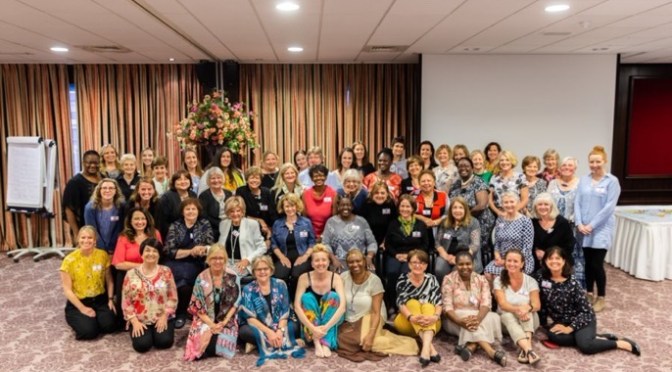
Sixty women leaders from 18 nations gathered in Amsterdam in June to celebrate the gifting, service and leadership of women in the Church across the globe. They mourned the injustices women suffer and called on Christians to take steps to honour women’s leadership in family, church and community.

In the first few days of June 2019, I was privileged to be among a group of Christian women leaders from all across the world met together in Amsterdam over three days to develop a ground breaking document known as The Call which addresses the injustices faced by women across the globe, and calls on Christian organisations everywhere to address the issues raised. Hosted by the World Evangelical Alliance and the Lausanne Movement, this empowering forum, known as Rise in Strength, was in many ways made even more salient by the posture of humility exhibited by the delegates as each celebrated the callings and skillsets of the others without the posturing and jostling for position which is often found in meetings where groups of leaders come together. Together those women

The Call is an incitement to the Church to embrace the purposes of the God who created mankind as equals, male and female, in His image. History will show that those three days were ones in which the Church took a giant leap forward in the battle against misogyny and gender bias as it operates across the spectrum of churches and denominations. 

As The Call is sent far and wide to denominations, networks, churches, theological colleges, charity organizations, blogs, vlogs and any other interested parties across the world, there is an expectation that it will increase the clarity through which the Church may view issues faced by women and girls in the world and in the Church. Such clarity, supported as it is by scripture and by the clear anointing of Holy Spirit on the lives of women leaders and scholars, will result in an increase of willingness for Church organizations and individuals to look again at matters concerning the other half of the Imago Dei. 

Here is the complete transcript of the document developed by the women at Rise in Strength. Please feel free to use it for your own context, and send it far and wide so that others may have the opportunity to take part in The Call to the Church for restoration of women to their rightful place among God’s people.

PLEASE SPREAD FAR AND WIDE

THE CALL TO ALL CHRISTIANS
We, sixty international women leaders[1], met at the Rise in Strength consultation in Amsterdam, June 2019, to celebrate the contribution of Christian women to the work of God in the world.
We gathered from diverse backgrounds, recognising the changing context in which we find ourselves.
We were united in our conviction that gender inequality continues to be a barrier that diminishes the effective witness of the Church to the transforming power of the Gospel.
We affirm that Jesus came that we may all have life and have it in all its fullness[2]. This Gospel transforms lives; the Bible affirms that Jesus called, accepted, healed and restored women. We commit to sharing and demonstrating this Good News; women and men[3] continue to be compelled by God’s grace and the empowerment of the Holy Spirit[4].
We affirm the theological approach of the Lausanne Movement’s Cape Town Commitment as a foundation for our Call to all Christians: “That all of us, men and women, married and single are responsible to employ God’s gifts for the benefit of others as stewards of God’s grace and for the praise and glory of Christ. [We] are also responsible to enable all God’s people to exercise all the gifts that God has given for all the areas of service to which God calls the Church.” [5]
We are compelled, building on this Biblical foundation, to broaden our awareness, increase our attentiveness, and commit to specific actions to restore God’s intention for all people.
AWARENESS
We recognise that our communities and leadership structures have not always been encouraging, freeing or even safe for women and girls, who are each valued and loved by God.
We acknowledge that the pathways for women to serve as leaders in the global Church are limited, and this has prevented many from contributing to the Church in this way.
We acknowledge that the Church has deeply hurt many women and girls, and not heard or acknowledged their pain.
We acknowledge that violence, in all its forms, towards women is perpetrated not only outside the Church, but also inside.
ATTENTIVENESS
We recognize that the global Church has too often ignored the voices of women in its communities.
We commit to being attentive to these voices, including experiences, perspectives, joys and suffering.
We commit to being attentive to women and girls among the most vulnerable populations and regions of the world, especially those living in extreme poverty, or with disability, those endangered by human trafficking, persecuted for their faith, denied education and legal rights – and so at greatest risk of gender-based violence and discrimination.
We commit to discerning the spiritual gifts of all women and girls, so as to draw upon resources God has given for the full health and strength of the whole Church, wherever it manifests across every sector of our society.
ACTION
We must all act to:
Engage in a positive dialogue, mourning and repenting of mistakes and the pain we have caused, and seeking reconciliation; believing this is a first step to making our communities more empowered in Christ and safer places for women, girls, men and boys.
Celebrate the strength, courage, gifts and work of women in churches around the globe.
Work in unity to address the issues which concern us regarding the most vulnerable populations, especially those in extreme poverty and facing persecution for their faith.
Consecrate our gifts and opportunities to further strengthen, grow and mature our local churches and the global Church, in imitation of Christ’s example of Servant leadership.
Commit to collaboration between women and men.[6]
Equip women and girls to take up leadership positions in the Church and wider society, including training and development, making the most of innovative resources .
We call on men and women of the global Church to act so that women, men, girls and boys can all embrace their spiritual giftings to strengthen the work of the Church, and Her witness to the glory of God.

[1] 64 women from 18 nations participated in the consultation
[2] (John 10.10b)
[3] (Gen 1.26-8, 2.23)
[4] (Acts 1.8)
[5] https://www.lausanne.org/content/ctc/ctcommitment#capetown, p.6
[6] Eph 5.21, John 17.21-3

The International Miracle of Pentecost

Happy Pentecost! This weekend, millions of Christians all across the globe are celebrating the baptism of the Holy Spirit and the birth of the apostolic church. Pentecost has always been very important for me, since the apostolic Pentecost as it is described in Acts 2 combines everything I like: charismatic fire, economic redistribution, universal evangelism as well as simplicity, worship and joy.

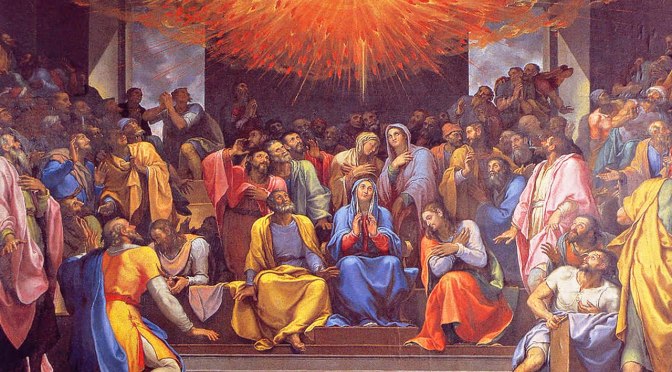
It all started when the wonderful Holy Spirit descended with fire and the international gift of tongues:

When the day of Pentecost came, they were all together in one place. Suddenly a sound like the blowing of a violent wind came from heaven and filled the whole house where they were sitting. They saw what seemed to be tongues of fire that separated and came to rest on each of them. All of them were filled with the Holy Spirit and began to speak in other tongues as the Spirit enabled them.

Now there were staying in Jerusalem God-fearing Jews from every nation under heaven. When they heard this sound, a crowd came together in bewilderment, because each one heard their own language being spoken. Utterly amazed, they asked: “Aren’t all these who are speaking Galileans? Then how is it that each of us hears them in our native language? (Acts 2:1-8, NIV)

In my experience, this is quite a common miracle. When the early Pentecostals met at the Azusa Street revival in Los Angeles to enjoy the restoration of Spirit baptism, many claimed that people actually started to speak real languages. In the October issue 1906 of The Apostolic Faith, the official publication of the Azusa Street church, the following article is included:

Sister Hutchins has been preaching the Gospel in the power of the Holy Spirit. She has received the baptism with the Holy Ghost and the gift of the Uganda language, the language of the people to whom she is sent. A brother who has been in that country understands and has interpreted the language she speaks. Her husband is with her and her niece, who also has been given the African language.

Continue reading The International Miracle of Pentecost

New Book: Guerrilla Gospel by Bob Ekblad

guerrilla-gospel-1-683x1024.jpgJesus was born into a world marked by oppression and injustice to announce and embody God’s global liberation movement. Like an insurgent, Jesus comes in under the radar, behind enemy lines, and then builds a foundation of trust with a growing entourage of humble followers. He incites a revolution that he calls the Kingdom of God.

Guerrilla Gospel: Reading the Bible for Liberation in the Power of the Spirit is a practical manual that condenses the outlines of God’s liberation movement.

In this book you will learn to

  • identify and overcome common obstacles to stepping into active faith,
  • grow in your awareness of how God speaks and the Spirit guides,
  • discover approaches to preparing messages that invite conversion and holistic transformation,
  • learn essential basics for preparing and leading Bible studies and
  • grow in understanding how the gifts of the Spirit are available now to provide essential support for the adventure of faith.

Get the book here!

Bob Ekblad is co-founder and co-director of Tierra Nueva in Burlington, Washington. Bob is ordained in the Presbyterian Church (U.S.A.).  He holds a ThD in Old Testament and is known internationally for his courses and workshops on reading the Bible.

Proof that Prayer Works

Article published in the Christian Post.

Can prayer be scientifically measured? In 1872, English intellectual Francis Galton, cousin of Charles Darwin, attempted to test the effects of prayer in a famous experiment. He hypothesized that the royal family, whose health the faithful prayed for every Sunday in Anglican parishes, would live much longer than the rest of the British population.

He found that the contrary was true, and concluded that prayer doesn’t work.

The royal diet and lifestyle did not factor into his equation, nor did Galton question the hierarchical theology of God favoring those privileged enough to command an entire nation to pray for them.

In more recent times, Richard Dawkins has hailed the “Great Prayer Experiment” as the definitive proof against prayer efficiency. The Experiment was a 2006 study conducted by Herbert Benson and team, showing that cardiac bypass patients who received prayer did not suffer from less complications after surgery than those who didn’t. In fact, the opposite was true! Continue reading Proof that Prayer Works

Why the Cross Changes Everything

Every Good Friday I usually go outside to pray when the time is approaching 3 PM. That’s when he died. He who transformed my life.

There was a time when I didn’t care at all about Jesus. He was cool, sure, but he didn’t have as many superpowers as Superman and he was far less badass than Samus Aran. The church, in my opinion, was a boring museum. The Bible was hard to read and lacked pictures.

But when I was confronted with my own mortality and understood the message of Easter – that he died for us to live forever – then I could not get enough of him. I opened the gospels and read. I can honestly say that I have never encountered so much wisdom and love from any other person, before or after.

Some want to reduce Jesus to a non-divine moral teacher. As C. S. Lewis has pointed out, it is impossible. A reasonable moral teacher does not claim to be the Son of God, the light of the world, and the door to eternal life – unless it is true.

But I understand why people recognize Jesus as wise and moral. He is! That’s what makes the painful killing of him so incomprehensible and wrong.

God died on that cross. God himself died for our sake so that we would have the eternal life we ​​in no way deserve. This eternal life, in eternal happiness, is greater than anything we can imagine. No other gift is so great and as wonderful as the gift of living in paradise.

All the peace and justice we long for will be realized to its fullest in heaven. That’s no reason to stop promoting such Kingdom-values here. On the contrary, when we truly have the eternal perspective we will become even more zealous to bring God’s Kingdom to earth. As John says:

“Beloved, we are now children of God, and what we will be has not yet been revealed. We know that when Christ appears, we will be like Him, for we will see Him as He is. And everyone who has this hope in Him purifies himself, just as Christ is pure.” (1 Jn 3:1-2)

What I realized 13 years ago is that when we celebrate on Sunday that Jesus arose from death, it is not just that we are happy for His sake. His resurrection shows where we are going if we follow him. His path is the path of life. A life that never ends. It is because of his painful death on the cross that we can go that way.

Today at 3 PM, think of Jesus and pray to him. He loves you so much that he was subjected to one of the world’s most evil execution methods. He gave everything for you. You are too precious and loved to be lost in the bottomless darkness of death. God, your Creator and Friend, calls you to eternal happiness.

Micael Grenholm is the editor-in-chief for PCPJ.

ska%cc%88rmavbild-2017-01-06-kl-21-17-02Pentecostals & Charismatics for Peace & Justice is a multicultural, gender inclusive, and ecumenical organization that promotes peace, justice, and reconciliation work among Pentecostal and Charismatic Christians around the world. If you like what we do, please become a member!
The Church, Poverty and Domestic Violence

She came to our women’s Bible study one day. Her name was Linda, no on really knew her, no one was really sure how she found our Bible study. After coming a few times, she disappeared from our group. Krista, one of our members, had one of those impressions that she should call her. And Linda returned one day to tell us that her husband was going to kill her.

What to do, we were just a ladies Bible study untrained in such things. The Spirit prompted me to ask Linda if she had an escape plan. Together, we worked out a plan, set a date, vowed to secrecy. And we prayed.

That night our little Bible study group attended a local Revival meeting in a near by city. After the message we huddled together at the altar and once again prayed for our friend Linda. Corporately, we felt like the friends of the lame man who had broken a hole in the roof and lowered our friend before Jesus, the one who could actually heal and bring life… So we prayed into that Bible story.

On the set date, we gathered together, helped Linda pack up her things, picked up her daughter at school and began the journey toward the airport. We were stuffed together like sardines but we all wanted to be there to see Linda off.

We collected a little money and prayed one more time for safety.

Linda made it out finding freedom in a faraway city with her mother. But many do not find such freedom or safety. As a pastor, I regularly come across women stuck in poverty largely because of domestic violence or other forms of abuse. It’s staggering to me how many of them shared stories of how the church supported their abusers, believed the abuser, at the expense of theirs and their children’s well-being.

I currently serve in a city with a significant homeless population and it is startling to learn how many homeless people are women, often women with children. As I learn their stories and get to know them, I have discovered the role domestic violence plays in poverty and homelessness.

Even more curious is how the “Biblical” narrative about husbands being the head of the home feeds abuse and justifies the behavior of those who abuse. I hear story after story after story of how pastors have told victims of genuine abuse to go home, try to be a better wife and submit more to her husband or just give him more sex. One woman we helped went to a Biblical prayer counselor who in front of her husband told her she had a Jezebel Spirit. This fed the narrative her abuser was using to keep her in his control. Because this was offered as a “word” from the Lord, she was terrified that she would be going against God if she left.

There was a popular Deliverance Ministry–Bondage Breakers in the mid to late 90’s that proliferated the notion that if a woman was not submissive to her husband then the devil would attack her. This became embedded in various deliverance ministries around the nation. When an abuse victim and her husband sought prayer counsel, this “biblical” idea would surface keeping the abused person in further bondage and shame.

It is curious how little pastors and churches grasp the role of abuse and violence in poverty and homelessness. Instead, in our political dialogue, we lay the blame for poverty on laziness and lack of ambition. In reality poverty and homelessness related to domestic violence has nothing to do with laziness and lack of ambition. According to the National Alliance to End Homelessness, on one night alone 55,000 beds in shelters across the country were set aside for homeless women affected by domestic violence. That number is staggering!

And I wonder how many more that night remained in their abusive home fearing that they and their children would end up without a home and in a shelter.

Here are some practical ideas that churches could do to help this crisis.

  1. Believe the one being abused. The body of Christ must stop with the teaching that women are easily deceived and that men are somehow less open to deception. This feeds the narrative that women are not reliable when they bring up abuse. I have observed that women go to their churches long after the abuse has begun. Often she has tried everything and suffered many years before she has mustered the courage to tell someone. In addition there is a psychology abusers use to gaslight and undermine a victim’s sense of reality making it harder for her to come forward.
  2. Give practical aid. Homelessness and domestic violence often stem from not being able to gather enough money to get into an apartment or rental. Often in situations when the victim finally leaves the abuse, she finds herself without enough money to pay a deposit and first months rent. It takes a few months to get rental assistance, childcare assistance, health care assistance and other helps. And this kind of assistance is needed just to climb out of homelessness. I don’t often find churches willing or able to provide much for transitional help. (We offered radical hospitality in our home for six months until victims were able to find work, get childcare and launch into self-support).
  3. Provide emotional support and prayer. Because of the psychology around abuse, emotional support and prayer are vital. Often women believe God has forgotten them or worse they are going against God when leaving the abuse. The gaslighting and emotional abuse has damaged the victim’s sense of self and decision making ability is diminished. Emotional and prayer support can help a sense of self re-emerge as emotions are validated and prayer is given.
  4. Include them in the church community. Often victims of abuse are excluded in the church community because there is yet a stigma around leaving one’s husband. Especially if the couple was a part of the community together. Often people have a hard time believing such things could happen among Christians and when the perpetrator is known it’s even more difficult. But being a part of a Christian community can be so healing if the victim is believed and supported. Often this is not the case and they are left wondering if God has abandoned them too.

Over the years, I have seen the hand of God moving mightily on behalf of victims of domestic violence. I know that he cares. Each time God brings another woman into my life, he speaks and lets me know what is needed. God also provides insight and resources in surprising ways. I know these women are on God’s heart even if they are not on the church’s hearts. The Army of Heaven is with them and we can join God in defeating this satanic system that keeps his beloved daughters from flourishing.

Pentecostal Spirituality: The Power to Practice (Not Just Believe)

By Elizabeth D. Rios, EdD, DMin (ABD)

I started this article a week ago, but felt something was missing. Today, I found it. I think it was holy indignation!

What sparked this holy anger?

Hearing a well-known, popular, nationally recognized Pentecostal preacher share (on an Instagram clip) on his pulpit that he hates politics. How he doesn’t give a rip about it. How he doesn’t care who is in charge.

He then goes on to say, “You know how we find our help, through Jesus Christ, the savior of the world, the power of the holy ghost. You get involved in that mess, you get involved in offenses. ‘That offends me, well I can’t believe…’ Who gives a rip what they say? I want to know what God says. I’ve lived long enough to be in a place where I am asking the question, is it going to be politics or Pentecost?”

To which you hear the congregation break out into applause. Although it wasn’t overwhelming applause there were still people who actually thought this was responsible preaching. Albeit, he’s been a pastor for decades (and I actually like and know him) but I had to hear it over a few times because I was sad and yes, mad over it. Continue reading Pentecostal Spirituality: The Power to Practice (Not Just Believe)

What Revival Looks Like: Sharing Possessions

by Craig Keener, originally posted on his blog as the second part of a series on Spirit empowering.

If the immediate expression of the outpouring of the Spirit on Pentecost was prophetic empowerment, the longer-range impact was a new community of believers who walked together in their lives and shared one another’s needs.

Much of Acts 2:41-47 follows the following structure:

A         2:41     Successful evangelism (3000 converts)

B         2:42     Sharing meals, praying together

C         2:44-45            Sharing possessions

B’        2:46-47a          Shared meals, worship

A’        2:47b   Successful evangelism

Whereas the conversions in 2:41 responded to Peter’s preaching, the conversions in 2:47 apparently responded to the life of the new community. Peter’s preaching explained divine signs at Pentecost; but the sacrificial love that Christians showed one another was no less divine, no less supernatural. Continue reading What Revival Looks Like: Sharing Possessions

Solidarity and Prayer: One Story

Maria wept as she shared the story of Mary and Joseph when they sought a place to stay in the city of Bethlehem. They had found no room at the inn. Maria shared the tradition of Posada in which the parents of Jesus looked for someone who would offer them hospitality and finding no one, they moved on to the next house also finding no welcome. Her voice was raw with emotion as she shared that Jesus–the one who dwelt within real people continued to seek hospitality in a world that offered him no welcome.

I wondered why this story brought up so much emotion in my friend. I didn’t ask, we had a hard time talking with one another due to a language barrier. I spoke little Spanish, and she spoke little English. Nevertheless somehow the Lord knit our hearts together with a deep love. A few years later, there was an ICE raid in our rural town and I was supposed to meet with Maria’s daughter for discipleship. The two girls in the group had frightened looks on their faces as Maria’s daughter explained that her mom was undocumented. We cried together and prayed. I ached inside as I witnessed the trauma experienced by my young friends.

From that moment on, Maria and her family were in my prayers. I often noticed a shadow of shame fall on her face. As Maria gained more English, we began to talk together about her immigration status. Often we gathered to pray together. Continue reading Solidarity and Prayer: One Story