Tag Archives: Wealth

Trump Spoils Food Worth $500 Million Instead of Giving it to the Poor

Food that was supposed to be distributed to millions of hungry people, worth half a billion dollars, is currently being spoiled after Donald Trump stopped all American aid around the world – and the person who revealed this was immediately fired by the Trump regime!

Trump and his billionaire friend Elon Musk have shut down USAID, which was the world’s largest donor and accounted for 40 percent of all humanitarian aid in the world. They claim they are doing this to “reduce waste” and “increase efficiency” – but how is it efficient to let food worth 500 million dollars go to waste instead of feeding starving people? Isn’t that the very essense of wastefulness?

What Trump and Musk is doing to USAID is not only immoral but also illegal, yet Trump and Musk completely disregard what is legal right now by halting aid that Congress has approved in a very authoritarian way. Here are more examples of life-saving measures that have been stopped by Trump and Musk:

  • Ivory Coast: A US-sponsored program to collect sensitive intelligence information about Al Qaeda-related incidents has been discontinued.
  • Sudan: Most soup kitchens feeding 816,000 people in Khartoum have been closed down.
  • Uganda: Aid workers say that around 40 newborns were infected with HIV per day when the USA stopped funding antiretroviral drugs.
  • Ukraine & Syria: Organizations providing maternal care, vaccinations, and firewood have been forced to cease their operations.
  • Thailand: Patients were told to leave a US-funded refugee hospital on the border of Myanmar.

Additionally, hundreds of Christian organizations around the world have been forced to halt initiatives to provide food and healthcare to millions of poor people. Several evangelical organizations and churches have now appealed to Trump to restore aid to Christian organizations – something he refuses to do.

At the same time, there are other evangelical Christians who completely rejoice over the closure of USAID because it is seen as “anti-woke” and because they believe in the propaganda that it combats corruption. How does that combat corruption by stopping care for children with HIV and letting food rot, you wonder?

Of course it does not. Instead, Trump and Musk ensure that they benefit themselves and their companies while pocketing billions from aid meant for the poorest. The love for money is truly a root of all evil, as the Bible says (1 Tim 6:10).

Both Trump and Musk have repeatedly lied about USAID supposedly spending 50 million dollars on “condoms for Hamas.” In reality, they spent the 50 million on an AIDS program in the Gaza province of Mozambique, not in the Gaza Strip.

Musk was confronted about this by a journalist at the White House, and he admitted he was wrong (without saying that the aid should be reinstated) but claimed that it is still unreasonable to spend 50 million on condoms somewhere because there are too many condoms—despite the fact that the majority of the project is not about purchasing condoms at all, but rather about combating AIDS in other ways!

It is completely incomprehensible how an incredible amount of competence and experience in helping the poor is thrown in the trash when USAID is shut down, while the incompetent, criminal billionaires Trump and Musk have been given more power than anyone else on earth.

And the sad part is that many Christians cheer for them while at the same time cutting back on the massive amount of aid work carried out by Christian organizations. May God bring repentance, sanity and hope to the United States.

Micael Grenholm is a Swedish church historian, author and an editor for PCPJ.

ska%cc%88rmavbild-2017-01-06-kl-21-17-02

Pentecostals & Charismatics for Peace & Justice is a multicultural, gender inclusive, and ecumenical organization that promotes peace, justice, and reconciliation work among Pentecostal and Charismatic Christians around the world. If you like what we do, please become a member!

Trump has no Empathy and is a Threat to Democracy, According to His Former Aides

More and more of those who previously worked for Trump are now warning about him, stating that he lacks a moral backbone and lies constantly—which most of us had figured out already, but now even those who were once his supporters are starting to realize the truth. Not a moment too soon!

Stephanie Grisham, on the right in the picture below, worked for Trump when he was president, called herself a “true Trump believer,” and was, among other things, his press secretary. She recently urged Republicans to vote for Democrat Kamala Harris instead and revealed what Trump says when he thinks no one is listening.

“Behind closed doors, Trump mocks his supporters—he calls them ‘basement dwellers,'” Grisham said during her speech at the Democratic Party Convention. “Basement dwellers” is an insulting term describing someone who is poor and lacks a social life.

“When people were dying in intensive care units, he was mad that the cameras weren’t filming him,” Grisham said. “He has no empathy, no morals, and no fidelity to the truth. He used to tell me: ‘It doesn’t matter what you say, Stephanie. Say it enough, and people will believe you.'”

Trump’s campaign responded to this in a very calm, professional, and nuanced manner. No, of course not.

They wrote that Grisham is “a dummy and a liar” who “clearly suffers” from many “mental issues.”

The question that arises, of course, is whether that doesn’t make Trump an even bigger “dummy with mental issues” since he hired her to be responsible for his communication with the outside world. The claim that it’s Grisham who is lying and not Trump is bizarre, given that he has been caught lying over and over again.

Grisham’s account of how Trump was annoyed that TV cameras were filming intensive care patients instead of him is also confirmed by another of his former employees, Olivia Troye, who also urges Republicans to put democracy above party and vote for Harris instead of Trump.

Other former Trump employees who are warning about him include his former Secretary of Defense, Mark Esper, who has called him a “threat to democracy,” and his former National Security Advisor, John Bolton, who has said that he is “unfit to be president.”

This is far from the first revelation about the gross things Trump says when he thinks no one is listening. He told his friend Billy Bush that you can grab women by their genitals and sleep with married women when you are as famous as he is, and he told a bunch of billionaires who support the Republican Party that he would make them and himself “rich as hell” by significantly lowering taxes for the super-rich.

Micael Grenholm is a Swedish church historian, author and an editor for PCPJ.

ska%cc%88rmavbild-2017-01-06-kl-21-17-02

Pentecostals & Charismatics for Peace & Justice is a multicultural, gender inclusive, and ecumenical organization that promotes peace, justice, and reconciliation work among Pentecostal and Charismatic Christians around the world. If you like what we do, please become a member!

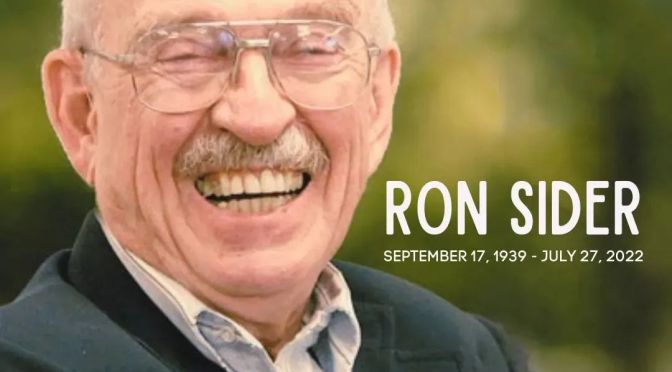
In memory of Ron Sider and his amazing work for peace and justice

One of the great champions of a Christianity shaped by peace and justice, Ron Sider, has gone home to God. His 1977 book “Rich Christians in an Age of Hunger” has been named one of the most influential religious books of the 20th century, motivating hundreds of thousands to live more simply and help the poor.

This book has sold over 400,000 copies and has been translated into multiple languages. In it, Sider argues that Christians have a moral responsibility to actively work towards ending poverty and economic inequality and that prosperity theology, which teaches that wealth is a sign of God’s favor, is misguided.

Sider’s work has also had an impact on the broader society. He has been a leading voice in the Christian social justice movement for several decades, and has been influential in shaping the thinking of many Christians on issues of poverty, economic justice, and the role of faith in politics and society. He was the founder of Evangelicals for Social Action (nowadays called Christians for Social Action), an organization that works to mobilize evangelicals to advocate for social justice issues. Through his books, speaking engagements, and involvement with this organization, Sider has been instrumental in raising awareness of poverty and economic inequality and encouraging Christians to take action to address these issues.

Ron Sider was also a devoted pacifist and his speech at a Mennonite conference in 1984 that pacifists needed to be as willing to make sacrifices for peace as soldiers led to the founding of the Christian Peacemaker Teams, an organization that sends nonviolent observers to conflict zones.

Ron Sider’s work on nonviolence and peacemaking is centered around his belief that Christians have a moral responsibility to actively work towards peace and justice. He argues that war and violence are not consistent with the teachings of Jesus and that Christians should instead strive for nonviolence and reconciliation.

One of his notable contributions in this area is his book “Just Peacemaking: Ten Practices for Abolishing War” which was first published in 1992. In this book, Sider outlines ten practices that individuals, churches and nations can engage in to work towards the abolition of war and the establishment of just peace. These practices include: nonviolent resistance, conflict resolution, economic alternatives to military spending, and the promotion of democracy and human rights. He also argues that Christians should actively work towards disarmament and the abolition of nuclear weapons, and that the just war tradition has been misused to justify violence and war.

Sider’s work on nonviolence and peacemaking has been influential in shaping the thinking of many Christians on issues of peace and justice. He has been a leading voice in advocating for nonviolence and disarmament, and his work has helped to raise awareness of the moral implications of war and violence.

I listened to him when he visited Gothenburg over ten years ago and I was struck by his passion to follow Jesus and his Sermon on the Mount no matter what it costs us. We need more disciples like Ron!

Why Millionaire Televangelist Kenneth Copeland is Suddenly Begging You for Money to Buy His Fourth Private Jet

The prosperity preaching televangelist and multimillionaire Kenneth Copeland has stirred a lot of controversy lately. He tried to blow away the coronavirus, was one of the first pastors to deny that Joe Biden won the election (in an extremely bizarre way) and now he is begging people who are millions of dollars poorer than him for a new private jet.

Now, if you’re familiar with Copeland you know that he already has a private jet. In fact, he has three. He stores them at an airport called Kenneth Copeland Airport, right next to his million-dollar mansion in Texas.

The motivation he recently gave at the extremist Christian show Flashpoint is that he can’t fly commercial because he refuses to get vaccinated for Covid and many airlines require vaccination these days. “That’s the mark of the Beast”, he said.

This is clearly not the real reason Kenny is begging for your money, as there are several airlines in the US that does not require vaccination (even though it definitely can be argued that they should), and we know that Copeland argued against flying commercial long before the pandemic in order to motivate his love for private jets. Then, the reason was that that commercial planes are “tubes full of demons“.

The real reason Copeland is acting like this is, I think, that his self-worth is in those jets, they communicate success to himself and to a huge part of his audience. Practically, he doesn’t need four private planes any more than you and me, but on an existential and spiritual level he they are like oxygen to him. He is terrified of the thought of not being able to buy luxuries and status objects with other people’s money, since he himself has been preaching for decades that such a lifestyle is the ultimate evidence that God is with you.

It is just as the apostle Paul expressed it thousands of years ago:

“Those who want to get rich fall into temptation and a trap and into many foolish and harmful desires that plunge people into ruin and destruction. For the love of money is a root of all kinds of evil. Some people, eager for money, have wandered from the faith and pierced themselves with many griefs. But you, man of God, flee from all this!” – 1 Timothy 6: 9-11

Kenneth Copeland is stuck in this trap of wealth, and it is consuming him. Like most other preachers, he has likely lost a lot of income during the pandemic—he warned his audience early on that even if they lose their jobs, they should continue tithing.

I’m guessing most of them didn’t.

And as Kenny has become one of the primary laughing stocks on the internet due to his bizarre statements and performances, he has a hard time attracting a younger audience. His empire is crumbling, and it destroys his self-worth.

That is why his friend Jesse Duplantis lied about how gifts to Copeland’s will “speed up” Jesus’ return. In their world, that’s true. Now, I’m not defending this craziness. It is unbiblical, catastrophic spiritual abuse. But my point is that these men are broken, afraid and have plunged themselves into ruin and destruction, and they’re so addicted to their wealth that they think that only more wealth can solve their problem.

We need to pray for them, for healing and repentence. But whatever you do, don’t give these millionaires more money. That’s just like handing a bag of cocaine over to a drug addict.

Micael Grenholm is editor and contributor for PCPJ.

ska%cc%88rmavbild-2017-01-06-kl-21-17-02

Pentecostals & Charismatics for Peace & Justice is a multicultural, gender inclusive, and ecumenical organization that promotes peace, justice, and reconciliation work among Pentecostal and Charismatic Christians around the world. If you like what we do, please become a member!
Biblical Prosperity: Why the Prosperity Gospel Is Wrong

My grandmother and aunt were both charismatics, and they worked at the local Christian television station. There were many times when I was growing up that I would watch that television station simply out of curiosity. This was before I became a committed Christian, and some of the theology that I saw on this station seemed very strange to me. It was through this television station that I was first introduced to the Prosperity Gospel.

I came across many shows featuring Mike Murdock, Rod Parsley, Jesse Duplantis, and Joel Osteen. I distinctly remember being turned away by their preaching. I was a big fan of Jesus at the time, but I wasn’t comfortable with Christianity. And they were a big reason why. I remember seeing their fame and fortune, and I had a very difficult time reconciling that with the poverty and humility I read about in the Gospels.

Unfortunately, for the last one hundred years or so, the American Church has become captivated by the Prosperity Gospel. This has especially been the case within Pentecostal and Charismatic churches. Continue reading Biblical Prosperity: Why the Prosperity Gospel Is Wrong

Did Jesus Really Not Come to Address Global Hunger?

I was recently published in the Christian Post where I argued that Christians should live simply, generously and sustainably to address global hunger. Three million children die annually, while the rest of the world has much more food than we need (and throw away large portions of it).

I didn’t expect much opposition to what I wrote, but it turns out that in some evangelical circles, feeding the hungry is a sensitive topic.

Jeff Maples at Reformation Charlotte wrote a passionate response in which he, among other things, calls me a heretic and say that I preach a demonic message that might lead to me losing my salvation. Let’s see if he has any Biblical support for these accusations:

Evangelicals are lining up at the door trying to make the case that Jesus is all about a socialistic government that makes everyone equal. One of the stupidest articles I’ve seen in a long time is an article recently published at the Christian Post by Micael Grenholm titled How would Jesus respond to global hunger? In the article, while he doesn’t use the word “socialism,” Grenholm argues that Jesus taught a form of socialism based on the story of Lazarus and the rich man in Luke 16:19-31.

Maples is right about me not mentioning socialism. I also don’t mention governments. How Maples reaches the conclusion that my point with the article is that “Jesus is all about a socialistic government” is therefore quite a mystery. Continue reading Did Jesus Really Not Come to Address Global Hunger?

The Problem With Prosperity

The prosperity gospel, or “health and wealth” preaching, originated about 70 years ago in the United States. At various tent meetings connected to Voice of Healing and similar ministries, preachers like Oral Roberts and A. A. Allen started to teach things like financial sowing and reaping, the prosperous power of faith and that God wants us to be rich.

Their theology was influenced by Baptist theologian E. W. Kenyon, who in turn was highly influenced with ideas from New Thought. This American movement is quite similar to New Age and emphasizes, among other things, the power of the mind to influence physical reality by, for example, naming and claiming health and wealth before it actually has materialized.

Sounds familiar?

Of course, a believer in the prosperity gospel will probably reject the brief historical review above and claim that they believe in these things because it is what the Bible teaches. And so, we must deal with the Biblical material. In this article, I will go through two passages that challenge prosperity teaching, and two that’s being used in its defense. Continue reading The Problem With Prosperity

Benny Hinn Just Denounced the “Health and Wealth” Gospel—but Why?

Benny Hinn is for many synonymous with the prosperity gospel of “health and wealth”. The Israeli televangelist has for decades been preaching that you get rich if you donate a lot to him, that Jesus was rich and that luxury and affluence signifies a “blessed” life.

Needless to say, many were surprised when he said this:

The recording is from a service last Monday that was being broadcast live on Facebook. Hinn said, among other things:

I think it’s an offense to the Lord, it’s an offense to say give $1,000. I think it’s an offense to the Holy Spirit to place a price on the Gospel. I’m done with it. I will never again ask you to give $1,000 or whatever amount, because I think the Holy Ghost is just fed up with it.

The Christian Post points out that Hinn himself did that just five years ago. Hinn continued:

I don’t want to get to Heaven and be rebuked. I think it’s time we say it like it is: the Gospel is not for sale. And the blessings of God are not for sale, and miracles are not for sale. And prosperity is not for sale.

Skärmavbild 2019-09-06 kl. 11.41.19

A lot of headlines has described this as Benny Hinn denouncing the prosperity gospel. He did point out, however, that he still believes in prosperity, since “the Bible clearly teaches it.” But his understanding of what prosperity means has changed:

When I was younger, I was influenced by the preachers who taught whatever they taught. But as I’ve lived longer I’m thinking, wait a minute, you know this doesn’t fit totally with the Bible and it doesn’t fit with the reality. So what is prosperity? No lack…

Did Elijah the prophet have a car? No. Did not even have a bicycle. He had no lack. … Did Jesus drive a car or live in a mansion? No. He had no lack. How about the Apostles? None lacked among them,” Hinn said. “Today, the idea is abundance and palatial homes and cars and bank accounts. The focus is wrong … It’s so wrong.

At Pentecostals & Charismatics for Peace & Justice, we’re happy that Hinn has changed his mind on this. The Bible warns against those receiving money in order to impart God’s gifts and blessings to others (Acts 8:20). Paul goes against the idea that one can gain financially through faith in his first letter to Timothy:

These men regard godliness as a means of gain. Of course, godliness with contentment is great gain. For we brought nothing into the world, so we cannot carry anything out of it. But if we have food and clothing, we will be content with these. Those who want to be rich, however, fall into temptation and become ensnared by many foolish and harmful desires that plunge them into ruin and destruction. (1 Tim 6:5-9)

So why did Benny Hinn change his mind? Many have pointed out that his nephew Costi Hinn, who denounced himself from his uncle’s ministry years ago, recently published his book, God, Greed, and the (Prosperity) Gospel. Costi, who not only rejects prosperity teaching but also charismatic theology, shares in the book how it has been to enjoy a luxurious lifestyle based on the gifts of people more poor than you are, and the struggles he’s had justifying this from the Scriptures.

So was Benny influenced by his nephew? Maybe, but Costi’s departure from charismaticism makes me doubtful that his words would have much authority for Benny. I think that Benny genuinely describes the cause for his change of opinion when he says

I’m sorry to say that prosperity has gone a little crazy and I’m correcting my own theology and you need to all know it. Because when I read the Bible now, I don’t see the Bible in the same eyes I saw 20 years ago… The more you know the Bible the more you become biblically based and more balanced in your opinions and your thoughts, because we are influence.

I do think that Bible study helped Benny realize his errors. And I take this as great encouragement to continue to point to the Scriptures when discussing with fellow brothers and sisters why we should care about peace and justice. People are not beyond redemption and correction. Even those with deep convictions can change over time. We should not give up pointing to what the Bible really teaches about poverty and wealth.

Micael Grenholm is editor and contributor for PCPJ.

ska%cc%88rmavbild-2017-01-06-kl-21-17-02Pentecostals & Charismatics for Peace & Justice is a multicultural, gender inclusive, and ecumenical organization that promotes peace, justice, and reconciliation work among Pentecostal and Charismatic Christians around the world. If you like what we do, please become a member!

Do Christians Have to Tithe?

by Joel Daniels, originally posted at Engaged Pentecostalism (follow them!).

This series of posts is dedicated to (re)considering basics of Christian faith, and today we examine one regularly misconstrued topic: tithing.

Tithing Mandate?

The Church persistently preaches that Christians must tithe, meaning give 10% of their income to the local church. Of course, there’s a whole sub-genre on whether or not 10% means from net or gross pay. Churches tend to push gross.

And lest we think this is a minor concern, churches often organize around this compulsory practice. I’ve been on staff at churches, in fact, that would not allow churchgoers into leadership positions until they tithed, even though other less concrete aspects of their lives were not as unequivocally scrutinized.

So the question I want to consider is whether or not tithing is a prescribed Christian practice, especially within the contemporary Church context where tithing (or at least giving of some sort) is the one message that is preached every single week during the offering portion of the service. In what follows, I will suggest that tithing is actually not a Christian prescription. But before we delete our online giving profiles, we’ll also discover that Jesus’ actual invitation is much more profound and “costly.” Continue reading Do Christians Have to Tithe?

Living Generously

Poverty is one of the most pressing issues in the world today. Despite our best efforts we still have a very long way to go. Children continue to die of hunger, people still make the choice between food and education, some will never have the opportunity to fulfill their potential, simply because there’s not enough.

In an era when it has been reported by the bank, Credit Suisse in November 2017, that the world’s richest 1% own half the world’s wealth, the other side of the coin is that the 3.5 billion poorest adults each have assets of less than $10,000. These people, who account for 70% of the world’s working age population, own just 2.7% of the global wealth.

None of us can fail to notice that there are crises at the gates of every culture and nation. War and famine produce refugees in numbers that are untenable. Our broken economies are driven by the greed of those for whom the almighty dollar has far greater value than the life of one small child, one refugee, one trafficked woman, one homeless person.

Not the least of our problems is the lack of good leadership. When the prophet Daniel was interpreting King Nebuchadnezzar’s dream about his future insanity, he pleaded with him to change his ways (Daniel 4:27) in order to avoid the catastrophic effect of his pride. His key point was that he ‘break from his wicked past and be merciful to the poor’. Integral to really good leadership is mercy for the poor. Continue reading Living Generously