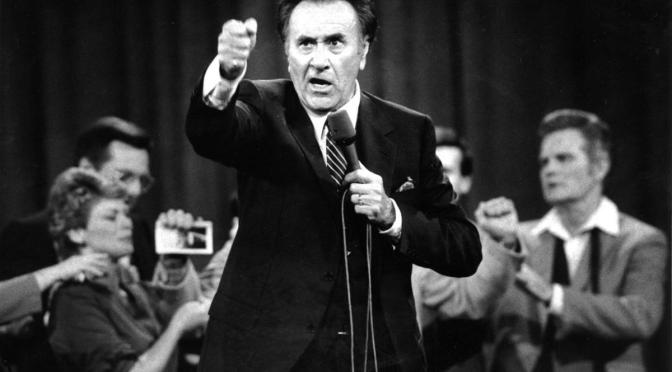
Since the early 1980s, with the rise of the Moral Majority Movement and the Religious Right, much of the American political and cultural landscape has been dominated by a very specific type of Christian, commonly known as conservative evangelicals (though I think this is a misnomer).
This wing of the Church has successfully taken over much of American media – including radio, television, and the Internet. They have successfully lobbied in politics at every level of government. They were a major force behind the elections of several presidents – Ronald Reagan, both George Bushes, and now Donald Trump. Their version of Christianity and its connections with power and money are all throughout American society. Even in the small town where I grew up, I was once active in a conservative evangelical church in which pamphlets were handed out instructing their congregants how to vote, and I recall another instance at another local church in which the local Republican Party came by for signatures after worship.
This partnership between American big business, politics, and conservative churches seems like it has always been the case. For many of us, the last 40 years feel like a lifetime (and as someone born in the early 90s, it has been a lifetime). However, we must remember that this has not always been this way.
Food that was supposed to be distributed to millions of hungry people, worth half a billion dollars, is currently being spoiled after Donald Trump stopped all American aid around the world – and the person who revealed this was immediately fired by the Trump regime!
Trump and his billionaire friend Elon Musk have shut down USAID, which was the world’s largest donor and accounted for 40 percent of all humanitarian aid in the world. They claim they are doing this to “reduce waste” and “increase efficiency” – but how is it efficient to let food worth 500 million dollars go to waste instead of feeding starving people? Isn’t that the very essense of wastefulness?
What Trump and Musk is doing to USAID is not only immoral but also illegal, yet Trump and Musk completely disregard what is legal right now by halting aid that Congress has approved in a very authoritarian way. Here are more examples of life-saving measures that have been stopped by Trump and Musk:
Ivory Coast: A US-sponsored program to collect sensitive intelligence information about Al Qaeda-related incidents has been discontinued.
Sudan: Most soup kitchens feeding 816,000 people in Khartoum have been closed down.
Uganda: Aid workers say that around 40 newborns were infected with HIV per day when the USA stopped funding antiretroviral drugs.
Ukraine & Syria: Organizations providing maternal care, vaccinations, and firewood have been forced to cease their operations.
Thailand: Patients were told to leave a US-funded refugee hospital on the border of Myanmar.
Additionally, hundreds of Christian organizations around the world have been forced to halt initiatives to provide food and healthcare to millions of poor people. Several evangelical organizations and churches have now appealed to Trump to restore aid to Christian organizations – something he refuses to do.
At the same time, there are other evangelical Christians who completely rejoice over the closure of USAID because it is seen as “anti-woke” and because they believe in the propaganda that it combats corruption. How does that combat corruption by stopping care for children with HIV and letting food rot, you wonder?
Of course it does not. Instead, Trump and Musk ensure that they benefit themselves and their companies while pocketing billions from aid meant for the poorest. The love for money is truly a root of all evil, as the Bible says (1 Tim 6:10).
Musk was confronted about this by a journalist at the White House, and he admitted he was wrong (without saying that the aid should be reinstated) but claimed that it is still unreasonable to spend 50 million on condoms somewhere because there are too many condoms—despite the fact that the majority of the project is not about purchasing condoms at all, but rather about combating AIDS in other ways!
It is completely incomprehensible how an incredible amount of competence and experience in helping the poor is thrown in the trash when USAID is shut down, while the incompetent, criminal billionaires Trump and Musk have been given more power than anyone else on earth.
And the sad part is that many Christians cheer for them while at the same time cutting back on the massive amount of aid work carried out by Christian organizations. May God bring repentance, sanity and hope to the United States.
Micael Grenholm is a Swedish church historian, author and an editor for PCPJ.
Pentecostals & Charismatics for Peace & Justice is a multicultural, gender inclusive, and ecumenical organization that promotes peace, justice, and reconciliation work among Pentecostal and Charismatic Christians around the world. If you like what we do, please become a member!
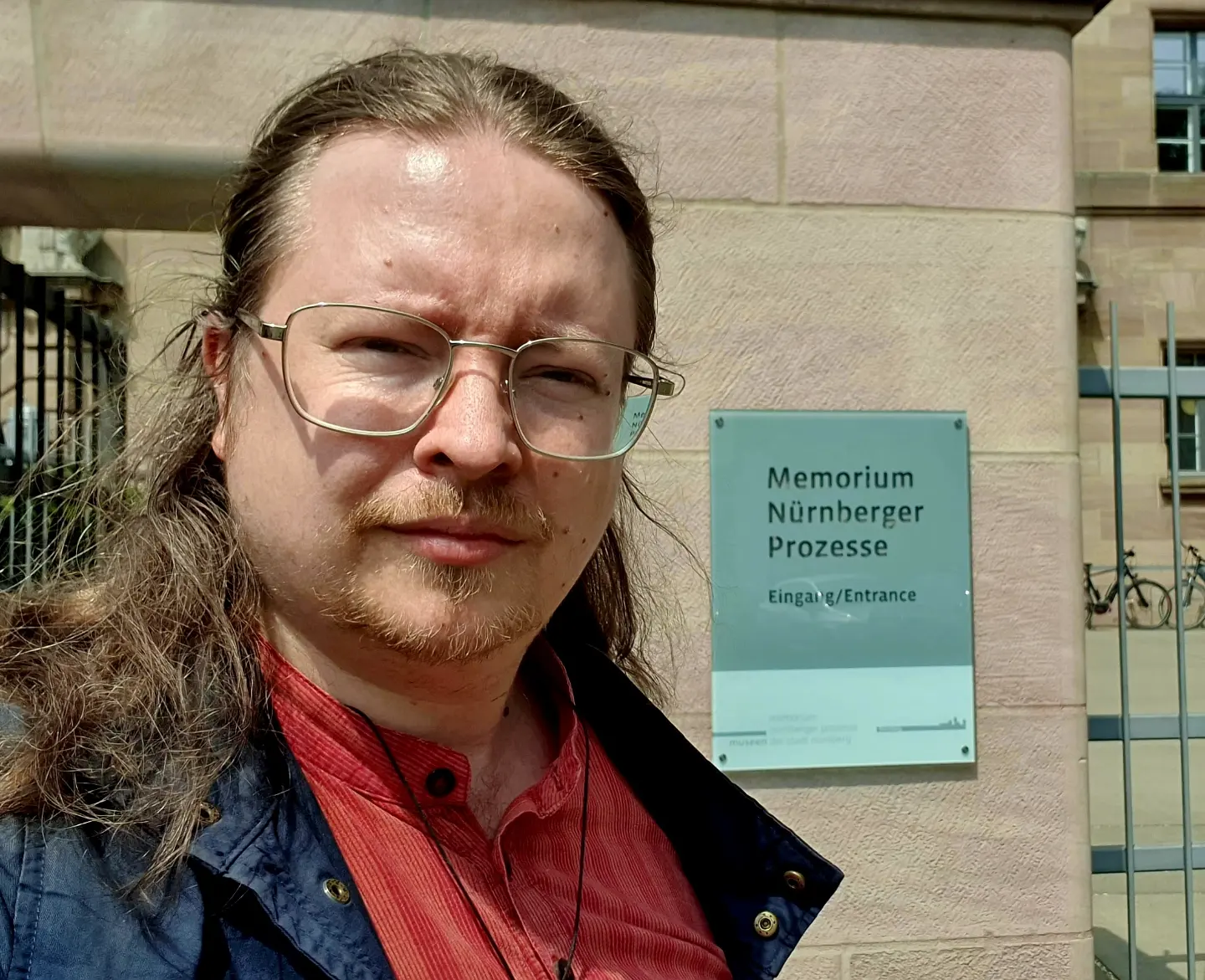
“Would you like to come to Germany?” I asked my communal brother Jacob when I had been invited to speak about peace theology in Nuremberg. “Jawohl!” he answered. So then we went to Kirchentag, Europe’s largest Christian conference, which is estimated to gather around 100,000 people.
And of course, we took the train there! The best way to travel with consideration to the climate, the view, and opportunities for evangelism!
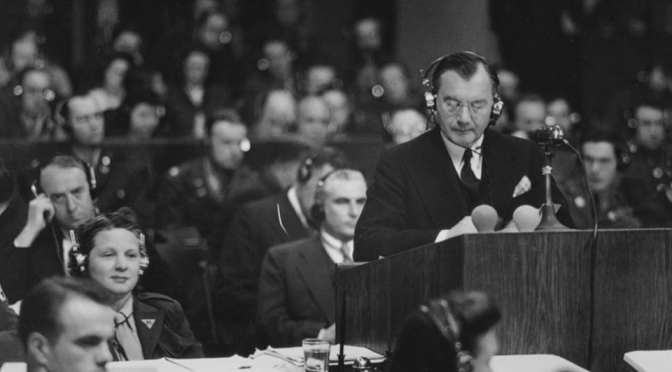
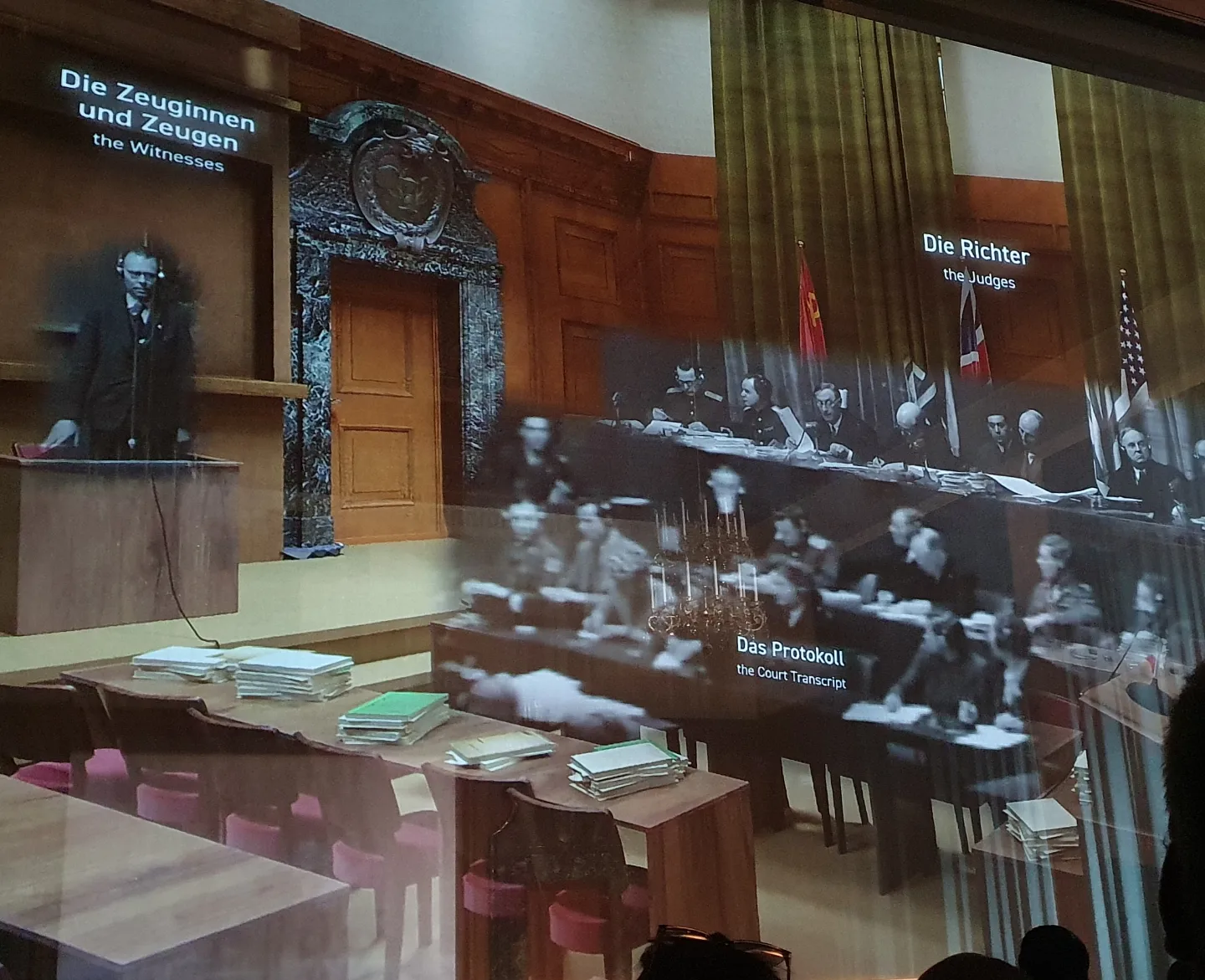
Once there, we visited the museum for the Nuremberg Trials – the place where several Nazis were convicted of crimes against humanity after World War II was over. They were not perfect trials, and they led to several death penalties, which in themselves are crimes against human rights, but despite their shortcomings, Nuremberg paved the way for the International Criminal Court and that politicians, like everyone else, can be held accountable for their actions.
Something that is really striking is how all the Nazis claimed to be innocent. They argued, partly, that the Holocaust was a war action parallel to how the Allied armies also massacred German civilians by bombing cities, and partly that they could not be held accountable for the genocide because they were just following orders.
But neither the “yes, but what about you” argument nor the “I was just doing my job” argument absolves us from moral responsibility for how we treat our fellow humans. Yet these arguments are often used by us non-Nazis to justify all kinds of bad behavior. Instead of taking responsibility for not living at the expense of the poor, overusing the Earth’s resources, or endangering refugees, we often reason that someone else is worse, and we are just doing our job. But how will the world ever become a better place if we only shift the blame?
The Bible emphasizes that everyone is responsible for their deeds (Rom. 2:5-6). And thankfully, God offers forgiveness when we fall short and power through His Spirit to take greater responsibility to do good towards others (Eph. 2:8-10). It was powerful to see how the courtroom where the Nazis were tried was adorned with a crucifix. We truly need God’s help in these dark times to ensure that their terrible ideas disappear once and for all.
Now, comparing the Nazi excuse “I was just doing my job” and today’s similar excuses for various bad behaviors could be seen as unfair and in violation of Godwin’s Law. But there is no literal law against drawing parallels with Nazism and contemporary phenomena online, especially when the comparison starts from a museum about Nazism and includes the writer himself (I write us non-Nazis above). It is not forbidden to have such a conversation in real life, so why should it be forbidden on the Internet?
Godwin observed how absurd it was that almost every forum thread on the Internet in the 90s, no matter what it was about, led to people calling their opponent Hitler. There is no prohibition against discussing parallels between World War II and our time – on the contrary, the absence of such comparisons would be extremely dangerous!
At the museum, I was struck by how bureaucratic and mundane the crimes of Nazism were, what Hannah Arendt called “the banality of evil”, where not only soldiers but also cleaners, drivers, factory workers, etc. were “just doing their job”. I think this is a very thoughtful comparison to how almost the whole society actively contributes to the climate crisis when too few are making changes – and the climate crisis risks killing not just six million people but several billion.
Knowing that what one is doing could contribute to several million or billion deaths, and not trying to change it but instead continuing, I absolutely think is parallel to contributing to genocide. But just as the Nuremberg Trials focused on those at the top of the hierarchy, the politicians and businessmen causing the largest emissions also bear the greatest responsibility. And we must never forget that whatever harm we cause, there is always forgiveness and transformation available in Jesus Christ!
Micael Grenholm is a Swedish church historian, author and an editor for PCPJ.
Pentecostals & Charismatics for Peace & Justice is a multicultural, gender inclusive, and ecumenical organization that promotes peace, justice, and reconciliation work among Pentecostal and Charismatic Christians around the world. If you like what we do, please become a member!
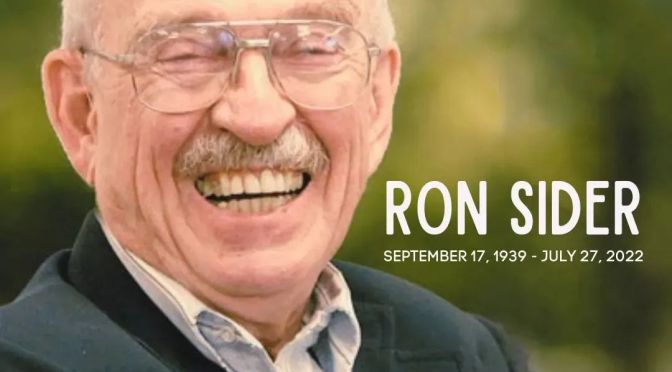
This book has sold over 400,000 copies and has been translated into multiple languages. In it, Sider argues that Christians have a moral responsibility to actively work towards ending poverty and economic inequality and that prosperity theology, which teaches that wealth is a sign of God’s favor, is misguided.
Sider’s work has also had an impact on the broader society. He has been a leading voice in the Christian social justice movement for several decades, and has been influential in shaping the thinking of many Christians on issues of poverty, economic justice, and the role of faith in politics and society. He was the founder of Evangelicals for Social Action (nowadays called Christians for Social Action), an organization that works to mobilize evangelicals to advocate for social justice issues. Through his books, speaking engagements, and involvement with this organization, Sider has been instrumental in raising awareness of poverty and economic inequality and encouraging Christians to take action to address these issues.
Ron Sider was also a devoted pacifist and his speech at a Mennonite conference in 1984 that pacifists needed to be as willing to make sacrifices for peace as soldiers led to the founding of the Christian Peacemaker Teams, an organization that sends nonviolent observers to conflict zones.
Ron Sider’s work on nonviolence and peacemaking is centered around his belief that Christians have a moral responsibility to actively work towards peace and justice. He argues that war and violence are not consistent with the teachings of Jesus and that Christians should instead strive for nonviolence and reconciliation.
One of his notable contributions in this area is his book “Just Peacemaking: Ten Practices for Abolishing War” which was first published in 1992. In this book, Sider outlines ten practices that individuals, churches and nations can engage in to work towards the abolition of war and the establishment of just peace. These practices include: nonviolent resistance, conflict resolution, economic alternatives to military spending, and the promotion of democracy and human rights. He also argues that Christians should actively work towards disarmament and the abolition of nuclear weapons, and that the just war tradition has been misused to justify violence and war.
Sider’s work on nonviolence and peacemaking has been influential in shaping the thinking of many Christians on issues of peace and justice. He has been a leading voice in advocating for nonviolence and disarmament, and his work has helped to raise awareness of the moral implications of war and violence.
I listened to him when he visited Gothenburg over ten years ago and I was struck by his passion to follow Jesus and his Sermon on the Mount no matter what it costs us. We need more disciples like Ron!
The media does not seem to think it is as exciting and controversial as if Donald “Fire and Fury” Trump had received it. But WFP is needed more than ever.
They do an incredibly good job of identifying hunger crises before they break out and fighting for as many as possible to survive. The problem is that, like most UN programs, they are underfunded.
Micael Grenholm is a Swedish pastor, author and editor for PCPJ.
Pentecostals & Charismatics for Peace & Justice is a multicultural, gender inclusive, and ecumenical organization that promotes peace, justice, and reconciliation work among Pentecostal and Charismatic Christians around the world. If you like what we do, please become a member!
Why are many American Pentecostals disobedient regarding efforts to stop the spread of COVID-19? Are Pentecostals and Charismatics in other parts of the world behaving differently? How was the strong faith in healing that characterized early Pentecostals impacted by the pandemic known as the “Spanish Flu”?
A few weeks ago, PCPJ gathered a panel of scholars and Pentecostal leaders to discuss these important questions. The panel consisted of:
– Jörg Haustein, doctor of World Christianities, University of Cambridge. – Erica Ramirez, president of PCPJ, director of applied research, Auburn Seminary. – Daniel Isgrigg, director for the Holy Spirit Research Center, Oral Roberts University. – Niclas Lindgren, director, PMU Interlife. – Andrea Johnson, Assistant Professor of History, California State University DH. – Micael Grenholm, pastor, editor at PCPJ.
Everybody brought interesting food for thought to the table. Isgrigg compared Pentecostal reactions to the Spanish Flu with what we see today. Ramirez spoke about what aspects of the Pentecostal faith makes it vulnerable to conspiracy theories. Haustein pointed to the nuance between different Pentecostal and Charismatic groups even in the same country. Johnson gave a historical backdrop to how American Pentecostals view politics.
I was recently published in the Christian Post where I argued that Christians should live simply, generously and sustainably to address global hunger. Three million children die annually, while the rest of the world has much more food than we need (and throw away large portions of it).
I didn’t expect much opposition to what I wrote, but it turns out that in some evangelical circles, feeding the hungry is a sensitive topic.
Jeff Maples at Reformation Charlotte wrote a passionate response in which he, among other things, calls me a heretic and say that I preach a demonic message that might lead to me losing my salvation. Let’s see if he has any Biblical support for these accusations:
Evangelicals are lining up at the door trying to make the case that Jesus is all about a socialistic government that makes everyone equal. One of the stupidest articles I’ve seen in a long time is an article recently published at the Christian Post by Micael Grenholm titled How would Jesus respond to global hunger? In the article, while he doesn’t use the word “socialism,” Grenholm argues that Jesus taught a form of socialism based on the story of Lazarus and the rich man in Luke 16:19-31.
Maples is right about me not mentioning socialism. I also don’t mention governments. How Maples reaches the conclusion that my point with the article is that “Jesus is all about a socialistic government” is therefore quite a mystery. Continue reading Did Jesus Really Not Come to Address Global Hunger?→
The prosperity gospel, or “health and wealth” preaching, originated about 70 years ago in the United States. At various tent meetings connected to Voice of Healing and similar ministries, preachers like Oral Roberts and A. A. Allen started to teach things like financial sowing and reaping, the prosperous power of faith and that God wants us to be rich.
Their theology was influenced by Baptist theologian E. W. Kenyon, who in turn was highly influenced with ideas from New Thought. This American movement is quite similar to New Age and emphasizes, among other things, the power of the mind to influence physical reality by, for example, naming and claiming health and wealth before it actually has materialized.
Sounds familiar?
Of course, a believer in the prosperity gospel will probably reject the brief historical review above and claim that they believe in these things because it is what the Bible teaches. And so, we must deal with the Biblical material. In this article, I will go through two passages that challenge prosperity teaching, and two that’s being used in its defense. Continue reading The Problem With Prosperity→
This series of posts is dedicated to (re)considering basics of Christian faith, and today we examine one regularly misconstrued topic: tithing.
Tithing Mandate?
The Church persistently preaches that Christians must tithe, meaning give 10% of their income to the local church. Of course, there’s a whole sub-genre on whether or not 10% means from net or gross pay. Churches tend to push gross.
And lest we think this is a minor concern, churches often organize around this compulsory practice. I’ve been on staff at churches, in fact, that would not allow churchgoers into leadership positions until they tithed, even though other less concrete aspects of their lives were not as unequivocally scrutinized.
So the question I want to consider is whether or not tithing is a prescribed Christian practice, especially within the contemporary Church context where tithing (or at least giving of some sort) is the one message that is preached every single week during the offering portion of the service. In what follows, I will suggest that tithing is actually not a Christian prescription. But before we delete our online giving profiles, we’ll also discover that Jesus’ actual invitation is much more profound and “costly.” Continue reading Do Christians Have to Tithe?→
Poverty is one of the most pressing issues in the world today. Despite our best efforts we still have a very long way to go. Children continue to die of hunger, people still make the choice between food and education, some will never have the opportunity to fulfill their potential, simply because there’s not enough.
In an era when it has been reported by the bank, Credit Suisse in November 2017, that the world’s richest 1% own half the world’s wealth, the other side of the coin is that the 3.5 billion poorest adults each have assets of less than $10,000. These people, who account for 70% of the world’s working age population, own just 2.7% of the global wealth.
None of us can fail to notice that there are crises at the gates of every culture and nation. War and famine produce refugees in numbers that are untenable. Our broken economies are driven by the greed of those for whom the almighty dollar has far greater value than the life of one small child, one refugee, one trafficked woman, one homeless person.
Not the least of our problems is the lack of good leadership. When the prophet Daniel was interpreting King Nebuchadnezzar’s dream about his future insanity, he pleaded with him to change his ways (Daniel 4:27) in order to avoid the catastrophic effect of his pride. His key point was that he ‘break from his wicked past and be merciful to the poor’. Integral to really good leadership is mercy for the poor. Continue reading Living Generously→













 PCPJ
PCPJ 