Tag Archives: palestine

Why are these Christians denying that children are starving in Gaza?

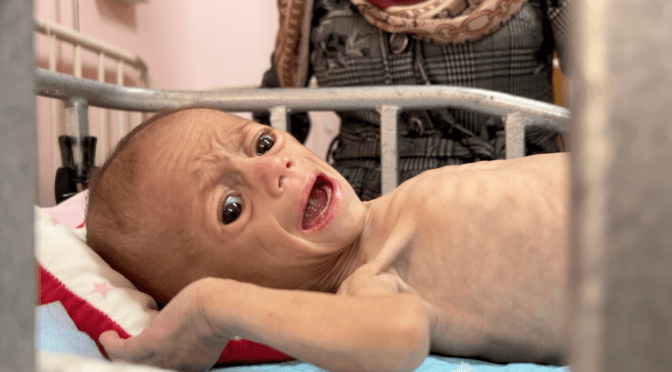
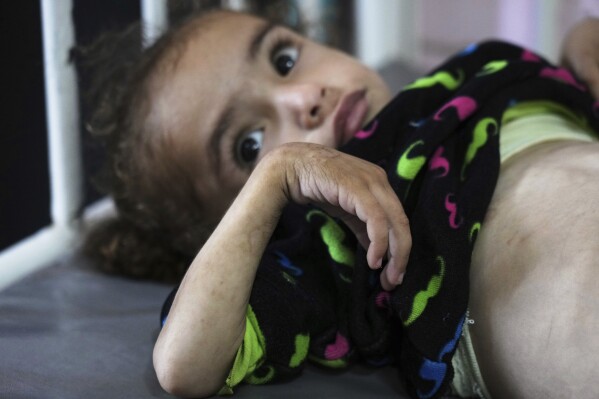
Children are starving in Gaza, with many being malnourished and some losing their hair and will to live.

The image above were taken by the BBC and the one below by the AP. They show five-month-old Siwar and two-year-old Mayar, both severely malnourished due to the food shortage in Gaza.
Worsening hunger in Gaza has sparked global condemnation and intense diplomatic pressure on Israeli Prime Minister Benjamin Netanyahu to allow humanitarian aid to reach the over 2 million people trapped in the territory, after aid had been entirely blocked for more than two months in violation of human rights.

On Sunday evening, Netanyahu said the blockade would be lifted, acknowledging that a growing “starvation crisis” was beginning to harm Israel’s international reputation. He said that he would allow a “minimal” amount of aid due to “diplomatic reasons“. According to the UN, the aid Israel now allows is far from sufficient.

Blocking all emergency aid for over two months so that children starve, become malnourished and are forced to eat garbage is a crime against humanity and never, ever okay. Hamas is a terrible terrorist organization that has committed many other crimes against humanity. But forcing children to starve is a crime against humanity and the unauthorized use of starvation as a weapon of war no matter how terrible Hamas is. It is not something that can be done.

It is always wrong to let children starve, and therefore it was wrong for Netanyahu’s government to deliberately and systematically refuse to let in emergency aid so that children began to starve. That doesn’t excuse the crimes Hamas commits, just as Hamas’ crimes are also no excuse for Netanyahu letting children starve.

Yair Golan, head of the opposition Democratic Party and a former deputy chief of the Israeli military, criticized the government’s conduct. He argued that the military campaign had been excessively violent and that much of the harm was already irreversible.

Speaking to Reshet Bet radio, Golan compared Israel’s growing international isolation to that of apartheid-era South Africa.

“A sane country doesn’t engage in fighting against civilians, doesn’t kill babies as a hobby and doesn’t set the expulsion of a population as a goal,” he said.

Over 15,000 children have now died in Gaza, according to Save the Children.

Still, this past week, Christians who support Israel’s war in Gaza have said and written to me:

  • That no children have died in Gaza.
  • That there is no famine in Gaza.
  • That there is famine in Gaza, but you mustn’t talk about it because that’s exactly what Hamas wants.
  • That there is famine in Gaza, but Israel has not blocked food shipments there for over two months.
  • That Israel has blocked food shipments to Gaza for over two months, which has led to famine—but it’s still entirely Hamas’ fault.
  • That Israel has blocked food shipments to Gaza, and that’s completely justified since Israel has no responsibility to feed Gaza’s civilian population, even after the Israeli army destroyed 70 percent of all agricultural land in Gaza.
  • That starving Palestinians are just “reaping what they’ve sown.”
  • That God wants the Palestinian people to be wiped out just like certain nations were exterminated in the Old Testament.

This is insane. It’s as if one has to live in a parallell reality in order to defend Israeli war crimes. Or blatantly support war crimes and genocidal rhetoric, calling for Palestinians to be “wiped out” upfront.

What would Jesus do?

Micael Grenholm is a Swedish church historian, author and an editor for PCPJ.

ska%cc%88rmavbild-2017-01-06-kl-21-17-02

Pentecostals & Charismatics for Peace & Justice is a multicultural, gender inclusive, and ecumenical organization that promotes peace, justice, and reconciliation work among Pentecostal and Charismatic Christians around the world. If you like what we do, please become a member!
Israeli Soldiers Say They Were Ordered to Kill Civilians and Children in Gaza

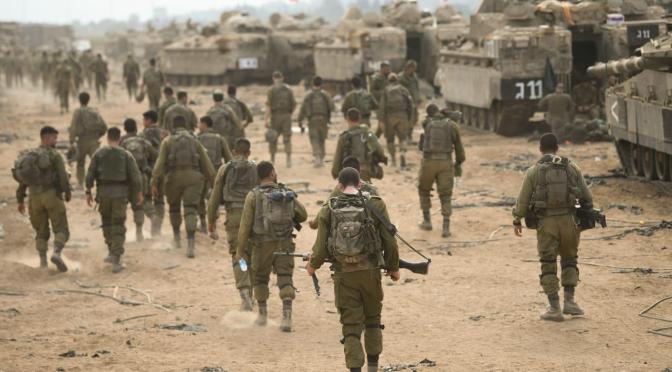
Israeli soldiers are now speaking out about how they have been ordered to kill men, women, and children in Gaza because “no one counts as a civilian,” “everyone is a terrorist.” They have created a “kill zone” that covers a third of all Gaza’s farmland, where every building has been destroyed and every Palestinian is shot at—for instance, when they come to collect food.

These are some of the most horrifying war stories I have ever read. Just a few weeks ago I heard a Pentecostal pastor claim that Israel does everything it can to avoid civilian casualties and that the International Criminal Court’s charge that Israeli Prime Minister Benjamin Netanyahu should be arrested for war crimes should not be taken seriously.

But Israeli soldiers themselves say this is happening. Their accounts appear in a report by Breaking the Silence—an Israeli organization founded by combat veterans—and are corroborated by The Guardian, which conducted its own interviews. The existence of the kill zone—where virtually every building has been razed—can also be confirmed by satellite imagery.

These are very real war crimes.

One soldier, Yotam Vilk, recounts how they were ordered to shoot every Palestinian who entered the kill zone. He personally saw twelve people killed, including a teenage boy.

A sergeant in the Israeli army said they were told to kill every man who entered the zone, while women and children were to be driven away with tank fire. Different units seem to have had different rules. One captain said that every person who entered the kill zone “was considered a threat and sentenced to death,” regardless of whether it was a woman or a child.

Another captain described how the pain of Hamas’s horrific terror attack on 7 October 2023 made Israeli soldiers want to inflict the same pain in return:

“[We] set out on this war out of insult, out of pain, out of anger, out of the sense that we had to succeed. This distinction [between civilians and terrorist infrastructure], it didn’t matter. Nobody cared. We decided on a line … past which everyone is a suspect.”

“A lot of us went there, I went there, because they killed us and now we’re going to kill them. And I found out that we’re not only killing them – we’re killing them, we’re killing their wives, their children, their cats, their dogs. We’re destroying their houses and pissing on their graves.”

Hate breeds more hate, violence breeds more violence. Hamas’s heinous terror attack does not justify Israeli shelling of civilians. There are no winners, no “good” armies in this dreadful war. Let us stand on the side of peace and life in this terrible conflict.

Choosing Another Messiah

by Ramone Romero.

I did not die so that you could defeat,
steal from, kill and destroy your enemies.
I died so that you would love them
as I loved you while you were My enemies.

What do you want, My children?

Do you want Me and My kingdom
or do you want Barabbas
and what he fought and killed for?
You cannot have both.

Woe! Woe! Woe!
My people are choosing Barabbas,
following him, and teaching his ways!
They reject Me for another ‘Jesus’!

Turn, My people!
Turn from your ways and be saved!
For the path you are choosing
leads only to death!

I give life through the Cross
—not through the sword!
If you live by the sword,
you will die by the sword.

*****

Ramone Romero is an artist based in Osaka, Japan. 

ska%cc%88rmavbild-2017-01-06-kl-21-17-02

Pentecostals & Charismatics for Peace & Justice is a multicultural, gender inclusive, and ecumenical organization that promotes peace, justice, and reconciliation work among Pentecostal and Charismatic Christians around the world. If you like what we do, please become a member!
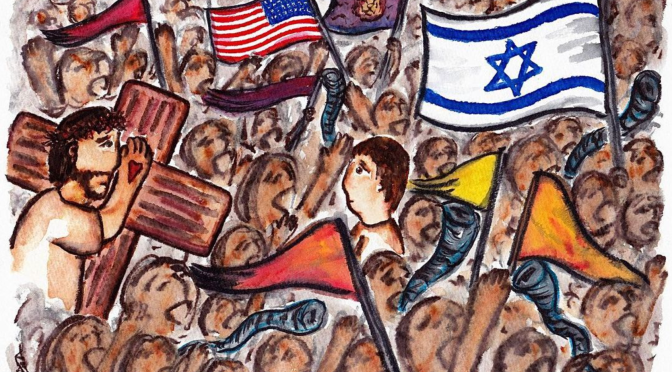
(art: “The Release of Barabbas” and “Follow the Lamb”, by Ramone Romero)

What if Jesus Entered Gaza?

by Sune Fahlgren.

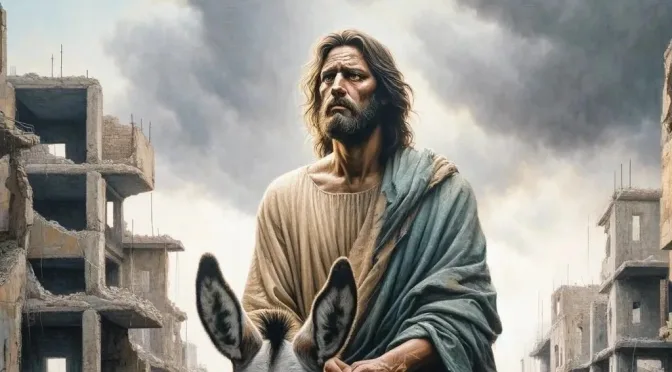
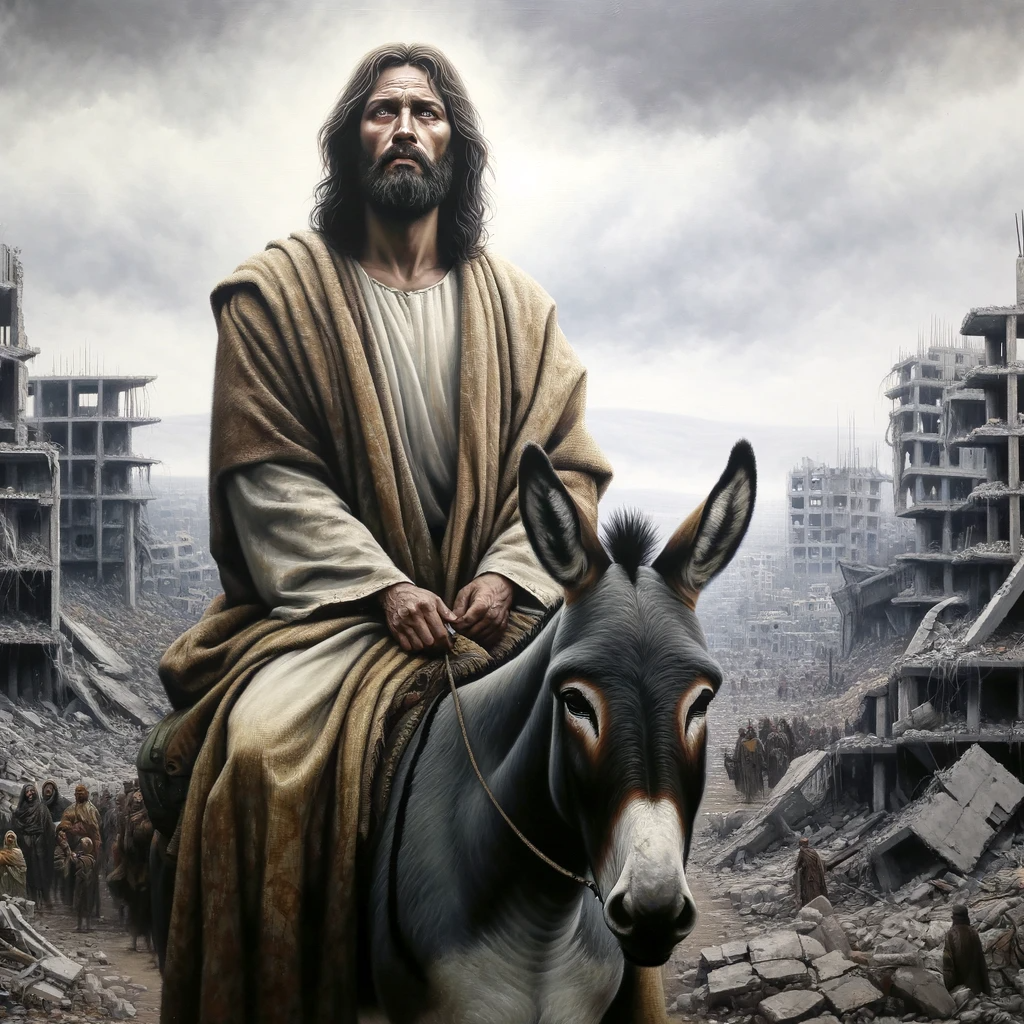
This advent, Matthew 21 will be read in churches all over the globe, telling the story of when Jesus rides into Jerusalem on a donkey. Let us imagine Jesus instead approaching Gaza City… The Prince of Peace has heard the cries from over two million people, completely without future and hope. What happens when he rides into war-torn Gaza?

A gigantic humanitarian disaster is already a fact. Jesus knows this and therefore chooses to see reality with his own eyes during a few days of temporary ceasefire.

The disciples have rushed ahead to arrange permission through the now only possible border crossing at Rafah, a place that Jesus passed with his parents during their flight to Egypt. The disciples present Jesus as the supreme leader of the approximately 300 Christians remaining. They want to celebrate the advent of hope with Jesus’s radical message of peace at the center.

The stir is great at Rafah during the temporary ceasefire, with both prisoner exchanges and queues of long-haul trucks with aid. Like everyone else – diplomats, healthcare, and aid workers, truck drivers – Jesus must go through security procedures. Even his sandals are x-rayed. However, he is completely unarmed. Jesus and three of his disciples are allowed in.

Inside the Gaza Strip, which is no larger than Las Vegas, some young boys offer Jesus a donkey to ride on. Cars exist, but gasoline is now lacking. Lamps exist, but there is no longer electricity. Water exists in springs, but it is not drinkable.

Jesus’s path goes through a moonscape. Old monasteries and Christian memorials from desert fathers and mothers are now just grains of sand. Israeli military operations in 2008, 2012, 2014, and now 2023 have dropped tens of thousands of bombs, causing devastation of unimaginable proportions. Every teenager in Gaza has been traumatized multiple times.

The closer Jesus gets to Gaza City, the stronger the sewage stench from the Mediterranean. There are no longer any functioning purification plants. All sewage is flushed into the sea. Even the once beautiful beaches with fishing boats are now a ticking bomb.

Jesus rides slowly into Gaza City, which has become a “ghost town”. He recites aloud the old prophetic words: “Prepare the way for the Lord in the wilderness, make a straight path in the desert for our God…” Then Jesus begins to pronounce names of places where violence has triumphed in modern times: Guernica, Oradour, Babij Jar, Katyń, Lidice, Sharpeville, Treblinka, Hanoi, Rwanda… “And in advent 2023, we must add Gaza,” says Jesus with sorrow in his voice.

The remaining people in Gaza City have heard about the unusual visit and come running. In the absence of anything else, they lay their t-shirts on the ground. Some have made palm leaves out of bomb scrap. Some young men dance dabke in front of the donkey ride, and children sing along the way “Biladi, ya ardi” (“My homeland, my earth”). Jesus is hailed as a prophet, a liberator.

The disciples start to get worried. Surely Jesus shouldn’t be this political? He could be killed as a supporter of Hamas. Silence the children! They are singing the national anthem. But Jesus calms the anxious:

“Strangely enough, there is currently a unique space for action for all involved parties. I want to talk to the leaders of Israel and the Palestinians about their responsibility, and offer a vision of Gaza as a thriving free trade area in the Mediterranean – like Singapore in Asia. I want to meet with Netanyahu, and as a Jew, plead for the peace talks to be resumed for the sake of Israel’s own best.”

Jesus reminds that he has already delivered a speech to humanity known as the “Sermon on the Mount”. A message of bold kindness and radical mercy. It is now the mission of his disciples to turn this manifesto into socio-politics and broad popular movements. Violence must not obliterate politics! The Jewish philosopher Hannah Arendt argued that “only through politics does real power and freedom develop.”

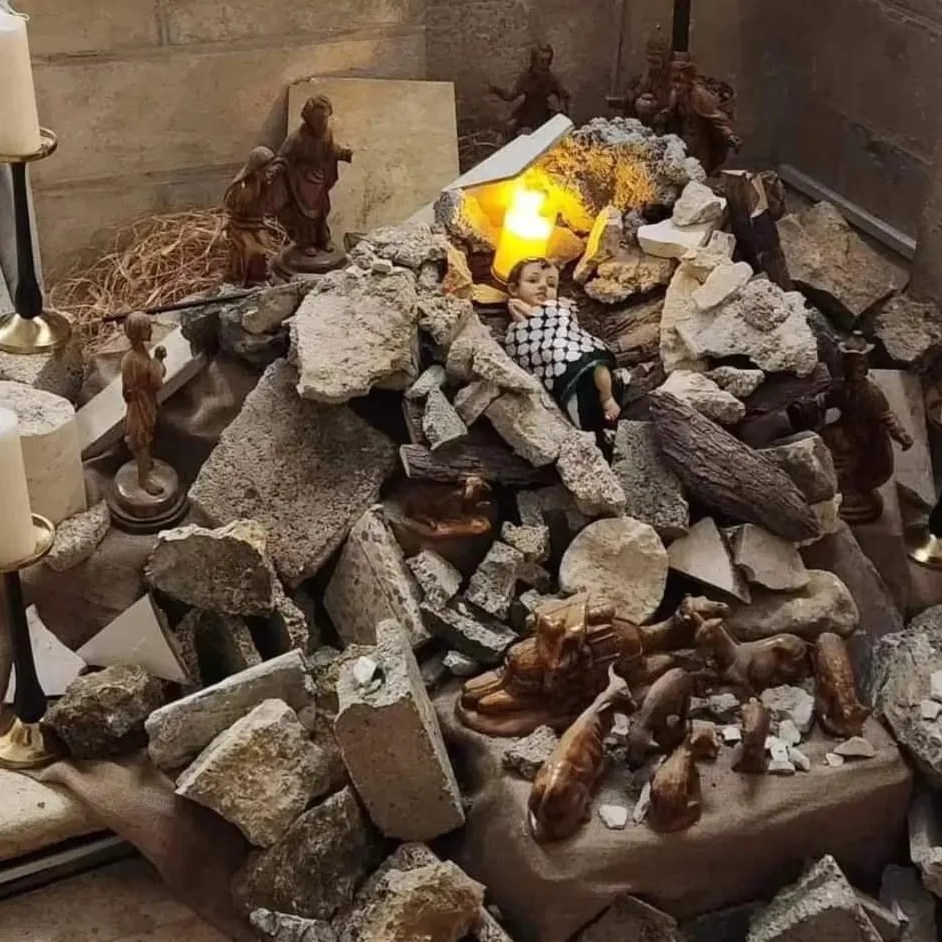
Nativity scene in the Lutheran Church in Bethlehem, Palestine, Christmas 2023

We, who in thought accompany Jesus into Gaza, probably find it hard to see a solution to the war that is now raging. But still, it is not only the violence and nationalism of the warring parties that prevent a just peace, but the self-absorption of many at political or at “biblical” and other religious positions. My question is therefore: Where are the broad alliances, built on respect for each other, where we dare to seek out the core of the conflict?

Gaza is a microcosm of evil and barbarity in our time, but also of simple people’s distress, courage, and resilience. To imagine Jesus riding into Gaza highlights the horrors of war: the arrogance of power, the ongoing displacement, and the vulnerable situation of civilians.

Sune Fahlgren is associate professor of practical theology at the University College Stockholm, Sweden. This is a modified translation of an article he wrote for the Swedish newspaper Dagen.

A Prayer for Israel and Gaza

God, you are the light that darkness cannot overcome. You are the Prince of Peace and the Reconciler, you make the impossible possible.

Protect all those affected by the war between Hamas and Israel. May the horrific acts of terror be stopped, may those taken hostage be freed, may those seeking refuge from rockets and bombs be spared, and may this terrible conflict come to an end.

I pray especially for the children on both sides who are the most vulnerable—hold your hand over them, God, and give them a peaceful future. Amen.

Two things that should be self-evident:

  • Murdering, raping, and kidnapping civilians is not a “fight for liberation”; these are horrific acts of terror that Hamas has committed against Israel and cannot be excused.
  • Stopping the import of food and water to the entire population of Gaza is the wrong way for Israel to respond to these acts of terror; it is a life-threatening collective punishment that violates international humanitarian law.

Half of the population of the Gaza Strip is children. A million children who bear no responsibility for Hamas’s rule and their horrific terror attacks. They are some of the most vulnerable right now in the war.

Doctors Without Borders are on the ground in Gaza and report that most of their patients are children between the ages of 10 and 14. They have called for humanitarian corridors so that food and medicine can reach the most vulnerable.

They also write that they have offered medical support to Israeli hospitals where a very high number of injured are being cared for after Hamas’s terror attacks. So far, the Israeli healthcare system has managed without their support, but they are ready to help there too if needed.

Donate to them here!

All people are created by God, and all suffering on both sides must be prevented. As missionary Heidi Baker wrote the other day on site in Jerusalem: “Pray for peace and for the innocent, no matter their nation or creed.”

Micael Grenholm is a Swedish church historian, author and an editor for PCPJ.

ska%cc%88rmavbild-2017-01-06-kl-21-17-02

Pentecostals & Charismatics for Peace & Justice is a multicultural, gender inclusive, and ecumenical organization that promotes peace, justice, and reconciliation work among Pentecostal and Charismatic Christians around the world. If you like what we do, please become a member!

The Lasting Impact of Night Raids

This article is cross-posted from Churches for Middle East Peace.

It’s midnight. There’s a knock on the door. You yell that you are coming to open it in hopes that the soldiers don’t blow it open. Moments later, dozens of soldiers invade your house. Your children wake to masked soldiers with guns pointed directly at them, yelling in a language your children don’t understand. They force your family into one room and tear your house apart without explanation. This is the reality that many families have faced across the West Bank.

Night raids are one of the most devastating acts of the Israeli military occupation in the West Bank. The violent raids occur between midnight and 5 AM, often without the families getting an explanation. According to the Women’s Center for Legal Aid and Counseling, 1,360 night raids are executed every year, the majority within 2 kilometers (1.2 miles) of a settlement or near roads that settlers frequent. 

Continue reading The Lasting Impact of Night Raids

Stop Treating the Israeli-Palestinian Conflict Like a Sports Event

Once again, the Holy Land has been struck by war.

I feel compelled to write something that I wish nobody should have to write, something that should be obvious to everyone but which for some ill-conceived reason can be controversial to state in certain contexts:

War is awful.

Hamas firing on and killing the Israeli civilian population is awful.

The counterattacks by the Israeli Defense Forces (IDF) killing Palestinian civilians are awful.

War has no winners, there is no one to “cheer” on as if it were a sports event, there is no victory in war that does not come at the price of hating, tormenting and killing your fellow human beings.

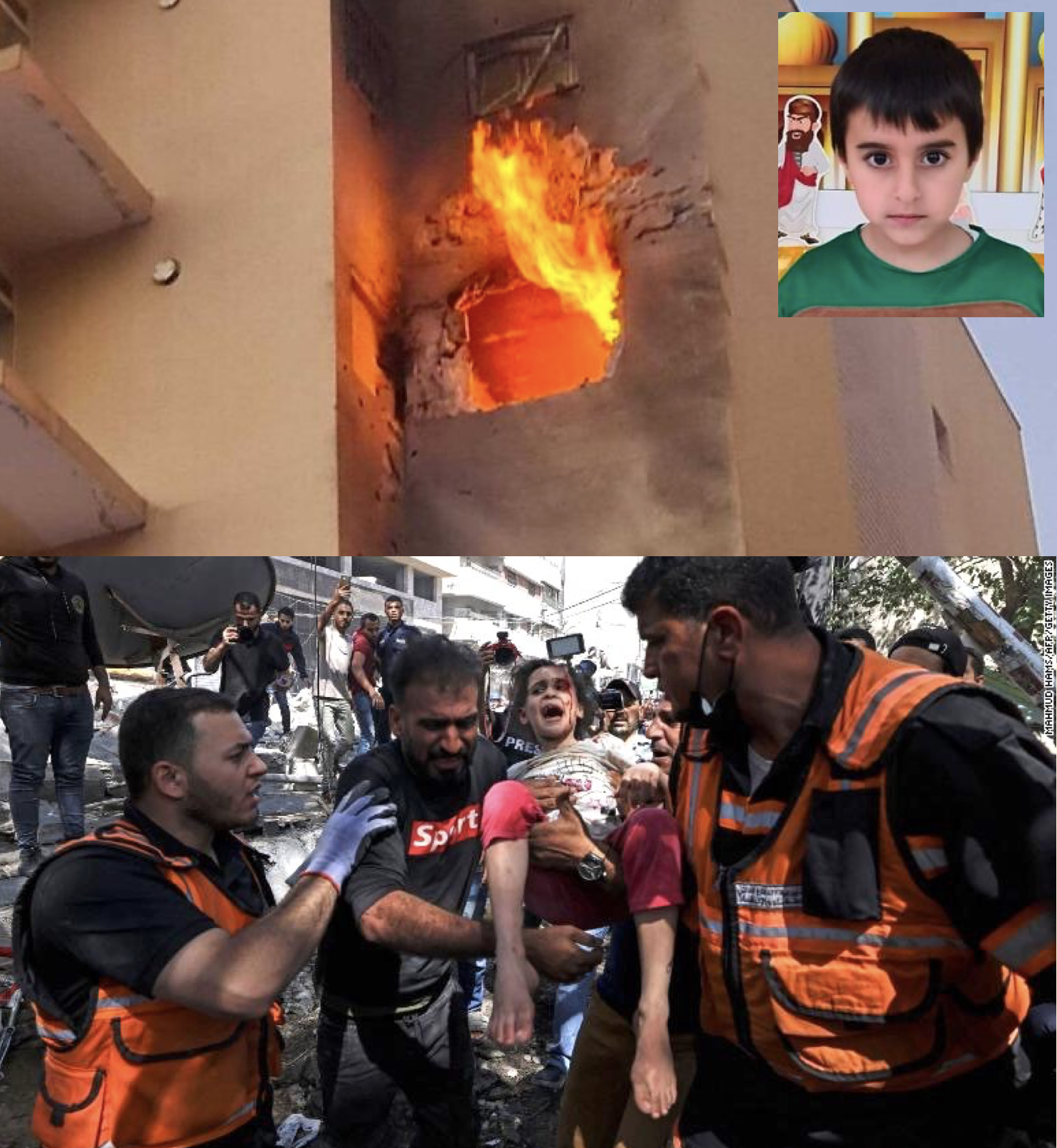
Take a look at these pictures.

The upper image shows an apartment in Israel that was hit by one of Hamas’ rockets a few weeks ago. Five-year-old Ido Avigal, pictured to the right, lived in that apartment. He died immediately.

The picture below shows a girl being rescued by medical personnel after an Israeli attack in Gaza. The attack destroyed nine buildings and killed 43 people, including eight children.

In total, 68 children have been killed in the Holy Land these last couple of weeks. 66 of them were Palestinian.

All of this is awful. It’s sickening.

Continue reading Stop Treating the Israeli-Palestinian Conflict Like a Sports Event

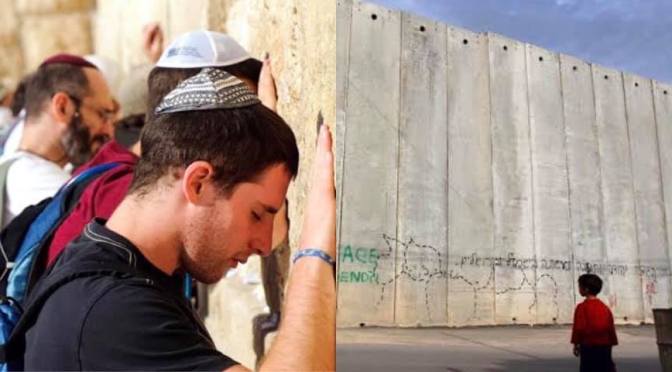
The Two Walls of Israel

(a thought, and a prayer, by Ramone Romero)

If only…

I was thinking

If only all the prayers in that wall

The Western Wall

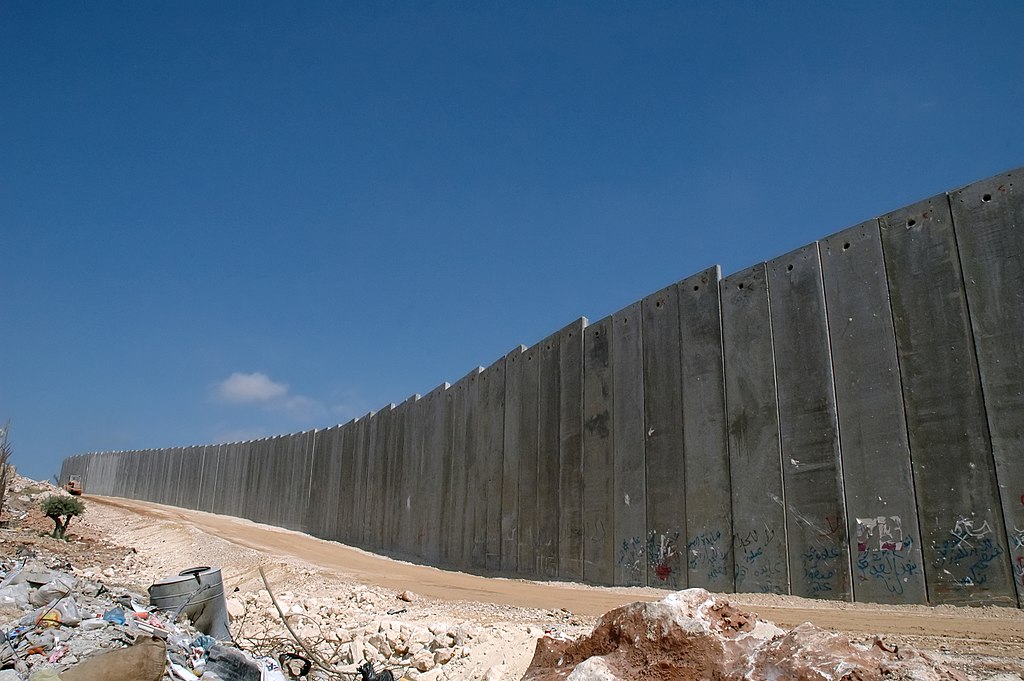
Were put into the West Bank Barrier instead

If only all those prayers

At the ruins of the temple

Were put into the lives of people

Who live among ruins

In the West Bank

In Gaza

Whose homes and lives

Have been left in ruins

If only

If only the wishes that the temple still stood

Were put into seeing the temples of people

Who are standing next door

If only their temples could be rebuilt

In lives

As living stones

If only the temples where we seek God

Were the temples of our neighbors

If only we saw

That the holy temple of God

Is people

Is one another

And our prayers were changed

Into a desire to see them blessed

If only our devotion to religion

Was a devotion to one another

To loving our neighbor

Instead of putting walls between us

If only

Think of what a holy place it could be

When our neighbor is as sacred to us

As the holiest temple of God

If only

I thought, and I pray, in hope

“If only.”

Occupation and Covid: A Strange Christmas in Bethlehem

Guest blog by our friends at Churches for Middle East Peace, originally published here.

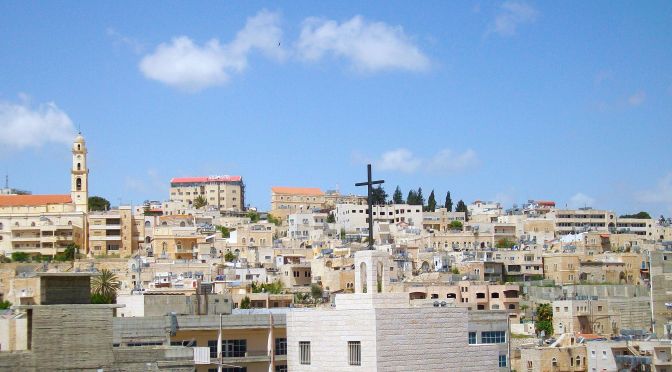
Bethlehem, considered the cradle of Christianity, is perhaps one of Earth’s most special places to embrace the Christmas spirit. Located in the Israeli-occupied West Bank, it’s the “little town” where Jesus was born, and it attracts thousands of pilgrims at Christmas. 

Christians have flocked to Bethlehem for centuries to celebrate the Christmas season, and each year the city hosts approximately one million tourists. 

A Sacred City for Three Religions

Bethlehem is the site of the Church of the Nativity, an underground cave where Christians believe Mary gave birth to Jesus. A 14-pointed silver star beneath an altar that the emperor Constantine the Great and his mother Helena had built around the year 338 marks the spot, and the stone church is a key pilgrimage site for Christians and Muslims alike.

Continue reading Occupation and Covid: A Strange Christmas in Bethlehem

Biblical Justice: Making Things Right

by Katie McRoberts. Originally published at the blog of Churches for Middle East Peace, reposted with permission.

Jezebel, Ahab’s wife, said, “Is this how you act as king over Israel? Get up and eat! Cheer up. I’ll get you the vineyard of Naboth the Jezreelite.”

So she wrote letters in Ahab’s name, placed his seal on them, and sent them to the elders and nobles who lived in Naboth’s city with him. In those letters she wrote:

“Proclaim a day of fasting and seat Naboth in a prominent place among the people. But seat two scoundrels opposite him and have them bring charges that he has cursed both God and the king. Then take him out and stone him to death.”

As soon as Jezebel heard that Naboth had been stoned to death, she said to Ahab, “Get up and take possession of the vineyard of Naboth the Jezreelite that he refused to sell you. He is no longer alive, but dead.” When Ahab heard that Naboth was dead, he got up and went down to take possession of Naboth’s vineyard. 1 Kings 21:7-10, 15-16

While many consider the stories of the Old Testament, often framed by punishment and retribution, to be an example of God’s justice, the reality is that a comprehensive picture of justice is much more complicated. The Bible shows justice as not only an appropriate consequence for sin but also as an expression of appropriate concern for others. Righteousness before God means being in right relationship not only with God but others as well. Continue reading Biblical Justice: Making Things Right