The day after every U.S. Presidential Inauguration, Washington National Cathedral (of the Episcopal Church) hosts an interfaith National Prayer Service. Normally, this event does not get a lot of attention. It is a mundane tradition of American civic religion. This year was different, however.
Bishop Mariann Budde delivered the homily for the service. In her homily, she took a few moments to remind President Trump of the importance of showing mercy to others, especially the most vulnerable and marginalized in our communities. Trump and his supporters responded to this homily by claiming that Bishop Budde was “politicizing” the faith. Trump specifically called her a “so-called Bishop” and “Radical Left hard line Trump hater”. He also demanded an apology from the bishop and the Episcopal Church.
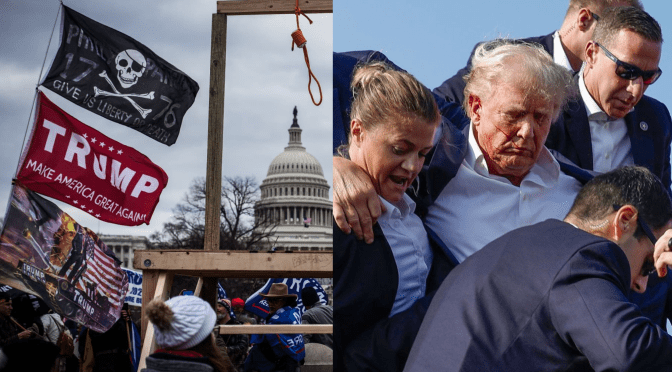
Assassination attempts are always horrendous, evil and sinful, and we condemn the attempted murder of Donald Trump in the strongest terms. No political disagreement is an excuse for violence. Yet, the United States has a dark history of political assassinations – Lincoln, Kennedy, Luther King – as well as assassination attempts. And before Trump, there was Pence.
In this election cycle, many seem to have forgotten the attempted assassinations of Mike Pence, Nancy Pelosi and other members of Congress on the January 6th storming in 2021 when Trump supporters tried to overturn the results from the 2020 presidential election. Some of them had even made a noose, shouting that it was time to hang Mike Pence for accepting the election results.
Trump is asked to give a message of hope to the J6 prisoners. He says they are patriots, and what’s happening to them is a disgrace since Antifa and BLM burned down all our cities and nothing happened to them. pic.twitter.com/poz6KED184
Of course, this does in no way legitimize or excuse the assassination attempt of Trump. As a peace organization, we reject all typs of violence, both when it comes from Trump’s camp as well as when its directed towards it.
Violence is all too often a vicious cycle: sin that leads to sin that leads to sin. After Trump had been hit and the Secret Service had killed the attacker, his bodyguards wanted to immediately take him to a safe area but the former president ordered them to wait so that he could raise his fist to the audience and shout: “Fight!”
The audience loved it, and even some in the non-MAGA crowd have called it “badass”. At the Republican convention where Trump was nominated as presidential candidate in spite of being a convicted felon, the audience shouted “Fight! Fight! Fight!” as he entered the stage with a damaged ear from the attack.
Do you see the double standards here? Trump and many of his supporters have welcomed political violence and threats of violence multiple times, but when political violence is aimed at Trump the demand is not only that his critics should denounce the violence (which, of course, they should) but also denounce factually correct statements that are critical of Trump, such as him being a threat to democracy with his disdain for election results that don’t go his way. And if calls for unity is incompatible with talking about threats to democracy, why don’t Trump’s supporters criticize him when he described the Democrats as a threat to democracy?
Because of the very fact that we’re against all violence, we feel obliged to remind everyone that the Trump movement is in no way foreign to assassination attempts and deadly threats. Violence begets more violence – what’s needed is the way of the Prince of Peace who tells us to love our enemies and reject all kinds of killing.
Micael Grenholm is a Swedish church historian, author and an editor for PCPJ.
Pentecostals & Charismatics for Peace & Justice is a multicultural, gender inclusive, and ecumenical organization that promotes peace, justice, and reconciliation work among Pentecostal and Charismatic Christians around the world. If you like what we do, please become a member!
We live in a violent world. The war in Ukraine is killing thousands and causes huge waves of refugees, economic instability and food shortages. The war in Syria is still going on, and the conflicts in Yemen, Afghanistan and South Sudan no longer even make headlines. During most of the last decade, the world has become less peaceful.
In response to such violence, many people think that the solution is more violence. Conventional wisdom tells us that we need to arm ourselves so we become stronger and deadlier than the “bad guys”.
Christian pacifists, who just like most Christians for the first 300 years believe that Jesus’ words about loving our enemies and turning the other cheek mean that we should not use violence, are often accused of being naive. Some have even claimed that Christian pacifism is evil! While abstaining from violence sounds loving in theory, many argue that the practical consequences of such a stance is catastrophic with countless innocent people killed as the “good guys” refused to harm or kill those who were after civilian blood.
War and violence are thus portrayed as a necessary evil, a last resort that we unfortunately have to use to stop authoritarian, mass-killing regimes.
All this is intuition. It’s what seems reasonable. But when researchers started to compare violent resistance to nonviolent resistance, they were in for a chock.
It turns out that nonviolence is at least twice as effective.
I encountered this research when I was part of a program in peace and conflict studies at Uppsala University. The findings is a real game-changer, making scholars from all around the world rethinking the need and use for military violence in the modern era.
Erica Chenoweth
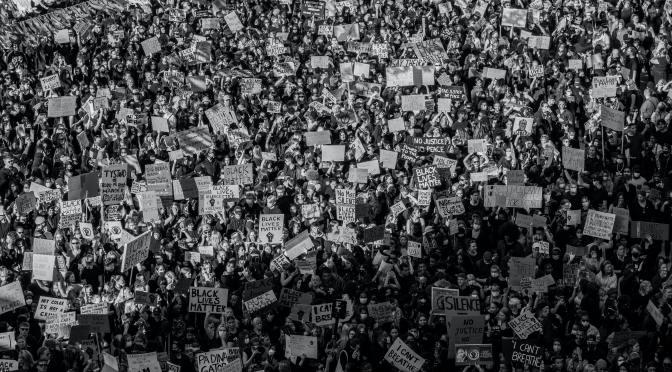
An influential study by conflict researchers Erica Chenoweth and Maria Stephan from 2012 showed that nonviolent movements are twice as effective as violent movements in achieving their goals. They expanded upon this research in the book Why Civil Resistance Works. They collected data from over 300 protest movements between 1900 and 2016. 53 % of the nonviolent movements managed to achieve their goal, usually a change of regime, within a year, compared with 26% of the violent movements.
This study was groundbreaking, as no one had compared the results of violent and nonviolent methods in such a comprehensive way before. In 2018, Chenoweth published a new study together with Evan Perkoski that examined how well nonviolence compared to violence counteracted mass killing, when regimes kill 1000 people or more. They found that nonviolent movements were five times more effective at avoiding this than violent movements.
What are the reasons for the effectiveness of nonviolence? Chenoweth points to several factors. Nonviolence is generally cheaper and can easily recruit many more, there is greater variety of nonviolent methods than violent methods, it is psychologically more difficult for loyalists to harm or kill nonviolent trainees than armed rebels, and it is easier for loyalists to change sides and unite with nonviolent protests and nonviolent sabotage.
Chenoweth’s work has made a significant impact on peace and conflict research in general. Even non-pacifists like James Pattison and Ed Cairns have gained greater respect for non-violent methods and warned against resorting to violence too quickly. Cairns wrote:
I’ve never believed that pacifism is an adequate answer to a world of atrocities that – in truly exceptional cases – call out for an armed response. But there’s an awful lot of evidence for caution – and reason to give peace a chance.
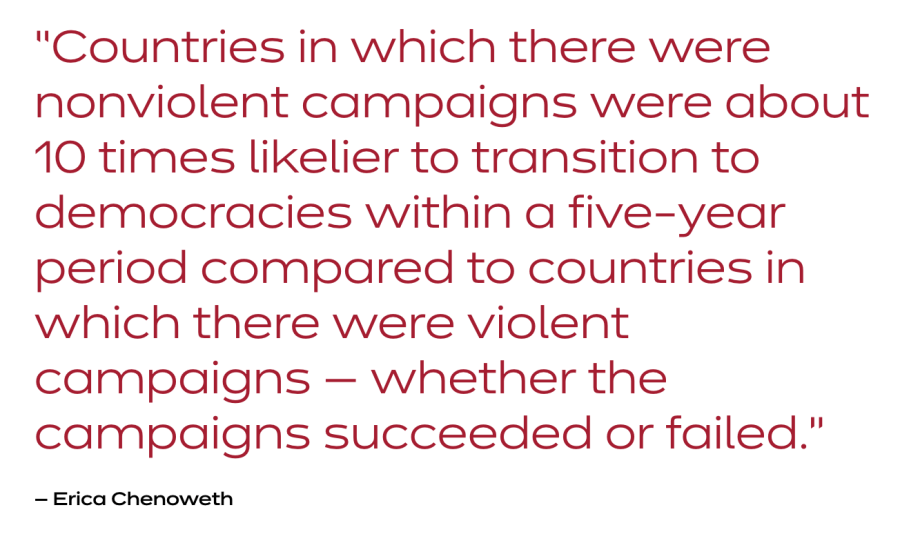
Note that Chenoweth’s research does not say that nonviolence leads to guaranteed success. Rather, nonviolence is more likely to succeed than violence. Even in countries where nonviolent campaigns have failed, people have been ten times more likely to move to democracy within a five-year period than if they protested with violence.
Even if you can not guarantee that non-violence will succeed, you can also not guarantee that violence will succeed. The “necessary” in violence as “necessary evil” is difficult to prove scientifically.
This is great news! Loving enemies, like Jesus commanded us to, is actually more beneficial than killing them. Such love does not have to be at the expense of protecting the innocent. The question now is if the leaders of the world will take this research seriously and spend time and money developing nonviolent defense systems rather than military ones?
Micael Grenholm is a Swedish theologian, author, and editor for PCPJ.
Pentecostals & Charismatics for Peace & Justice is a multicultural, gender inclusive, and ecumenical organization that promotes peace, justice, and reconciliation work among Pentecostal and Charismatic Christians around the world. If you like what we do, please become a member!
“God will let the satanic rearmament of nuclear weapons and biological warfare strike the godless themselves in forms of plagues that will exterminate large portions of humanity.”
– Folke Thorell, Evangelii Härold, 1968.
Pentecostals were the largest religious group among conscientious objectors in Sweden between 1967 and 1971, a time characterized by passionate debates on the ethics of war in the shadows of Vietnam and the Israeli-Palestinian conflict. In my master’s thesis on church history, I aimed to review and analyze how the Pentecostal periodicals Evangelii Härold and Dagen described and ethically motivated military violence and pacifism during this period.
The purpose was to identify potential motivations for pacifism and/or military support during a time when a large number of Pentecostals refused to bear arms, with a particular interest in how these motivations related to ethical evaluation on contemporary wars.
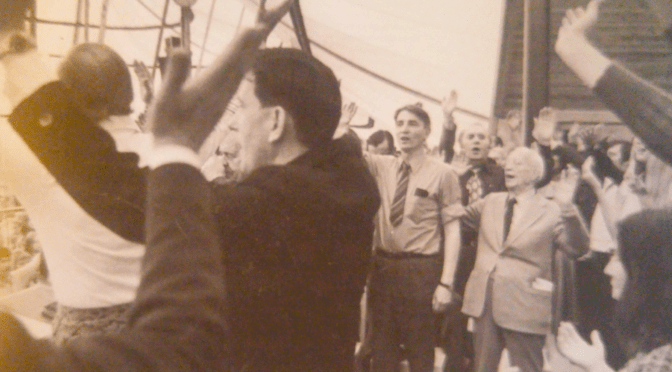
Swedish Pentecostals at a revival meeting in the 1960’s. The informal leader of the movement, Lewi Pethrus, can be seen to the right.
The findings were fascinating. Pacifism and conscientious objection were regularly promoted and seldom criticized, while most contemporary military violence was condemned with one glaring exception: Israeli warfare.
Folke Thorell, quoted above, thought that God principally is against war, but allows them to fulfill his eschatological plans and even engages himself in warfare. He envisioned two-thirds of all Jews to die in a future third world war involving nuclear bombs, a genocide so brutal it would make the Holocaust seem “minuscule” in comparison.
A Bible Study in Evangelii Härold titled “A Nuclear Physicist Interprets Revelation”, illustrated by a nuclear missile being fired from a submarine.
Unlike the American war effort in Vietnam, Israel’s wars were commonly viewed as eschatologically significant and biblically predicted holy wars, with several writers suggesting that God himself has waged and will wage war on Israel’s behalf. Pacifism was primarily motivated by obedience to the Bible rather than empathy, fitting with Lisa Cahill’s theory of obediential pacifism being distinct from empathic pacifism in the Christian tradition.
Support for Israeli warfare was also derived from biblical interpretation, primarily based on Old Testament texts. It was further motivated by ideas of Jewish suffering and death being part of God’s plan, with several Pentecostal writers speculating that an apocalyptic genocide would precede the second coming of Christ.
Many Pentecostals did not see this as standing in conflict with personal pacifism and conscientious objection, as both views were perceived as biblical.
Future research could further explore the relationship between Pentecostal eschatology and empathy, along with how mid-century Pentecostal Zionism might have been influenced by antisemitic ideas from the 1930’s.
Micael Grenholm is a Swedish pastor, author, and editor for PCPJ.
Pentecostals & Charismatics for Peace & Justice is a multicultural, gender inclusive, and ecumenical organization that promotes peace, justice, and reconciliation work among Pentecostal and Charismatic Christians around the world. If you like what we do, please become a member!
20 years ago, Al Qaida killed 3,000 civilians through terror and fire. That was a horrifying, indefensible act of violence.
In response, the USA started two wars that have killed 70,000 civilians in Afghanistan and 200,000 (!) in Iraq. Thousands of them were children.
That was also a horrifying, indefensible act of violence.
Shane Claiborne is an activist and theologian who had wise things to say concerning the violent aftermath of 9/11. From his book The Irresistible Revolution (2nd edition, pp. 185-187):
When Kingdoms Collide
Shortly after September 11th, I traveled to speak to a large congregation in the Midwest. (And no, it wasn’t Willow Creek.) Before I got up to preach, a military color guard presented the US flagat the altar. The choir filed in one-by-one, dressed in red white, and blue, with the “Battle Hymn of the Republic” playing in the background. I knew I was in big trouble. The congregation pledged allegiance to the flag, and I wished it were all a dream. It wasn’t. I got up to speak, thankful I was standing behind a large podium lest anyone try to pelt me with a pew Bible. I went forward to preach the truth in love with my knees knocking and managed to make it out okay with a bunch of hugs and a few feisty letters.
This is a dramatic (though painfully true) illustration of the messy collision of Christianity and patriotism that has rippled across our land. I thought this was an exceptional and dramatic example, but l’ve had same zingers since this. I spoke at a military academy where they had a full-on procession of military vehicles and weaponry. They fired cannons and saluted the flag, and then I got up to speak. I felt compelled to speak on the fruit of the Spirit (love, joy, peace, patience, kindness, gentleness, goodness, faithfulness, and self-control), the things Scripture says God is like and we should hope to be more like.
I talked about how the fruit of the Spirit take training and discipline and are not always cultivated by the culture around us. Afterward, one young soldier came up to me, nearly in tears, and told me that as he heard the list of the fruit of the Spirit, it became clear to him that these were not the things he was being trained to become. We prayed together, and I think of him often. I know that young man is not alone.
I saw a banner hanging next to city hall in downtown Philadelphia that read, “Kill them all, and let God sort them out.” A bumper sticker read, “God will judge evildoers, We just have to get them to him.” I saw a T-shirt on a sold’ that said, “US Air Force … we don’t die; we just go to hell to regroup.” Others were less dramatic-red, white, and blue billboards saying, “God bless our troops.” “God bless America” became a marketing strategy. One store hung an ad in their window that said, “God bless America–$1 burgers.”
Patriotism was everywhere, including in our altars and church buildings. In the aftermath of September 11th, most Christian bookstores had a section with books on the event, calendars, devotionals, buttons, all decorated in the colors of America, draped in stars and stripes, and sprinkled with golden eagles.
This burst of nationalism reveals the deep longing we all have for community, a natural thirst for intimacy that liberals and progressive Christians would have done much better to acknowledge. September 11th shattered the self-sufficient, autonomous individual, and we saw a country of broken fragile people who longed for community–for people to cry with, be angry with, to suffer with. People did not want to be alone in their sorrow, rage, and fear.
But what happened after September 11th broke my heart. Conservative Christians rallied around the drums of war. Liberal Christians took to the streets … Many Christians missed the opportunity to validate both the horror of September 11th and outrage at war as a response to September 11th.
In the aftermath of September 11th, many congregations missed the chance to bear witness of God’s concern for the victims of the attack and God’s concern for the victims of the imminent war. Many of us hunkered down into familiar camps rather than finding a more creative way of standing with all who suffer. Many of the antiwar activists would do well to visit the memorial in NYC. And many of the war hawks would do well to visit the Ameriyah shelter in West Baghdad. Every life lost is reason for grief and outrage.
The cross was smothered by the flag and trampled under the feet of angry protesters. The church community was lost, so the many hungry seekers found community in the civic religion of American patriotism. People were hurting and crying out for healing, for salvation in the best sense of the word, as in the salve with which you dress a wound.
A people longing for a savior placed their faith in the fragile hands of human logic and military strength, which have always let us down. They have always fallen short of the glory of God.
Pentecostals & Charismatics for Peace & Justice is a multicultural, gender inclusive, and ecumenical organization that promotes peace, justice, and reconciliation work among Pentecostal and Charismatic Christians around the world. If you like what we do, please become a member!
In an interview several years ago for Relevant Magazine, Mark Driscoll (well known pastor of Mars Hill in Seattle) said,
“In Revelation, Jesus is a pride-fighter with a tattoo down His leg, a sword in His hand and the commitment to make someone bleed. That is the guy I can worship. I cannot worship the hippie, diaper, halo Christ because I cannot worship a guy I can beat up.” (You can find the original interview here).
I frankly have trouble understanding how a follower of Jesus could find himself unable to worship a guy he could “beat up” when he already crucified him. I also fail to see what is so worshipful about someone carrying a sword with “a commitment make someone bleed.” But this aside, I’m not at all surprised Driscoll believes the book of Revelation portrays Jesus as a “pride fighter.” This violent picture of Jesus, rooted in a literalistic interpretation of Revelation, is very common among conservative Christians, made especially popular by the remarkably violent Left Behind series.
The most unfortunate aspect of this misreading, as Driscoll’s comment graphically reveals, is that the “pride fighter” portrait of Jesus easily subverts the Jesus of the Gospels who out of love chooses to die for enemies rather than use his power against them and who commands his followers to do the same (see e.g. Mt 5:43-45; Lk 6:27-36). In fact, if you read these passages carefully you’ll notice that Jesus makes loving enemies and refusing all violence the prerequisite for being considered a child of God! Loving enemies like Jesus commands (and like the rest of the NT teaches, e.g. Rom. 12: 14, 17-21; 1 Pet 2:21-23) requires that we crucify our fallen impulse to resort to violence, while the model of Jesus as a “pride fighter” with a “commitment to make someone bleed” allows us to indulge it. If we can dismiss the peace-loving Jesus as a “hippie, diaper, halo Christ,” then we’re free to wish and even inflict vengeance on our enemies all we like — and feel righteous about it!
I feel compelled to write something that I wish nobody should have to write, something that should be obvious to everyone but which for some ill-conceived reason can be controversial to state in certain contexts:
War is awful.
Hamas firing on and killing the Israeli civilian population is awful.
The counterattacks by the Israeli Defense Forces (IDF) killing Palestinian civilians are awful.
War has no winners, there is no one to “cheer” on as if it were a sports event, there is no victory in war that does not come at the price of hating, tormenting and killing your fellow human beings.
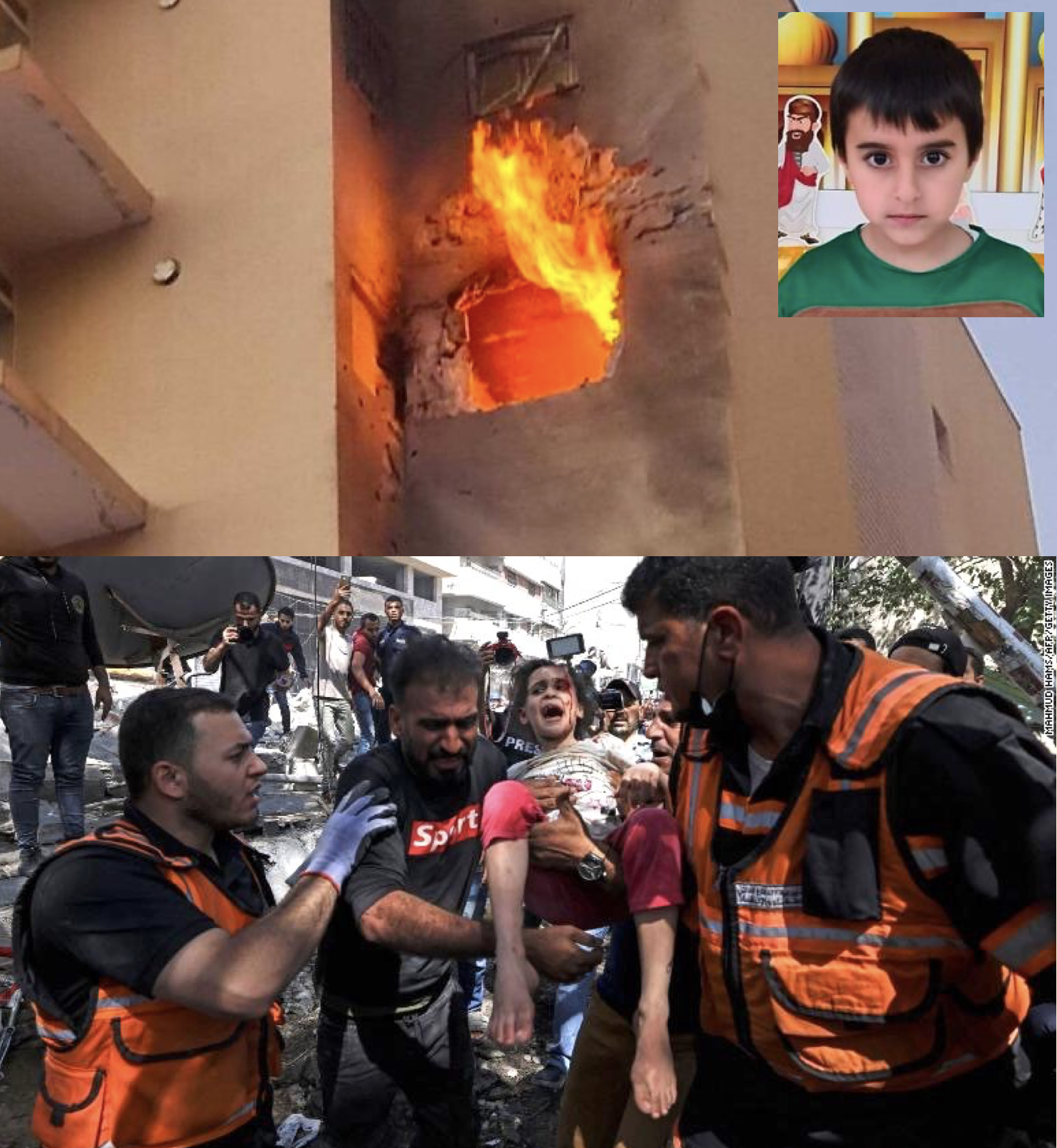
Take a look at these pictures.
The upper image shows an apartment in Israel that was hit by one of Hamas’ rockets a few weeks ago. Five-year-old Ido Avigal, pictured to the right, lived in that apartment. He died immediately.
The picture below shows a girl being rescued by medical personnel after an Israeli attack in Gaza. The attack destroyed nine buildings and killed 43 people, including eight children.
In total, 68 children have been killed in the Holy Land these last couple of weeks. 66 of them were Palestinian.
The topic of the pacifism in the early church is something I have written about before for PCPJ. However, in our world it often needs repeating and restating. The Church has often fallen into the temptations of politics and militarism. This is clearly seen in the Pentecostal/Charismatic Movement, which leaned towards pacifism in its early years, but became tolerant towards nationalism and militarism within only a few decades.
In the United States, we are in the midst of two events that make the topic of Christian pacifism relevant: 1. We are in the midst of a very brutal election season, and 2. We are approaching the 19th anniversary of the War on Terror, specifically the war in Afghanistan (which officially began October 7, 2001). It is the longest war in American history. Of course, PCPJ is an international organization, just as the Church is an international organization, but I think these are universal issues, and the war in Afghanistan includes many countries (including all of NATO). Additionally, PCPJ was founded in that time and context.
Considering that we have been in constant war for almost 20 years, I think it is time for Christians in the West to look back to our roots again and to not be seduced by politics or nationalism. What would Jesus say and do if He was here today? What would He say to a supposedly “Christian nation”? What would the prophets, apostles, and church fathers say in this time? Specifically, we should look at the early church. After all, Pentecostal/Charismatic Christianity is primarily about revival – an attempt at recovering the Christianity of the apostolic age. Continue reading Was the Early Church Really Pacifist?→
We are called by Jesus to be peacemakers (Matthew 5:9), resolving conflicts as we go forth to spread the Gospel about his love. Peace is always dependent on at least two parties, which is why we might experience conflict even when our intention is peace.
This is why Paul writes “If it is possible, as far as it depends on you, live at peace with everyone” (Rom 12:18). We try our best on our part, and pray that the other respond constructively.
What does this look like in practice? God seems to be very concerned with us asking that question, since the Bible provides us with several practical tools for conflict resolution and peacemaking.








 PCPJ
PCPJ 