Russell Moore used to be one of the top officials of the Southern Baptist Convention and is currently the Editor in Chief of Christianity Today. Last year, he was interviewed by NPR and explained why he thinks American Christianity is in crisis:
Russell Moore
It was the result of having multiple pastors tell me, essentially, the same story about quoting the Sermon on the Mount, parenthetically, in their preaching — “turn the other cheek” — [and] to have someone come up after to say, “Where did you get those liberal talking points?”
And what was alarming to me is that in most of these scenarios, when the pastor would say, “I’m literally quoting Jesus Christ,” the response would not be, “I apologize.” The response would be, “Yes, but that doesn’t work anymore. That’s weak.” And when we get to the point where the teachings of Jesus himself are seen as subversive to us, then we’re in a crisis.
I’m sure many want to discard this as some extreme, uncommon view among a very small minority of church goers, in spite of Moore telling us that multiple pastors has told him similar stories. However, the vital question is not how many evangelicals have a heretical view of Jesus’ words and teaching, but how this situation could even arise in the first place.
And it’s not that mysterious when you think about it, is it? Moore himself has been a vocal critic of Donald Trump and what the support for him among white evangelicals has done with their movement. With his adultery, sex with pornstars, constant lies, mocking of disabled people, hate against immigrants, disrespect for the poor and other sins, Trump is extremely unlike Jesus. Yet, he is constantly portrayed by many evangelicals as the one to save the country, sometimes in very blasphemous ways, which Trump himself makes sure to capitalize on:
And so, it’s not strange that when some evangelicals who are told over and over again that a Christian champion looks like Trump cannot recognize the true Jesus. As Russell Moore said in the very same interview:
I think if we’re going to get past the blood and soil sorts of nationalism or all of the other kinds of kinds of totalizing cultural identities, it’s going to require rethinking what the church is. And I don’t think that’s something new. I think it’s very old. I think it’s recovering a first-century understanding of what it means to be the church.
Micael Grenholm is a Swedish church historian, author and an editor for PCPJ.
Pentecostals & Charismatics for Peace & Justice is a multicultural, gender inclusive, and ecumenical organization that promotes peace, justice, and reconciliation work among Pentecostal and Charismatic Christians around the world. If you like what we do, please become a member!
I did not die so that you could defeat, steal from, kill and destroy your enemies. I died so that you would love them as I loved you while you were My enemies.
What do you want, My children?
Do you want Me and My kingdom or do you want Barabbas and what he fought and killed for? You cannot have both.
Woe! Woe! Woe! My people are choosing Barabbas, following him, and teaching his ways! They reject Me for another ‘Jesus’!
Turn, My people! Turn from your ways and be saved! For the path you are choosing leads only to death!
I give life through the Cross —not through the sword! If you live by the sword, you will die by the sword.
*****
Ramone Romero is an artist based in Osaka, Japan.
—
Pentecostals & Charismatics for Peace & Justice is a multicultural, gender inclusive, and ecumenical organization that promotes peace, justice, and reconciliation work among Pentecostal and Charismatic Christians around the world. If you like what we do, please become a member!
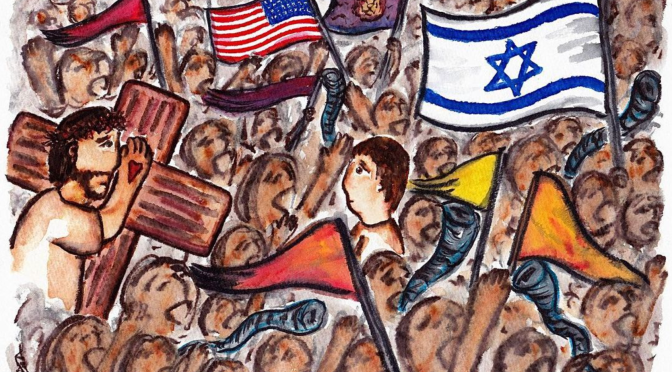
(art: “The Release of Barabbas” and “Follow the Lamb”, by Ramone Romero)
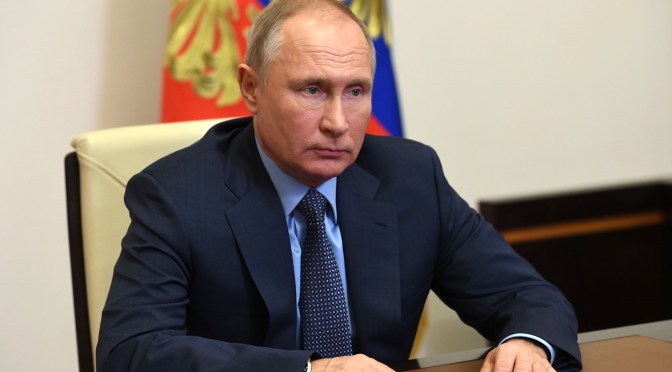
A few nights ago I had a surprisingly vivid dream featuring Russian President Vladimir Putin. I recall it now as if it were an event that actually happened.
At first I was walking behind him and an American woman I knew, who seemed determined to keep me from him. Then I saw him look at me at a gathering in a hotel, as I refused to sing some well-known American songs in English with what looked like American fans.
Then suddenly I was seated beside him in the front seat of his limo. Gracie sat beside a woman in the back seat who was maybe his wife– though I’ve since learned he’s divorced, so I’m not sure who this was. She lay back against the seat, her bare forearms covered with elaborate, symmetric tattoos.
We start talking more personally, and he immediately directs someone to pull the curtains between the back seat and the rest of the limousine, so those further back couldn’t hear or see us. Heavy black curtains are drawn, allowing for total privacy.
I tell him I’ve been praying for him. He looks skeptical, and I say:
“Mr. Putin, I mean prayer as conversation with God.”
His driver mockingly asks: “conversation with God?!”
I then remember that as Russian Orthodox Christians he and his driver would understand prayer more as rote, liturgical prayers from a prayer book. So I explain:
“I’m not talking about praying liturgical prayers, say from the Orthodox liturgy or prayer books. These prayers are precious, valuable and powerful, and we can certainly benefit from praying them. But we can also pray to God directly, conversationally about what’s on our heart and mind.
I look at him and say: “President Putin, I’ve been talking with God, with Jesus, like we’re talking now, asking him to give you wisdom to know what to do, and courage to make the right decisions.”
He visibly warms up, and looks at me with genuine interest.
I had seen some special bottles of liqueur or skin tonic. I wondered if he might give me a gift. Just then he offered me a bottle and some other gifts. I thought I should ask him how we could stay in contact in the future. But then I woke up.
This dream took me completely by surprise. I hadn’t been thinking about Putin, though I have been keeping up on the news on a daily basis regarding the Russian invasion of Ukraine. I also lead a weekly Bible study via Zoom with Russian recovery guys living near Krasnodar.
I read and hear Mr. Putin being regularly denounced as a brutal oligarch dictator, a war criminal, evil incarnate. He is often compared to Stalin or Hitler. He most certainly has blood on his hands.
However, in only demonizing Russia’s President we risk pushing him further into the darkness, from where even more destruction can be unleashed.
Throughout Scripture the prophets regularly communicated with heads of State, both in person and through letters and emissaries. These communications included intercession, as well as offers of specific counsel, warnings and outright denunciation too.
Jesus challenged the religious leaders of his day, embodying a way for saving that incorporated active love for and intercession on behalf of enemies.
“But I say to you who hear, love your enemies, do good to those who hate you, bless those who curse you, pray for those who mistreat you” (Lk 6:27-28).
The Apostle Paul was often imprisoned by the authorities of the Roman Empire who had blood on their hands– who he faithfully told about Jesus. He writes in Romans 12:14 “Bless those who persecute you; bless and do not curse,” followed by “Do not be overcome by evil, but overcome evil with good” (Rm 12:21). Paul wrote Timothy words that are certainly important to head now.
“First of all, then, I urge that entreaties and prayers, petitions and thanksgivings, be made on behalf of all people, for kings and all who are in authority, so that we may lead a tranquil and quiet life in all godliness and dignity. This is good and acceptable in the sight of God our Savior” (1 Timothy 2:1-3).
Mr. Putin has recently threatened to use nuclear weapons, which would lead to destruction like the world has never known. Certainly now is the time to include him and his political and spiritual advisors, and our own national leaders in our prayers, “so that we (followers of Jesus in the Ukraine, Russian, Europe and around the world) may lead a tranquil and quiet life in all godliness and dignity”– so we can focus our attention on advancing Jesus’ Kingdom.
In my dream I told Vladimir Putin that I pray for him. However in reality I have really only begun to actively pray for him since my dream. I invite you to join me in daily prayer for Mr. Putin, and for his advisors– including the Russian Orthodox Patriarch Kirill. Let’s remember to pray too for the Ukrainian people, leaders and soldiers– and for Russian soldiers. May we engage in active peacemaking from out of a commitment to prayer as the Apostle Paul urges in Philippians 6:18.
“With all prayer and petition pray at all times in the Spirit, and with this in view, be on the alert with all perseverance and petition for all the saints.”
Bob Ekblad is co-founder and co-director of Tierra Nueva in Burlington, Washington. Bob is ordained in the Presbyterian Church (U.S.A.). He holds a ThD in Old Testament and is known internationally for his courses and workshops on reading the Bible.
Pentecostals & Charismatics for Peace & Justice is a multicultural, gender inclusive, and ecumenical organization that promotes peace, justice, and reconciliation work among Pentecostal and Charismatic Christians around the world. If you like what we do, please become a member!
In Crucifixion of the Warrior God (CWG) I argue that Jesus and Paul instruct Christians to love and bless their enemies and to unconditionally refrain from violence (e.g. Matt 5:39-45; Rom 12:14-21). Moreover, I argue that this was the prevailing attitude of Christians prior to the fourth century when the Church aligned itself with the Roman Empire. In his critique of CWG that he delivered at the ETS in November, Copan argues against this, contending that I give “the false impression that Christians were uniformly pacifistic until Constantine.”
He cites the work of David Hunter and several other scholars who note that we find a number of references to Christians serving in the Roman military in the writings of Tertullian, Lactantius, Clement of Alexandra and Eusebius.[1] Not only this, but we have found a number of tomb inscriptions to Christian soldiers in the second and third centuries. On this basis, these scholars argue that the earlier scholarly consensus that the early church was uniformly pacifistic must be nuanced. At least some Christians were apparently not opposed to Christians serving in the military.
The first thing I’ll say is that it is a bit odd that Copan would raise this objection against me, for while I defend “the predominant nonviolence of the early church” prior to “the Augustinian revolution,” I also explicitly note that the earlier unqualified depictions of the early church as uniformly against military service “were not sufficiently nuanced” ((CWG, 24, n.45). Indeed, I refer readers to some of the same works that Copan cites against me (and add a number that he omits). Continue reading Was the Early Church Pacifistic?→
Jesus told us to love our enemies (Mt 5:44). This has been the cornerstone of Christian pacifist theology; whether you look at the early church, or the Anabaptists or the early Pentecostals, they all agreed on that loving enemies is incompatible with killing them, and hence they refused to wage wars or use violence against other human beings.
For this reason, the Christian non-pacifist has to argue for one of the following positions:
Killing is an act of love towards the one you kill.
We should not follow Jesus’ command to love enemies when we decide to kill people.











 PCPJ
PCPJ 