Tag Archives: Bible study

Why Did Jesus Tell His Disciples to Buy Swords?

Why did Jesus command his disciples to buy swords in Luke 22:38?

Now, however,” He told them, “the one with a purse should take it, and likewise a bag; and the one without a sword should sell his cloak and buy one. For I tell you that this Scripture must be fulfilled in Me: ‘And He was numbered with the transgressors.’ For what is written about Me is reaching its fulfillment.”

So they said, “Look, Lord, here are two swords.”

“That is enough,” He answered. (Lk 22:36-38)

A lot of people assume that it was in order to defend themselves, and use this as an argument for warfare and liberal gun laws. But if it’s one thing we can be sure of, it is that Jesus definitely didn’t intend the swords to be used for self-defense.

Continue reading Why Did Jesus Tell His Disciples to Buy Swords?

The Multicultural Multitude of Revelation

by Craig S. Keener, originally published on his blog.

While there is some debate about the identity of the 144,000 in 7:1-8, everyone agrees that the innumerable multitude in the next vision refers to believers from all peoples—a vision that ultimately includes all of us who believe in Jesus.

These people are “from all nations and tribes and peoples and languages” (7:9). Revelation uses this fourfold formula, in varying sequences, seven times. The formula echoes the book of Daniel. Daniel has the threefold formula six times; the Greek translation of Daniel makes the first instance (Dan 3:4) fourfold, as in Revelation. That context applies to Nebuchadnezzar’s Babylonian empire.

By the time of Revelation, however, people would no longer think of “all nations” as part of the Babylonian empire. Another passage in Daniel predicted an innumerable multitude from all nations serving the Son of man (Dan 7:13-14). Yet despite the hyperbole of Roman imperial claims, most people in John’s urban audience in the Roman province of Asia knew about many other parts of the world beyond the Roman Empire. The Roman Empire had trade ties with India, China, parts of Africa as far south as Tanzania, and northern Europe perhaps as far west as Iceland. The idea that members of all peoples would stand before God’s throne would have been unthinkable! Continue reading The Multicultural Multitude of Revelation

Is the Spirit Gender-Blind?

Throughout Christian history there have been stories of great heroes of the faith.  These heroes ranged from those who conquered social and systemic injustice and oppression, those who preached the Gospel courageously, those who taught children, and those who wrote theological tomes.  But what truly made these individuals heroes?  Aside from the fact that God greatly blessed these women and men and allowed them the opportunity to shine, the main reason these people changed the world, is because they lived into the calling and giftings that God assigned for them.

There are two main lists in the Bible looking at Spiritual gifts.  These are Romans 12:1-8 and 1 Corinthians 12:12-31.  Although there may be many additional gifts that didn’t exist in Biblical times (such as an uncanny use of social media and promotions for church work), the basics have stayed the same millenia later.  To give an idea of the various gifts which one  can possess, there are gifts of EDIFICATION (including: prophesy, teaching, exhortation, and encouragement), COMPASSION AND SERVICE (practical service, generosity, hospitality, mercy), and LEADERSHIP (apostleship, teaching, preaching, and evangelism).

Now in the church, the majority of gifts are not debated.  For example, both men and women can be able administrators, both can be encourage, and both can be generous with time, talents and treasures.  Yet, the issue arises when it comes to matters of leadership.  In some churches both men and women are able to accept roles such as deacon, elder, pastor or bishop, but in many others these roles belong solely to men.  Does that mean then that women were somehow bypassed when it came to giving out the spiritual gifts or does it mean that women are somehow inferior and therefore not eligible for these roles? Continue reading Is the Spirit Gender-Blind?

Should Christians Kill Each Other?

I talked to a brother the other day who was a conscientious objector in the 1960’s. I asked him why he refused to do military service.

“Because I don’t want to kill a Christian brother. And it would be unreasonable to first run and ask an enemy soldier what he believes before you eventually kill him. So I can’t kill anyone.”

I found this argument for pacifism very interesting. Now, I think it’s clear that Jesus doesn’t want me to kill anyone, regardless of their faith. He wants me to love my enemies (Mt 5:44) and not use weapons of war (2 Cor 10:3).

But obviously, other Christians disagree. They think that we are sometimes warranted to kill others. But do they seriously think that we should kill other Christians?

Did Jesus envision his disciples to ever kill each other?

I think the answer is obviously no. But I was curious if my non-pacifist sisters and brothers think differently. And so I asked them on Facebook:

If Jesus envisioned his disciples to sometimes kill each other, why didn’t he talk about it?

Skärmavbild 2019-11-17 kl. 22.20.49

So far, I have received hundreds of comments, and not a single one addresses why Jesus doesn’t talk about his disciples killing each other if he really envisioned it. Most people have asked me questions instead, of how I would stop Hitler or a murderer attacking my family etc. Interesting questions for sure, but this time I wanted an answer from them.

Some did address when they found it appropriate for Christians to kill other Christians. It was when a Christian is defending themself from an attacking Christian. This scenario is of course hard to identify. Most people who are “attacking” others do it in perceived self-defense, be it a preemptive strike or due to a perceived threat.

What’s worse for this theory of just fratricide is that it is completely detached from the Bible. Not only is Jesus silent on the matter of disciple-killing, but the rest of the New Testament also abstains from discussing it. It is as if the early Christians only expected them to love and care for one another rather than taking each other’s lives.

Contrary to popular belief, the Bible doesn’t even talk much about self-defense. The two views on violence one can reasonably deduce from the biblical text, is that it is either OK when a political leader demands it, or that Christians should be pacifists. The Just War theory that distinguishes between different kinds of wars originated with the pagan Cicero and was later adopted by church father Augustine without much input from the Scriptures. Before him, most church leaders were pacifists.

I think it’s pretty safe to say that Jesus doesn’t want his followers to slaughter one another. I find it even harder to imagine that he wants us to kill non-Christians, condemning them to eternal punishment. And so, I think that when he asks us to love our enemies and turn the other cheek, he really means that we should not kill anyone.

Micael Grenholm is a Swedish pastor, author and editor for PCPJ.

ska%cc%88rmavbild-2017-01-06-kl-21-17-02Pentecostals & Charismatics for Peace & Justice is a multicultural, gender inclusive, and ecumenical organization that promotes peace, justice, and reconciliation work among Pentecostal and Charismatic Christians around the world. If you like what we do, please become a member!

Patriarchy and the Jezebel Narrative

Narrative is the story through which we view reality.  We all have narratives that help us interpret our lives.  The Bible also is a narrative that helps us interpret reality.  There is a narrative that has floated around Charismatic and Pentecostal circles whenever anxiety surfaces around women co-leading with their husbands in marriage and having leadership roles in the Church and political world.  The Jezebel Spirit teaching comes from a false narrative drawn from 1Kings 16-21. 

Who was Jezebel in the Bible? 

Jezebel was the wife of Ahab who descended from a number of wicked kings who had each become progressively more evil in their ways.  Ahab was the son of Omri who was the son of Zimri who was the son of Elan who was the son of Bassash.  Each of these kings were idolaters, men of violence who did not keep the Torah, in fact this was said of each king:

“Baasha had done what was evil in the Lord’s sight.” 1Kings 16:7

Of Zimri, “ for he, too, had done what was evil in the Lord’s sight.” 1Kings 16:19

 “Omri did what was evil in the Lord’s sight, even more than any of the kings before him.” 1kings 16:25

“Ahab son of Omri did what was evil in the Lord’s sight, even more than any of the kings before him.  1Kings 16:30

Ahab had come from a family of wicked kings who had long practiced idolatry with each subsequent generation becoming more and more evil in the site of the Lord.  The intent of the author was to show that Omri was more evil than the kings before him and Ahab even more evil that Omri and all the others before him. Continue reading Patriarchy and the Jezebel Narrative

10 Things Christian Women are Tired of Hearing

I still remember my first experience of being told I couldn’t do something I wanted to do.  I was only four years old and my Sunday School teacher asked us to go around the room and share what we wanted to be when we grew up.  Without any hesitation I blurted out “I want to be a pastor.”  My teacher, who was warm and friendly, stooped down, put her arm around my shoulders and said “honey, women can’t be pastors.”  I remember being utterly confused.  I had always enjoyed lining my teddy bears up after church on the steps of my house, singing Bible songs, and pretending to preach sermons.  This is something I liked doing and that my parents always encouraged in their own ways.  Obviously, four was too young to understand the theological implications of such a bold statement – there was no possible way I could have known at the time that this has been a grey area debated over the centuries with Bible believing Christians on both sides of the fence.  All I knew was that I was being told I couldn’t do something that in my very core I felt I wanted to do, that I was called to do, that I was meant to do.

Since then, I have occasionally faced discouragement as a woman in other areas and I know that I am not alone.  Thus, when I was asked to write this blog for PCPJ, I opened up my Facebook by posting an open question: “To all my Christian Women friends, what are you tired of hearing?”  The results poured in and surprisingly (or perhaps not surprisingly) nearly everyone said the same things but in different ways.  I also took this offline by asking Christian and non-Christian women alike what they were tired of hearing, and I discovered that these very same issues often permeate into the lives of even those who are not religious.  That is to say, culture and tradition, often overshadow the truth and sometimes churches lose sight of what is Biblical and historically accurate in favour of what has simply been passed down to them or what they have been taught without further investigation.

Although this list is not exhaustive, here are some of the most common themes that women addressed when asked this question: Continue reading 10 Things Christian Women are Tired of Hearing

The Problem With Prosperity

The prosperity gospel, or “health and wealth” preaching, originated about 70 years ago in the United States. At various tent meetings connected to Voice of Healing and similar ministries, preachers like Oral Roberts and A. A. Allen started to teach things like financial sowing and reaping, the prosperous power of faith and that God wants us to be rich.

Their theology was influenced by Baptist theologian E. W. Kenyon, who in turn was highly influenced with ideas from New Thought. This American movement is quite similar to New Age and emphasizes, among other things, the power of the mind to influence physical reality by, for example, naming and claiming health and wealth before it actually has materialized.

Sounds familiar?

Of course, a believer in the prosperity gospel will probably reject the brief historical review above and claim that they believe in these things because it is what the Bible teaches. And so, we must deal with the Biblical material. In this article, I will go through two passages that challenge prosperity teaching, and two that’s being used in its defense. Continue reading The Problem With Prosperity

Does the Old Testament Justify “Just War”?

by Greg Boyd, originally posted in 2015 at his website ReKnew.

For more of Boyd’s thoughts on Old Testament violence, check out his book Cross Vision of The Crucifixion of the Warrior God.

Since the time of Augustine, Christians have consistently appealed to the violent strand of the Old Testament to justify waging wars when they believed their cause was “just.” (This is Augustine’s famous “just war” theory.)

Two things may be said about this.

First, the appeal to the OT to justify Christians fighting in “just” wars (if there are such things) is illegitimate for the simple reason that the OT knows nothing of a “just war” policy. The wars that Yahweh had the Israelites engage in were not fought on the basis of justice. They were fought simply because the Israelites perceived that Yahweh told the Israelites to fight them. They were holy wars, not just wars. Continue reading Does the Old Testament Justify “Just War”?

Shifting Our Focus from Rules to Mission

1On a Sabbath Jesus was teaching in one of the synagogues, 11 and a woman was there who had been crippled by a spirit for eighteen years.  She was bent over and could not straighten up at all. 12 When Jesus saw her, he called her forward and said to her, “Woman, you are set free from your infirmity.” 13 Then he put his hands on her, and immediately she straightened up and praised God.

14 Indignant because Jesus had healed on the Sabbath, the synagogue leader said to the people, “There are six days for work. So come and be healed on those days, not on the Sabbath.”

15 The Lord answered him, “You hypocrites! Doesn’t each of you on the Sabbath untie your ox or donkey from the stall and lead it out to give it water? 16 Then should not this woman, a daughter of Abraham, whom Satan has kept bound for eighteen long years, be set free on the Sabbath day from what bound her?”

17 When he said this, all his opponents were humiliated, but the people were delighted with all the wonderful things he was doing.  Luke 13:10-17 

Is the main point of this passage about healing?  Is the main point of this passage about our focus and mission as God’s people?  These are two of the many questions I puzzled about as I reflected.  And the answer is yes… This passage is about healing and yes this passage is about the focus and mission of God’s people.

Continue reading Shifting Our Focus from Rules to Mission

How Much Presidential Blasphemy Can We Tolerate?

This sentence from The Guardian has to go down in history as completely unimaginable concerning a U.S. president just a few years ago:

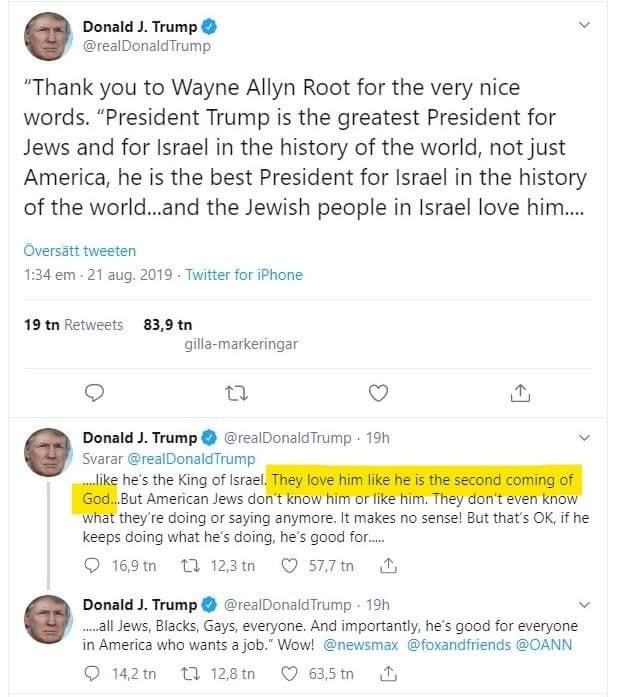
Over an ensuing half-hour rant, Trump trucked in antisemitic tropes, insulted the Danish prime minister, insisted he wasn’t racist, bragged about the performance of his former Apprentice reality show, denied starting a trade war with China, praised Vladimir Putin and told reporters that he, Trump, was the “Chosen One” – all within hours of referring to himself as the “King of Israel” and tweeting in all caps: “WHERE IS THE FEDERAL RESERVE?”

What really concerns me is the “Chosen One” and “King of Israel” part. The Guardian even leaves out something even more disturbing, namely that Trump welcomed the comparison between him and the second coming of God:

69218578_967140533624187_984150842019938304_n.jpg

A lot has already been written on Trump’s apparent pathological narcissism, and the tweets above provide additional evidence that his view of himself is severely disturbed. Any sane person, regardless of their own religious beliefs, would reject any comparison between themselves and the Creator of the universe. Continue reading How Much Presidential Blasphemy Can We Tolerate?