by John Dear
Mahatma Gandhi considered Jesus the most active person of nonviolence in the history of the world. He was dismayed, however, that so few Christians understood or embraced Jesus’ nonviolence.
by John Dear
Mahatma Gandhi considered Jesus the most active person of nonviolence in the history of the world. He was dismayed, however, that so few Christians understood or embraced Jesus’ nonviolence.
by Martin Luther King, Jr.
1) Nonviolence is a way of life for courageous people.
It is active nonviolent resistance to evil.
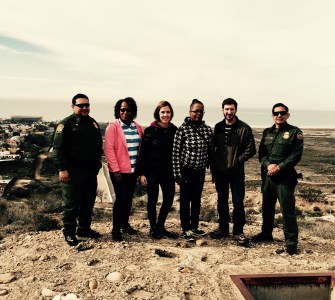
I am in Tijuana, Mexico, this week with Palmer Seminary students for our “Ministry on the Borderline” travel course, which focuses on immigration and the systems that propel undocumented immigration into the US (economic, social, etc.). We are being hosted by Raymond Schellinger, an American Baptist Church USA missionary who lives in Tijuana, and staying at Deborah’s House, a shelter for women and children victims of domestic violence. The students are learning about the systemic nature of violence in family, communities, and countries at large (especially in the relationship between the USA-Mexico as it is symbolized by the border fence).
by Derek Minno Bloom
As a teenager, I was politicized around issues of poverty, oppression, racism, etc. I felt the church I was involved in focused too much on prayer and not enough on action. Some Christians talked a lot about hope, but not much about making those hopes a reality; they launched many campaigns based on charity, but few based on solidarity.
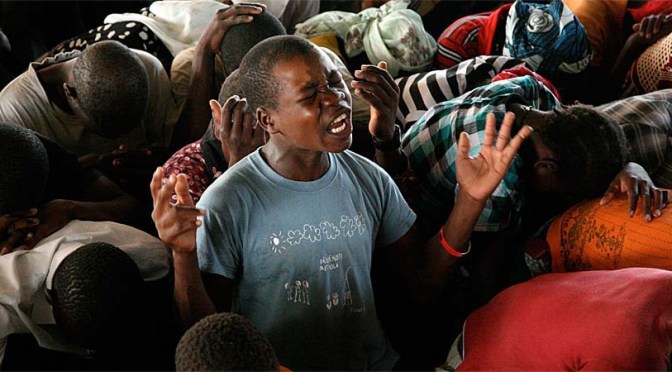
I attended the Anarchy and Christianity Conference in Champaign-Urbana in 2006, where issues of race and anarcho-primitivism were the main topics. Towards the end of the gathering I asked if people wanted to pray as an act of resistance. We prayed for God’s hand of justice to fall upon the world. I believed that others as well as ourselves could be liberated from the chains of patriarchy, racism, and war because of our prayers.
The Pentecostal and charismatic movements have a bad reputation among Christian anarchists and activists. There are too many examples of healing evangelists who control the masses through manipulation and hysteria, with promises of supernatural encounters only to gain money and status for themselves. Furthermore, many Pentecostals and charismatics support nationalism, war, discrimination and inequalities. They bless the Israeli occupation of Palestinian lands, they preach a prosperity gospel where strong faith leads to great wealth, they deny climate change and don’t care about the environment.
Yet, I am totally convinced that every Christian activist should embrace the gifts of the Spirit and pursue signs and wonders. Why? Because the mess I just described is of course not genuine a fruit of the Spirit, it is a result of what I call the Corinth Syndrome, when charismatic Christians portray their own crazy ideas and practices as divinely inspired.
The church at Corinth was experiencing charismatic chaos; they loved spiritual manifestations and everyone spoke in tongues simultaneously, but they showed no care for the poor and some were living in sexual immorality.[1] Paul’s solution to the Corinthian problem is not commanding them to be less charismatic; on the contrary, he urges them to seek the gifts even more![2] However, he emphasizes that this must be done in order and in love.
Continue reading Why I as an Activist Love the Gifts of the Holy Spirit
Pentecostal and Charismatic Christians comprise approximately 25 percent of global Christianity (around 600 million of 2.4 billion). This remarkable development has occurred within just the last century and has been called the “pentecostalization” of Christianity. Pentecostals and Charismatics experience Christianity and the world in distinctive ways, and Wipf and Stock’s Pentecostals, Peacemaking, and Social Justice series invites discovery and development of Pentecostal-Charismatic approaches to peacemaking and social justice.
The following books make up the growing series, with more to come.
Continue reading Pentecostals, Peacemaking, and Social Justice
by Craig Keener
In many circles, editorials and sermons on the true meaning of Christmas have become a routine, perhaps almost obligatory, protest against the materialism and rush of the season. Christmas, of course, has taken on various expressions in a range of cultures through history, along the way picking up fir trees, wrapped gifts, and developing permutations of figures such as St. Nicholas of Myra (a fourth-century bishop).
By Joshua Carson
If there’s one thing I’ve learned in my preaching classes at seminary this semester, it’s that the events of Thursday, Friday, and Saturday sometimes require a change in what a congregation needs to hear on Sunday, supplanting what the preacher may have planned to preach earlier in the week. As a youth pastor, I knew that my recent evening message to our students had to change, given that the Islamic State in Iraq and the Levant (ISIL) had carried out terror attacks that killed at least 129 people in Paris, France, on Friday, 44 people in Beirut, Lebanon, on Thursday, and 224 people on a flight out of Egypt’s Sharm el-Sheikh airport on October 31. I knew that our students were thinking, talking, posting, and tweeting about these events, and that they have grown more globally conscious over the last few years in praying for worldwide events.
“I am fully convinced that activism for peace and justice should be performed in the power of the Holy Spirit. Miracles, healing, prophecy and evangelism should be combined with peacemaking, economic equality, simplicity and care for the environment, just as in the biblical church.” -Micael Grenholm
by Robert Welsh
Christians who risk their lives for the Gospel always challenge me. Encountering heroic expressions of faith provokes me to question my own faith journey. Am I taking up my cross? If I were more courageous, would I take a different path? Should I be doing more “extreme” acts of faith? I had the opportunity to confront some of these questions as I studied Christians who risked their lives for the sake of making peace and bringing justice.