
by Hye Sung Francis Gehring.
What is the Charismatic Movement?
Many people make sweeping statements about the Charismatic Movement without much comprehension of the diversity among Charismatics, as evidenced by the multitude of books cautioning believers of this broad movement. In 2013, neo-reformed Baptist preacher and author John MacArthur held a conference that attracted thousands of participants that was dedicated to villifying the excesses of Pentecostals and Charismatics. This conference, “Strange Fire”, assumed Charismatics to be at least gravely deceived, if not hell-boundand blasphemers.
Thankfully, this sort of rhetoric is not as commonplace as it once was in the Church and is progressively losing its steam, as about 26% of the global Church is considered charismatic, and as different charismatic practices have been normalized and adopted by non-charismatic traditions (such as “listening prayer”, “prayer teams”, raising arms in worship, and even speaking in tongues, or the more sanitized “prayer languages”.) That said, people still have strange assumptions about what charismatic spirituality is, and many often are shocked when I claim that Quakerism is actually a thoroughly charismatic tradition.
The Charismatic Movement was initially a renewal movement across the Church rather than a distinct denominational tradition. In many ways it was influenced and informed by its predecessor, the Pentecostal Movement, but was distinct from Pentecostalism because its malleability and its desire to not start a new religious group but instead renew the participants’ respective churches in the power of the Holy Spirit. Lutherans, Methodists, Presbyterians, Catholics, and virtually every Church tradition was impacted by this movement.

The Charismatic Movement introduced many Christians to the “baptism of the Holy Spirit”, an experience theologically nuanced in different ways throughout the Movement but could be summed up as a “stirring” or “activation” of the Spirit within. This experience is often ecstatic or euphoric, and those who have received such an experience often claim to have felt God’s love and/or power in those moments as well as have manifested the gift of tongues or, to a lesser extent, prophecy.
The Renewal was not simply for the sake of a personal mysticism but was always meant to revitalize and bless Christian fellowship. The Charismatic Movement touched whole churches, bringing forth the corporate use of the charismata (a Greek word used by Paul that is roughly translated as “grace-expression” or , more commonly, “spiritual gifts”) Paul spoke of in 1 Corinthians 12:7-10, which include prophecy, healing, interpretation of tongues, and so on, to denominations that were not associated with such phenomena.
The use of these “supernatural” gifts and these “charismatic” experiences are not at all foreign to the Church. This charismatic thread has been an aspect of the Church since Christ’s ministry of healing the sick and casting out demons. Though the use of these gifts have waned throughout Church history, there have been several resurgences of charismatic phenomena, such as the healing revivals St. Augustine witnessed (Augustine, Book XXI, City of God), the ecstatic and miraculous experiences among medieval mystics (such as with Bernard of Clairvaux and Hildegard of Bingen), the modern Pentecostal movement, and countless other movements that believed the Spirit’s miraculous and emboldening power is a timeless gift for the Church.
The charismatic conviction that every individual may access God’s power and hear God’s voice, whether it be for the sake of building up and encouraging the Church, or the proclamation and demonstration of the Gospel, or even for an individual’s edification, is at the heart of Quakerism and, in my opinion, qualifies it as a charismatic tradition.

The charismatic thread in Quakerism
Quakerism follows this thread seen throughout the Church history where disciples sought the Spirit’s power for their lives and ministries so ardently that the intervention of God became expected. This is evident in Friends history from the very beginning with George Fox. Miracles placed a huge role in Fox’s ministry, giving him the reputation of being a healer. Fox’s own ministry was sparked by a revelatory experience where God spoke to him that only Christ could speak to his condition, revealing that there was no need for earthly mediators to connect to God.
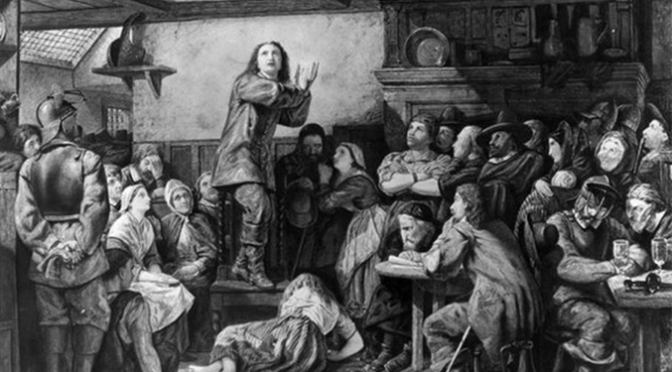
Fox was not the only early Friend who experienced the power of the Spirit in such a spectacular manner, as meeting was widely experienced as a space for the Spirit to dramatically touch lives and empower the body of believers, and visions and rapturous experiences were frequent in the early days of the Society.
Even after the initial ecstatic period had long passed, revelations remained vital to Quaker spirituality. John Woolman, a Quaker minister and early abolitionist, wrote about an “opening” experience in his journal where he saw the Light manifest and God speak to his spirit. He wrote, “I awoke; it was yet dark, and no appearance of day or moonshine, and as I opened mine eyes I saw a light in my chamber, at the apparent distance of five feet, about nine inches in diameter, of a clear, easy brightness, and near its centre the most radiant. As I lay still looking upon it without any surprise, words were spoken to my inward ear, which filled my whole inward man. They were not the effect of thought, nor any conclusion in relation to the appearance, but as the language of the Holy One spoken in my mind. The words were, CERTAIN EVIDENCE OF DIVINE TRUTH. They were again repeated exactly in the same manner, and then the light disappeared.”
Even today, Quaker meetings continue to host the presence of God (though with perhaps a deeper contemplative edge) and the gift of prophecy often manifests among us during worship, often referred to as “vocal ministry”. The model of unprogrammed Quaker meeting, where all can equally be vessels of the Spirit, is in line with what Paul teaches in 1 Corinthians 12:7-11, where all gathered may be used to manifest the power of God.
Quaker meeting also fully embraces what God granted the Church on the day of Pentecost, which was when the Spirit of God was poured out on the Church to empower the her and grant her the ability to hear God and prophesy. This event is the foundation of the Pentecostal Movement and at the heart of charismatic spirituality. On the day of Pentecost, Peter preached as soon as the Spirit was poured out and recounted Joel’s prophecy,
“I will pour out my Spirit on all people.
Your sons and daughters will prophesy,
your young men will see visions,
your old men will dream dreams.
Even on my servants, both men and women,
I will pour out my Spirit in those days,
and they will prophesy.”
 In Quaker meeting, we see this prophecy fulfilled week after week, as we corporately experience the baptism of the Spirit and hear the voice of God from whomever God chooses to minister. We may not be a tongue-talking, holy-rolling bunch of folks, though I wouldn’t mind a little more of that, but one thing we Quakers know is the powerand voice of the Spirit. As the Society of Friends, we have a glorious heritage as a people of the Spirit and I’m thankful that even today we continue to reap the gifts of Pentecost in our profoundly charismatic worship.
Hye Sung Francis Gehring is an amateur pneumatologist, a pentecostal Quaker, and a friend of God & man.
 PCPJ
PCPJ 
A number of those who have looked at the outpourings of the Spirit over the centuries have found Quakers to be among the forebears of the modern pentecostal-charismatic movement. For example, Charles P. Schmitt in Floods Upon the Dry Ground, devotes 3 pages to “The Mystical George Fox and the Quakers (1624-1691)”. And early documents of the Assemblies of God refer to Quakers as their ancestors.
LikeLike
When I experienced the new birth on March 26, 1964 and the baptism in the Holy Spirit just two weeks later I came into the life that Fox and others knew and wrote about 300 years before. I have been using the gift of tongues in my prayers ever since. I agree with the author about the pentecostal roots of Quakerism. Of more importance than the experience of pentecostalism, however, is that we center our lives and fellowship in Jesus of Nazareth. If Jesus is at the center then we can have true fellowship with the Father and with each other.
LikeLike
This speaks to my condition as my forefather’s would say. I was raised in the manner of Friends; my ancestors are Friends on my mother’s side all the way back to the earliest preaching of Fox..I am a born again, spirit filled Christian who was introduced to the baptism of the Holy Sprit early in my walk with Christ…thankfully before the anti-Charismatic teaching reached my ears..I have always known from my own personal experience, with the move of the Holy Spirit and confirmation of His Word, that Quakerism was a Charismatic expression of the Word of God in early Friend’s experience..I see that most Friends are now Universalists in their theology and even the small remnant of Christian Friends have a stunted understanding of the power of God that dwells within them…and I see too much idolization of the Quaker traditions and also reliance on what former Friends have written as authority rather then the knowledge of the Word of God…I strongly sense that God is moving amongst Friends to a renewal and revival in Christ to be a beacon of His light and power to overcome the works of Satan. I am convinced that the year 2024 is going to be extremely disturbing to many people and even terrifying, but those who are filled with His spirit and move in His power will be a light and comfort to the world…both Quakers and other denominations as well. I am praying for God’s direction, and wisdom now more then ever.
LikeLike
Books have been written about why the Quaker movement fizzled out although I love it in its original state. Many are Pentecostal in a sentimental way although the dynamic as what was witnessed at Azusa quickly passed also. Few would ask how that expression of the kingdom of God became something other and by whom? A few might speculate as to what had occurred in the upper room two millennia ago prior to the events of the day of Pentecost. Few would consider that at Azusa they had an upper room for “tarrying” (no talking allowed above a whisper) and that downstairs the meeting was often silent Quaker-style and “waiting on God.” Yes that fact is often omitted. The point was to have a meeting together with God. AND an open mic policy similar to that known in the NT synagogues and early church (1 Cor. 12-14) was known and encouraged. God was able to work through ANY Body part and extend His gifts to the one in need… its recipient.Take a look and try to find any of the genuine historical revivals of church history where this open mic policy was not the case. Deep repentance and consecration as well as permission to share, testify and edify/encourage others. No two meetings the same. Divinely orchestrated.We have however replaced The Meeting with a Church Service and both pastor and denomination are determined to keep it so (while they beg like the priest of Baal upon Mt. Carmel for yet another Revival… on their terms and under their own control).
According to The Church Fathers spiritual gifts were largely unhindered in the congregations through the early centuries of church history up until the time when Christianity became legal and stadium-style pagan temples were donated to the Christians and the regulated “church service” officiated by one member took its place. The same thing occurs after each historical revival. The rule, realm and reign of God (his kingdom and expression of it) is substituted by the church service and the rule, reign and control of religious men.It is truly hilarious to note that in those silent Christian Quaker gatherings of long ago that more could be uttered by any in but a few words than what is uttered by one in their long oration accompanied by story, illustration, time fillers and detours so as to fill up a time slot for which they are being paid.I would LOVE to find yet another Quaker-Pentecostal church that embraces the best of both traditions (and jettisons the new and politically inserted eschatology that promotes murder and genocide).We really really need to get back to discerning the Lord’s Body and allow the members to function in meeting (Ephesians 4:12). What is the purpose of one attending the Sunday Morning spectacle for 5, 10. 30 of 50 years? What does that equip them for?WEST COAST CANADAPlease reply if you ever encounter something better especially here.
—
footnote: More than 120 years ago it was known that spiritualists and hypnotists would crash the meetings to try their influence there. Those leaders exercised discernment and shut this down shifting the focus in meeting back on God. And today few would entertain the possibility that the stage hypnotist is the one behind the pulpit.
LikeLike
p.s – Azusa arranged their seating not facing one way (e.g. the minister) but in a square fashion (Quaker-style). William Seymour often spent most of the meeting with his head buried in some crates (praying/worshipping) and only got up when felt lead to speak. He did not dominate the meeting. People did not come to hear “the pastor” but to find God…and to meet Him.
Imagine gathering as a family as flesh and blood brothers and sisters and every time you meet only “the parent” can speak and share.
LikeLike