Since the early 1980s, with the rise of the Moral Majority Movement and the Religious Right, much of the American political and cultural landscape has been dominated by a very specific type of Christian, commonly known as conservative evangelicals (though I think this is a misnomer).
This wing of the Church has successfully taken over much of American media – including radio, television, and the Internet. They have successfully lobbied in politics at every level of government. They were a major force behind the elections of several presidents – Ronald Reagan, both George Bushes, and now Donald Trump. Their version of Christianity and its connections with power and money are all throughout American society. Even in the small town where I grew up, I was once active in a conservative evangelical church in which pamphlets were handed out instructing their congregants how to vote, and I recall another instance at another local church in which the local Republican Party came by for signatures after worship.
This partnership between American big business, politics, and conservative churches seems like it has always been the case. For many of us, the last 40 years feel like a lifetime (and as someone born in the early 90s, it has been a lifetime). However, we must remember that this has not always been this way.
Did you know about this? In 1981, the world famous evangelist Billy Graham said:
“I don’t want to see religious bigotry in any form… It would disturb me if there was a wedding between the religious fundamentalists and the political right. The hard right has no interest in religion except to manipulate it.” – Billy Graham
Many have questioned whether this really is true so
and unlike most of the things the MAGA movement is claiming nowadays, it’s completely accurate. In the 1 February 1981 cover story of Parade magazine; Billy Graham’s commented his conversations with fellow pastor Jerry Falwell, who helmed the conservative political group the Moral Majority (which was neither moral nor a majority). The full quote from Graham is:
I told him to preach the Gospel. That’s our calling. I want to preserve the purity of the Gospel and the freedom of religion in America. I don’t want to see religious bigotry in any form. Liberals organized in the ’60s, and conservatives certainly have a right to organize in the ’80s, but it would disturb me if there was a wedding between the religious fundamentalists and the political right. The hard right has no interest in religion except to manipulate it.
This recent ad from Evangelicals for Harris is a stark reminder that the Gospel that Graham was preaching was nothing like the hateful, bigoted lies that Trump is building his authoritarian campaign on that tries to destroy democracy:
While Billy Graham’s son Franklin has joined the MAGA movement and desperately tries to claim that Billy would have been a Trump supporter as well if he had lived today, you can’t erase what has clearly been written down in history as the foundations of evangelical belief.
Micael Grenholm is a Swedish church historian, author and an editor for PCPJ.

Pentecostals & Charismatics for Peace & Justice is a multicultural, gender inclusive, and ecumenical organization that promotes peace, justice, and reconciliation work among Pentecostal and Charismatic Christians around the world. If you like what we do, please become a member!
Yesterday, Donald Trump was indicted for having paid over a hundred thousand dollars to the porn star Stormy Daniels to keep quiet about their sexual encounter shortly after his wife Melania gave birth to their son Barron. Trump’s former lawyer Michael Cohen admitted to the crime, calling it a “sex scandal of biblical proportions” and admitting that it was done on Trump’s orders.
The millions of (white) evangelical Christians who still support Trump also do not seem to care about his infidelity with porn stars and other women. In fact, after the infamous video where Trump boasted about committing sexual assault (“grab them by the pussy”) and sleeping with married women was released, he became more popular among white evangelicals.
This is largely due to the fact that many white evangelicals value traditional patriarchal masculinity, as historian Kristin Kobes Du Mez shows in her book Jesus and John Wayne. While they verbally condemn sexual assault and infidelity, it is something many evangelical men engage in themselves and are quite impressed by, and women are taught to accept sexual assault and rape in popular evangelical books about marriage and relationships. The book The Great Sex Rescue goes through this in detail and shows that evangelicals who have a so-called “complementarian” view of women and men have significantly worse marriages that often lead to divorce.
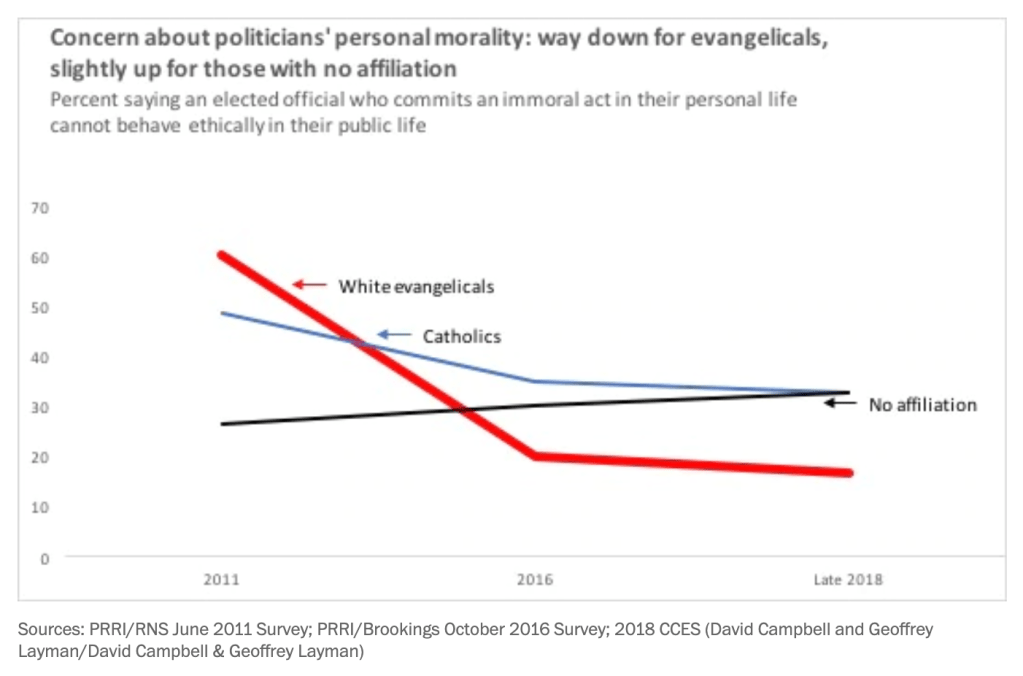
These statistics show beyond any reasonable doubt that the white evangelical endorsement of Trump has radically changed their values. In 2011, over 60 percent of them said that an elected official who commits an immoral act in their private life cannot behave ethically in their public life. In the Trump era, this conviction remains among less than 20 percent. Falwell Jr. and other evangelical leaders have convinced millions of Christians that a good character simply isn’t relevant when it comes to leadership, despite there being hundreds of verses in the Scriptures that suggest otherwise.
This book has sold over 400,000 copies and has been translated into multiple languages. In it, Sider argues that Christians have a moral responsibility to actively work towards ending poverty and economic inequality and that prosperity theology, which teaches that wealth is a sign of God’s favor, is misguided.
Sider’s work has also had an impact on the broader society. He has been a leading voice in the Christian social justice movement for several decades, and has been influential in shaping the thinking of many Christians on issues of poverty, economic justice, and the role of faith in politics and society. He was the founder of Evangelicals for Social Action (nowadays called Christians for Social Action), an organization that works to mobilize evangelicals to advocate for social justice issues. Through his books, speaking engagements, and involvement with this organization, Sider has been instrumental in raising awareness of poverty and economic inequality and encouraging Christians to take action to address these issues.
Ron Sider was also a devoted pacifist and his speech at a Mennonite conference in 1984 that pacifists needed to be as willing to make sacrifices for peace as soldiers led to the founding of the Christian Peacemaker Teams, an organization that sends nonviolent observers to conflict zones.
Ron Sider’s work on nonviolence and peacemaking is centered around his belief that Christians have a moral responsibility to actively work towards peace and justice. He argues that war and violence are not consistent with the teachings of Jesus and that Christians should instead strive for nonviolence and reconciliation.
One of his notable contributions in this area is his book “Just Peacemaking: Ten Practices for Abolishing War” which was first published in 1992. In this book, Sider outlines ten practices that individuals, churches and nations can engage in to work towards the abolition of war and the establishment of just peace. These practices include: nonviolent resistance, conflict resolution, economic alternatives to military spending, and the promotion of democracy and human rights. He also argues that Christians should actively work towards disarmament and the abolition of nuclear weapons, and that the just war tradition has been misused to justify violence and war.
Sider’s work on nonviolence and peacemaking has been influential in shaping the thinking of many Christians on issues of peace and justice. He has been a leading voice in advocating for nonviolence and disarmament, and his work has helped to raise awareness of the moral implications of war and violence.
I listened to him when he visited Gothenburg over ten years ago and I was struck by his passion to follow Jesus and his Sermon on the Mount no matter what it costs us. We need more disciples like Ron!
Civilization originally arose in the Middle East, but now it might disappear from the region. The waves of refugees we see today are tiny compared to the hundreds of millions of climate refugees that the coming decades risk bringing with them.
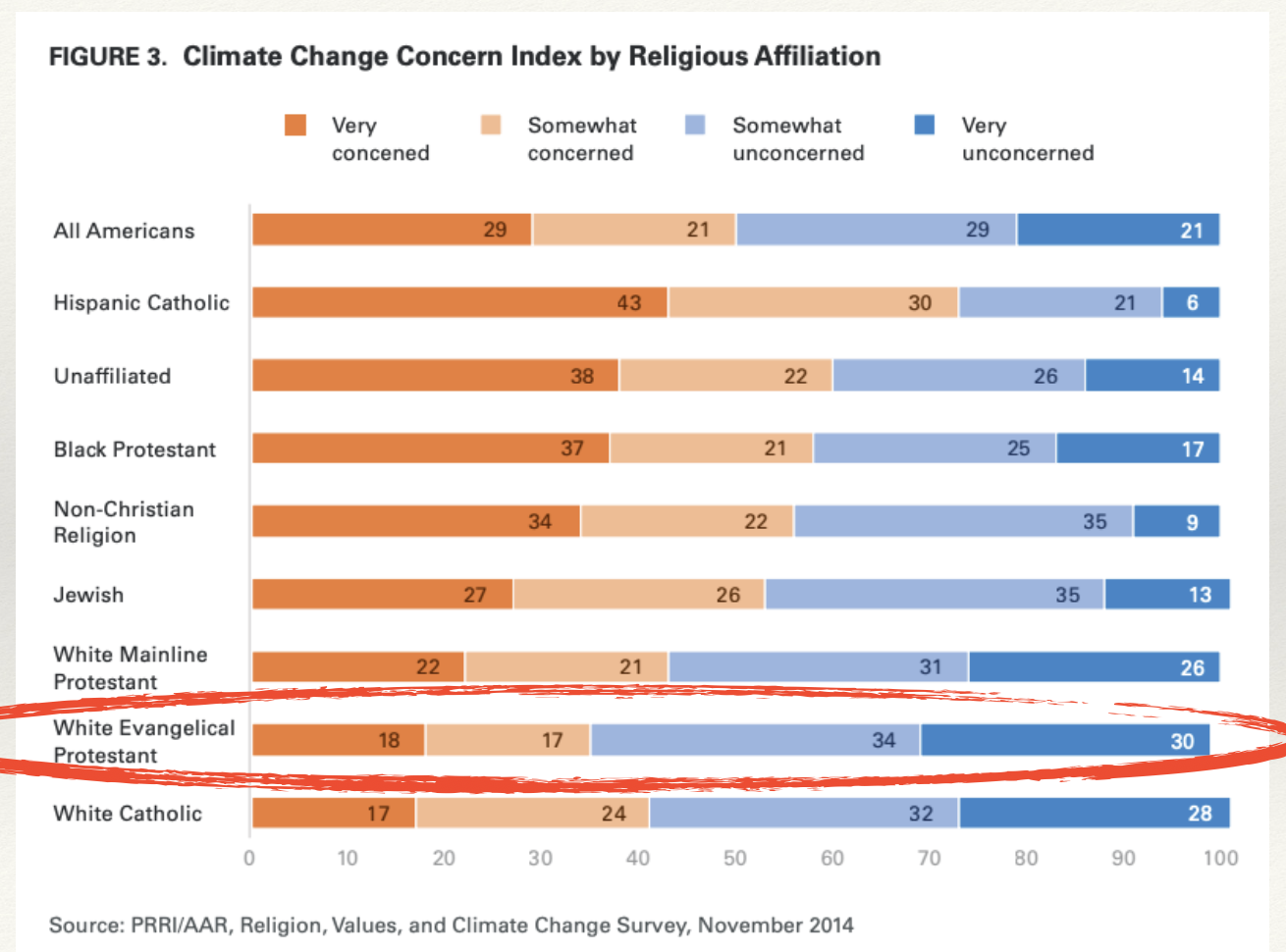
Isn’t it ironic that many evangelicals claim to care deeply about the nation and people of Israel, yet ignore how climate change might destroy the nation and people of Israel? A survey from 2014 showed that white evangelicals in the US are the least likely to be concerned over climate change.
There is no biblical reason for this. The Bible never says that climate change isn’t real or should not be prevented. The only reason white evangelicals think like this is that they view allegiance to the Republican party as important, which in turn has been highly influenced by science denial promoted by the fossil fuel industry with millions of dollars.
And so in a disturbing twist of fate, many evangelicals support extremist politicians like Donald Trump or Jair Bolsonaro claiming that they are “pro-Israel”, when in fact their policies might be what ultimately destroys Israel as a nation. Once again. these words written by Jeremiah 2,600 years ago, might be sung in Jerusalem:
“The old men are no longer gathered in the city gate, and the young men’s music has ceased. Joy is gone from our hearts, our dance has turned to sorrow … Mount Zion lies desolate, jackals roam about there. But you, Lord, reign forever “Your throne is from generation to generation.” (Lamentations 5)
But not on our watch. The good news is that the catastrophic scenario of an empty Middle East is still preventable, given that we manage to adjust our lifestyle and our communities to sustainability and a fossil-free reality during the coming eight years. We need help to do this – from each other and from God.
There is still time to act, so let’s act!
Micael Grenholm is a Swedish pastor, author, and editor for PCPJ.
Pentecostals & Charismatics for Peace & Justice is a multicultural, gender inclusive, and ecumenical organization that promotes peace, justice, and reconciliation work among Pentecostal and Charismatic Christians around the world. If you like what we do, please become a member!
Beware of false prophets, who come to you in sheep’s clothing, but inwardly are ravening wolves. – Matthew 7:15
Beloved, don’t believe every spirit, but test the spirits, whether they are of God, because many false prophets have gone out into the world. – 1 John 4:1
American Evangelicalism has been taken over by hypocrites. It is not new as this trend started several decades ago, but now we can see clearly the corruption before us. Conservative Christians, who claimed to be standing up for “traditional Christian/family values” supported a rich, womanizing con-man for president. People like John MacArthur, Wayne Grudem, and many leaders of American Evangelicalism made claims that Trump was the lesser of two evils since he was supportive of “traditional Christian/family values” despite being a flawed candidate. MacArthur in particular likes to take shots at LGBT people and said that he endorsed Trump in 2020 due to Trump’s social conservative views. However, Trump doesn’t seem to agree with MacArthur:
John MacArthur, like many of the leaders of American Evangelicalism, is a hypocrite and false prophet. Which I know this is strong language, but I am genuinely upset over the sad state of the Evangelical Church, and its hypocritical ways. How these people claim to follow Jesus but seem to ignore everything he said. How they are “pro-life” while against welfare services, pro-war, and anti-pandemic relief. Continue reading False Prophets and False Idols: The Sad State of American Evangelicalism→
300 years ago a movement of revival started within British and later American churches. This movement called the Church to return to the Gospel. It called the Church to share the message of Jesus with others and to follow Jesus more boldly. This movement was very diverse for its day. It affected most Christian denominations in the English-speaking world, and it touched many Christian communities. It was an international, interracial, intercultural, and interdenominational movement.
This movement promoted education, social reform, and inclusion in the Church. This movement was one of the main forces behind social justice movements for much of its history. Abolitionism, poverty-relief efforts, the Social Gospel, Labor Movement, Civil Rights Movement, and many other important causes were at least influenced by this movement.
The movement that I am talking about is Evangelicalism, but despite Evangelicalism having such a long and noble history, most don’t recognize it today – at least not in the United States. There are a number of factors that contributed to this:
First, Evangelicalism has always had a white supremacist wing. Even though Evangelicalism was indispensable in the abolitionist and civil rights movements, there was also always a segment that opposed those movements. On the one hand, you had John Wesley who argued strongly against slavery, but on the other you had Jonathan Edwards who owned slaves. There are still schisms in American churches over this exact issue. The Southern Baptist Convention is an example of an American Evangelical church founded on white supremacist principles. Continue reading It’s not Evangelicalism Anymore→
“I believe the evangelical alignment with the Trump administration has advanced the kingdoms of men but not the kingdom of God. I worry it has damaged the culture and tarnished our witness for generations.”
This is what Timothy Dalrymple, President and CEO for Christianity Today, writes in a recent article. This conviction does not prevent him from trying to understand evangelical Trump supporters. In fact, he does a good job laying out the logic behind why they act as they do, describing them as the Church Regnant:
The Church Regnant sees the kingdom of God, the end toward which we strive, as a world in which men and women are free to follow their faith, life is held sacred from conception to death, families can raise their children in biblical truth, churches take the lead in charity, and government provides a stable order for the flourishing of meaningful enterprise. […]
The Church Regnant views the election starkly as a battle between good and evil. The vices of the president seem small when the virtue of the world hangs in the balance. Winning political power means protecting the Christian way of life and sowing seeds of truth and goodness into culture, and thus bringing God’s blessing upon the land. Losing political power means the culture spirals into deepening immorality and untruth, eroding the foundations of society and leading to greater suffering for all.
Some people insist that the only reason that neither Jesus nor anyone else in the first several centuries of the church tried to dominate the political system of their day was because they were a small minority of people living in a nondemocratic and hostile environment. By contrast, the argument goes, American Christians are a sizable group living in a rather friendly, democratic land, and we are able to at least improve, if not someday dominate, our government and culture.
And since to whom much is given much is required (Lk 12:48), do we not have a spiritual and moral obligation to use this opportunity to the full advantage of the kingdom of God?
In this light, the argument concludes, to shirk the opportunity to rule because we are afraid of compromising our kingdom calling is irresponsible, pharisaical, and cowardly. The argument seems to make so much sense.
People often ask me: “Why do so many evangelical Christians support Trump?” . It’s a good question. What is with having a high view of Scripture that leads people to celebrate someone who in so many ways doesn’t sound and act like Jesus?
The difference between these groups is not their view of Scripture: they all see it as the authoritative Word of God. Something else is going on here. Let’s look at some statistics to find out!