Category Archives: Politics

Blessed Are the Leakers

by Bob Ekblad. Originally published at his blog, reposted with permission.

Followers of Jesus have a spiritual obligation to bring into the light offenses or injustices otherwise hidden from sight. While discernment is certainly needed in knowing how and when to speak, prohibiting leaks is like silencing the prophets, who in Scripture carried out a function in Israel similar yet far beyond that of WikiLeaks or the best investigative journalism.

Jesus himself taught: “Blessed are those who hunger and thirst for righteousness, for they shall be filled,” affirming all who long for truth and justice. This hunger and thirst will lead us to walk in the light ourselves through personal confession and repentance, and also to expose injustices that affect the vulnerable.

Think of confession of sin as the exposure of our own hidden secret attitudes and actions that the Holy Spirit brings up. The Spirit sounds our hearts, “leaking” our sins into our conscious awareness, bringing conviction and inviting confession, renunciation and new, life-giving choices. Continue reading Blessed Are the Leakers

Is Pentecostalism Dispensationalist?

by Tony Richie. Part 1 of 3. Read the whole article as a PDF here.

Introduction

A surging crisis on the current global horizon centers on so-called “Christian Zionism.” The controversy surrounding Christian Zionism arises from its association with political practices in the unceasingly and increasingly unstable Middle East region involving Israelis and Palestinians. Though an oversimplification, Christian Zionism is generally speaking a theological position with political implications.

However, Christian Zionism is exceedingly difficult to address because it exists in variegated forms, ranging from individuals or groups who generally support the right of contemporary Israelis to exist in their ancient homeland to extensively organized political activists with agendas of varying degrees of radicalism.[1]

The former usually cite biblical and humanitarian values in vindication of their support for Israel. Some of the latter tend to be completely uncritical of Israeli policies and practices, openly aggressive against their opponents, and either totally unaware of or unconcerned with the plight of Palestinians and religious others. Much of the basis for the latter position appears to be built upon a specific form of dispensationalist ideology. Continue reading Is Pentecostalism Dispensationalist?

The Politics of Pentecostalism

by Luis Aránguiz Kahn. Originally published at Pensimiento Pentecostal.

Pentecostalism is a movement that surged in the beginning of the 20th century simultaneously in different parts of the world and in the middle of the diversity of the protestant and evangelical churches. In general terms, its social base was made of the poor, marginalized and discriminated. In the case of South America, there were two points of beginning. In Brazil by the hand of Luigi Fransescon, and in Chile it was brought about by Willis Hoover. From there on the movement has expanded geographically to the entire Southern Cone, but it has also had a notable quantitative growth in the different countries in the zone. There has also been an influence from external Pentecostalism, especially from The United States.

By the nature of movement there coexists an ample heterogeneity of churches, practices and believes in the interior of the Pentecostalism. This, in methodological terms, complicates the analysis of the phenomenon and the possibility of offering an explanation that stretches over its diversity. Therefore once more, if we speak in general terms, it is possible to notice that the Pentecostalism has arisen from a political derivation that can reveal itself in two ways, and which will not be unknown to anyone familiar in any way with this type of church.

On the one hand, it is possible to observe the existence of a Pentecostalism which calls itself “apolitical”. Within this category every church and believer would fit who, in the name of a moral dualism which sees the behaviors of non-Christians as mundane, rejects the political field (especially in its partisan version ) by considering it mundane, that is to say sinful. In those who maintain this form of thinking, there exists a tendency to reaffirm the status quo. Even when the political field is avoided, the “apoliticals” tend to champion the political groups which uphold the conservation of order.

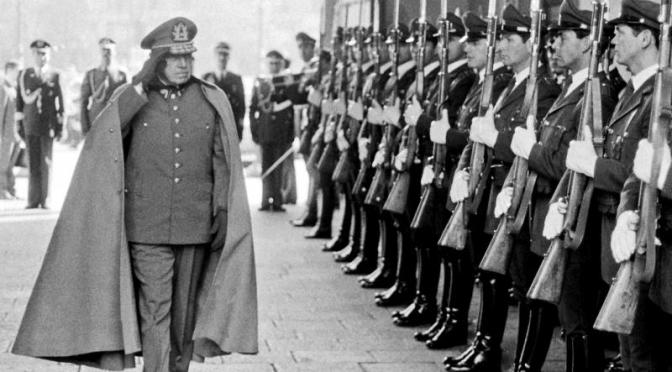
In this way, for example, it is not strange to encounter Pentecostals who support anti-Marxist dictatorships in the previous century, as seen in the cases of Guatemala and Chile. In the same way today it is possible to encounter Pentecostals who support parties which are morally conservative, in order to avoid legislations which approve homosexual marriage, abortion and euthanasia. In a certain way, whether they want it or not, the “apoliticism” ends up being more a distant horizon than a way of living, well examples like these show that although one avoids forming parties or participate in them, inevitably one will participate in the public square. Therefore the query that remains is understanding this apoliticism as a fundamentally political act. Continue reading The Politics of Pentecostalism

The “You’re in Japan” Card

by Ramone Romero.

Recently a friend I honor and respect pulled the “You’re in Japan” card on me. This is something that a few people have done over the years to imply that I can’t understand how things “really” are in America because I live in Japan.

I haven’t counted the number of times I’ve heard it, but I can remember the context of a few times. I think the first time was when the Bush administration was preparing the country with its propaganda about the need to go to war against Iraq in 2003, and I objected on Facebook and in emails that there was no evidence to support the drive to go to war. Later, other friends (always politically conservative) used the “You’re in Japan” card on me with issues like American healthcare, race relations, the Trump campaign and presidency, and Confederate flags and monuments.

Obviously there’s some significant truth to the fact that, being far away, I can’t get a complete picture of how things are “on the ground” in America. At the same time, there is a lot that can be learned online, from reading comments and articles, etc. I’m not a novice in filtering news and reports, or taking the first thing I hear as the gospel truth of a situation. I think most of my friends realize that I try to discern very carefully, and don’t just re-post or write things without critical thought. Continue reading The “You’re in Japan” Card

To Whom Has God Given Authority To Kill Donald Trump?

I was holding my breath the other week when Kim Jong-Un and Donald Trump – probably among the most unreliable political leaders of this age – were waging a war of words. Trump said that if Kim continues to threaten the United States they will be met with “fire and fury”, a statement he later said “wasn’t tough enough” (but what could be tougher?). The North Korean leadership almost immediately responded with threats of nuking the American colony of Guam, which likely would start the first nuclear war ever.

Thankfully, Kim later announced that he’s standing by, waiting for the next move by the “stupid yankees”. And I was able to breath again. But I’m taking short breaths, and pray that these madmen will come to their senses.

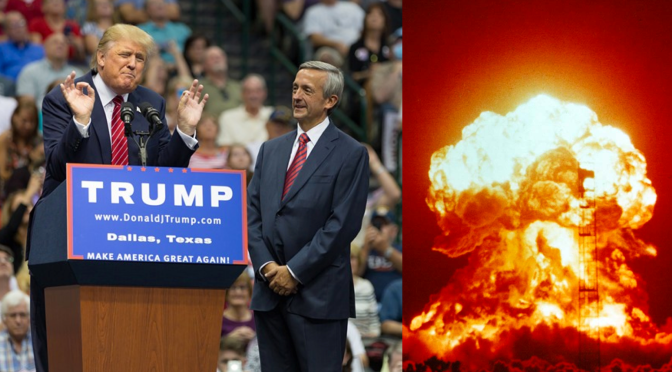
And then I stumble upon the comments by Southern Baptist Megachurch pastor Robert Jeffress, who as this crisis was at its peak boldly proclaimed that “God has given Trump authority to take out Kim Jong Un”. So how does Pastor Jeffress defend this claim?

“When it comes to how we should deal with evildoers, the Bible, in the book of Romans, is very clear: God has endowed rulers full power to use whatever means necessary — including war — to stop evil. In the case of North Korea, God has given Trump authority to take out Kim Jong Un.”

Trump, Jeffress and Kim

Now, it’s important to understand that Jeffress isn’t claiming any personal revelation here: he claims that based on the Bible alone, specifically Romans 13, one can reach the conclusion that God wants Trump to kill Kim. But Romans 13 emphasizes that all governments have the same authority: Continue reading To Whom Has God Given Authority To Kill Donald Trump?

Chile’s Prophetic Pentecostals that Refused to Support Pinochet

Prophetic pentecostalism: the case, challenges and hopes

by Luis Aranguiz Kahn.

“Prophetic Pentecostalism” is the name that a particular group of Pentecostal believers put to distinguish themselves from the main Pentecostal branch in Chile. So, what was the difference? In first place, it is necessary to say that Pentecostals in Chile has been mainly conservative in terms of politics. Before the coup d’etat of Pinochet, they used to declare themselves “apolitical” to avoid the political struggle between the strong leftwing winds that ultimately took Allende to presidency in 1970 and the rightwing counterpart.

In the middle of this complex political context, appeared a different kind of Pentecostal that was not apolitical but openly leftist. Highly influenced by Liberation Theology, they then faced the dictatorship and at the same time went against the general Pentecostal tide. Meanwhile in 1974 many important leaders of the biggest Pentecostals churches of the country signed a public letter supporting Pinochet, this little group was resisting in its denomination (Mision Iglesia Pentecostal – MIP) and its communities.

Prophetic Pentecostals were also involved in ecumenical activity, something very strange to find in Pentecostals of that time given the many prejudices about the World Council of Churches and the suspicion of some kind of Marxist influence inside it. Those were times of a deep split among Christians. Chile, as a post-colonial State was largely influenced by USA not only in political terms, but also political, cultural and therefore religious. Continue reading Chile’s Prophetic Pentecostals that Refused to Support Pinochet

The Problem with Patriotism

I have a challenge for my American readers this day. Before you wave the banner of your empire and enjoy billions of dollars being blown up in fireworks, pray that God will help you love all people, including all those harmed by American consumerism, militarism and racism, and that He will help you pledge allegiance to His Kingdom first and foremost.

After all, Scripture says that we are foreigners and strangers on earth (Hebr 11:13) and that we are citizens in Heaven (Phil 3:20). We are called to love all people as ourselves (Lk 10:25-37) and while the early Christians didn’t revolt against the Roman empire, they were known for pledging allegiance to another king than the emperor, namely Christ (Acts 17:7). I think Shane Claiborne nails it in his altar call on Red Letter Christians about celebrating interdependence day rather than independence day:

Dr. Martin Luther King spoke of us all being bound up in an “inescapable web of mutuality.” He talked of how we have encountered half the world by the time we have put on our clothes, brushed our teeth, drunk our coffee and eaten our breakfast, as there are invisible faces that make our lives possible every day. That’s why I’ve always struggled with “Independence Day.”

Continue reading The Problem with Patriotism

Nobody Likes Trump’s Twitter

Donald Trump has been active on Twitter since 2009, avaraging on 11 tweets per day to a total of over 35 000 tweets. For those who take the time to go through the statements, they can basically find every self-contradiction imaginable. Like this one:

And despite once calling his Twitter “so powerful that I can actually make my enemies tell the truth“, Trump revealed earlier this year that he doesn’t like Twitter. “I don’t like tweeting, I have other things I could be doing.” The reason, he continued, is that it’s the best way he can counteract “the dishonest press” and tell his true, totally-not-self-contradictory, opinions.

But it’s not just the media he passes by via his Twitter feed. His aides, co-workers, party-members and supporters are increasingly alarmed by how he frequently contradicts the stories they have been sharing with the media to defend his policies. Continue reading Nobody Likes Trump’s Twitter

Christian Trump Supporters, How Can You Be OK With This?

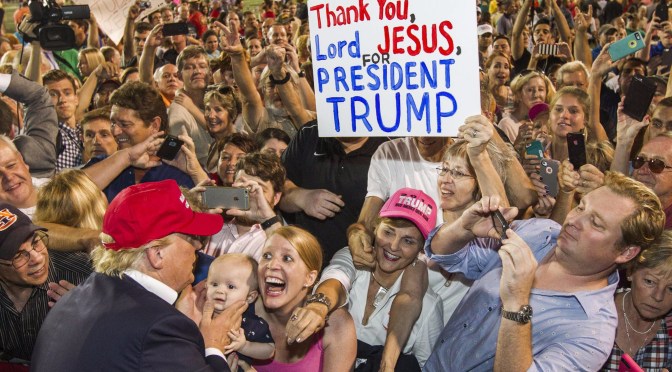
Donald Trump has been President of the USA for four months now, and one must be very ignorant or biased not to see that it already has been a chaotic presidency.

Just take the Russia investigation. Recently, American spies uncovered that Russian officials had talked about how to influence Trump through Paul Manafort and Michael Flynn, Trump associates with close ties to Russia.

Few have missed how Trump fired James Comey, the director of the FBI that was leading an investigation on the Trump campaign’s connections to Russia. Trump then accidentally revealed to NBC News and to the Russian foreign minister and ambassador that the Russia investigation was his motivation for firing Comey.

Trump’s meeting with Russian officials in the Oval Office was unprecedented, and while American media was banned from the meeting, Russian media wasn’t. Reports suggested that Trump shared highly classified code-word intel with the Russians, something his staff denied but Trump himself admitted on Twitter. He then accidentally revealed that the source of the intel was Israel, when he himself was in Israel. Continue reading Christian Trump Supporters, How Can You Be OK With This?

Political Protest is Spiritual Warfare

by Hye Sung Francis Gehring.

When I was a freshman in college, my friends and I were discovering charismatic spirituality together. We often had long prayer sessions, and we always expected to experience and hear God. It was messy, naive, often fueled by fear, but God was somehow in it as we experimented with this bizarre mysticism that was so confident in Christ’s Spirit being within us. Some of us walked through our campus often, quietly praying in tongues, rebuking the spirits among us causing fear, spiritual drought, depression, etc., and declaring a better way for the Church and for the school. We called this spiritual warfare.

I still believe in the power of spiritual warfare, even if much of our demon-hunting was a bit silly. I’d like to think that Holy Spirit interpreted our prayers the way they needed to be interpreted, and maybe we did push the devil out of our campus a bit. Hopefully. But still, before Friends of Jesus retreats, I often try to spend time in intercession, praying for the outpouring of the Spirit and protection from the enemy, who loves to stir up quarreling among believers and quench the Holy Ghost. I’m still a firm believer that Christ handed an authority to the Church to be declare, prophesy, and shake things on this earth, and in the spirit realm, to realize the reign of God among and within us. Continue reading Political Protest is Spiritual Warfare